Resume Guide for Freshers: How to Make a Job-Ready Resume for Campus Placements
By FreePare Team · Sat Jun 20 2026 · 28 min read

A resume is often the first thing a recruiter or interviewer sees before meeting you.
For freshers, a resume is not just a document. It is a short summary of your education, skills, projects, internships, achievements, and career readiness.
Many students prepare aptitude, reasoning, coding, and interviews seriously, but they create their resume at the last moment. This can create problems during campus placements because interviewers often ask questions directly from the resume.
A good fresher resume should be simple, clear, honest, and easy to read.
This guide will help you create a job-ready resume for campus placements.
It is written as a set of before-and-after examples rather than a list of rules, because almost every fresher resume problem is a writing problem, not a design problem. For each section you will see a weak line of the kind that appears on most student resumes, the same content rewritten, and an explanation of exactly what changed. The examples use one made-up student throughout — a final-year B.Tech Computer Science student we will call Rahul Sharma — so you can see how a single ordinary profile is presented well. His profile is deliberately ordinary: one internship, a couple of academic projects, decent but not exceptional marks. Substitute your own facts; never copy his.
Why Resume is Important for Freshers
In campus placements, companies review many student profiles. Your resume helps recruiters quickly understand who you are and whether you are suitable for the role.
A good resume helps you:
- Create a strong first impression
- Show your skills clearly
- Highlight your projects
- Make interview questions predictable
- Present your education properly
- Show your seriousness
- Avoid confusion during screening
Even if you do not have work experience, you can still create a strong resume by presenting your skills, projects, internships, and achievements properly.
The fourth point in that list is the one students underestimate. Your resume is the question paper for your interview. Interviewers rarely arrive with a fixed set of questions for each candidate; they read your resume in the two minutes before you walk in and ask about whatever is on it. That means every line you write is a decision about what you will be asked. Written well, your resume steers the conversation towards the work you can defend. Written carelessly, it invites questions about a skill you listed once and never used.
Best Resume Format for Freshers
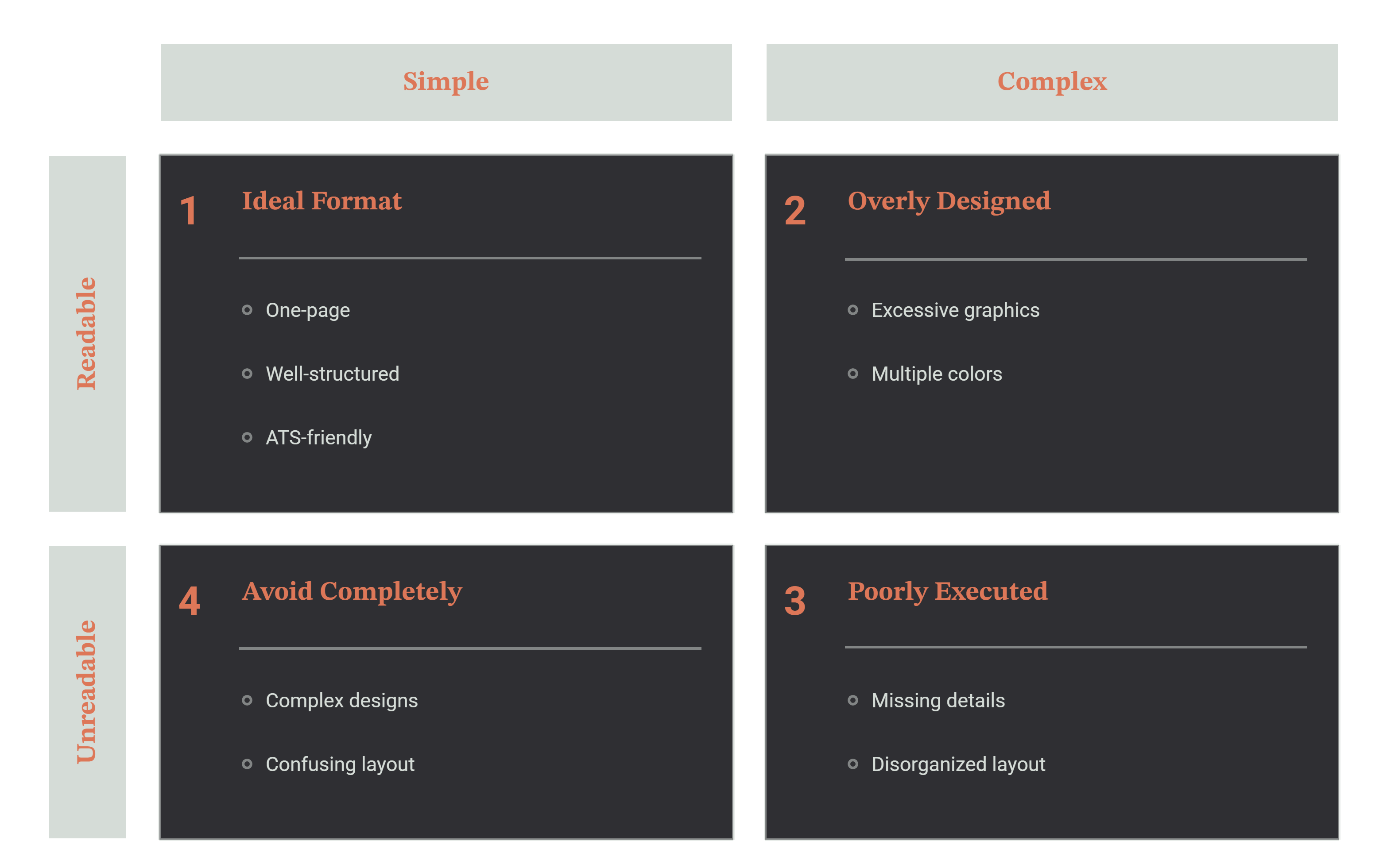
For most freshers, a one-page resume is enough.
Your resume should be:
- Clean
- Simple
- Easy to read
- Well-structured
- Honest
- ATS-friendly
Avoid using too many colors, graphics, icons, or complex designs.
A simple resume is better than a stylish resume that is difficult to read.
For section order, put the strongest thing about you closest to the top. For a fresher that is almost always education and then projects. Skills can sit above or below projects depending on which is stronger. Hobbies, languages, and personal details go last, or are left out.
One thing worth deciding early is how you will produce the file. Building a resume from scratch in a word processor usually goes wrong in the same two ways — the layout breaks when you add one more line, and the spacing drifts as you edit. A structured tool keeps the sections consistent while you concentrate on the wording, which is the part that actually decides whether the resume works. FREEPARE's free resume builder gives you the standard fresher sections in a fixed layout and exports a clean PDF, so you can spend your time on the before-and-after rewrites in this guide instead of on margins.
What to Include in a Fresher Resume
A fresher resume should include these sections:
- Name and contact details
- Career summary
- Education
- Technical skills
- Projects
- Internships or training
- Certifications
- Achievements
- Positions of responsibility
- Languages known
- LinkedIn, GitHub, or portfolio link
You do not need to include every small detail. Add only what supports your career goal.
A useful test for anything you are unsure about: would you be comfortable being asked a follow-up question about this line for two minutes? If yes, keep it. If not, either learn it properly before the drive or take it off.
Name and Contact Details
Place your name at the top of the resume.
Include:
- Phone number
- Professional email address
- LinkedIn profile
- GitHub profile, if relevant
- Portfolio link, if available
- City and state
Use a professional email ID.
Good example:
rahul.sharma@gmail.com
Avoid casual email IDs like:
coolrahul123@gmail.com
Your contact details should be correct because recruiters may use them to reach you.
Here is a full contact block, before and after.
| Weak | Strong | What changed |
|---|---|---|
| RAHUL SHARMA Address: H.No. 214, Sector 9, Near Shiv Mandir, Rohini, New Delhi - 110085 DOB: 14/08/2004 | Father's Name: Suresh Sharma | Marital Status: Single | Nationality: Indian Mob: 98XXXXXX21 Email: coolrahul123@gmail.com | Rahul Sharma New Delhi, India | 98XXXXXX21 | rahul.sharma@gmail.com linkedin.com/in/rahul-sharma-dev | github.com/rahulsharma-dev | The full postal address, date of birth, father's name, marital status and nationality were removed — none of them affect a hiring decision, and together they were taking four lines at the top of the page. City and state are enough. The email was changed to first name and surname. Two links were added that let a recruiter see actual work. |
A second pair, about the links themselves:
Weak: GitHub: github.com/rahul2004xyz (profile has three empty repositories and no README)
Strong: github.com/rahulsharma-dev (profile has two repositories with a short README explaining what the project does, how to run it, and a screenshot)
What changed: Nothing about the resume line — the fix is behind the link. A GitHub link is one of the few things on a fresher resume that can be independently verified, which makes it valuable when it is real and damaging when it is empty. If your profile has nothing in it, spend an evening writing README files for your existing projects before you add the link, or leave the link out.
How to Write a Career Summary
Freshers often write copied career objectives.
Example of a weak objective:
“To work in a challenging environment where I can use my skills and grow.”
This sounds generic.
Instead, write a short and specific summary.
Example:
“Final-year B.Tech Computer Science student with knowledge of Java, SQL, and web development. Built academic projects using React and Node.js. Looking for an entry-level software development role where I can apply problem-solving and programming skills.”
Keep it short, honest, and role-relevant.
The difference between those two is worth stating precisely, because it is the same difference that runs through every section of this guide.
What changed: The weak version contains no information. Delete the word “challenging” and you have a sentence that could belong to any student in any branch in any year — which means a recruiter reading fifty resumes learns nothing from it and simply skips to the next section. The strong version names a degree, three specific technologies, evidence that they were used on something, and the kind of role being applied for. Every noun in it is checkable.
Here is a second pair for a student who is not from computer science:
Weak: “Seeking a position in a reputed organization where I can utilize my knowledge and skills for the growth of the organization as well as myself.”
Strong: “Final-year Electronics and Communication student with hands-on work in embedded C and Python. Built a sensor-based monitoring system as a final-year project and completed a six-week industrial training in PCB testing. Looking for an entry-level role in embedded systems or hardware testing.”
What changed: The strong version answers the three questions a recruiter has when they reach the top of your resume — what are you studying, what have you actually done, and what are you asking for. Note that it does not claim expertise. “Hands-on work in embedded C” is a modest and defensible claim; “expert in embedded systems” from a student is not.
Two practical rules for this section. Keep it to two or three lines, because a summary that runs to a paragraph is being read as filler. And rewrite the last line for the kind of role you are applying to — if you are applying to both software and analyst roles, the summary should not say “software development role” in both versions of the file.
How to Add Education Details
Mention your latest education first.
Include:
- Degree
- College name
- University name
- Year of passing
- CGPA or percentage
Example:
B.Tech in Computer Science
ABC Institute of Technology
2026
CGPA: 8.1/10
You can also include Class 12 and Class 10 details if required by the company or if your scores are good.
Most education sections fail by taking up too much room for information that fits in three lines. Compare:
| Weak | Strong | What changed |
|---|---|---|
| Education Qualification I am pursuing my Bachelor of Technology degree in the stream of Computer Science and Engineering from ABC Institute of Technology which is affiliated to XYZ University, and my current aggregate is 8.1. I passed my Class 12 from DEF Senior Secondary School in 2022 with 82% and my Class 10 from the same school in 2020 with 88%. | B.Tech, Computer Science and Engineering — ABC Institute of Technology (XYZ University), 2022–2026, CGPA 8.1/10 Class 12 (CBSE), DEF Senior Secondary School, 2022 — 82% Class 10 (CBSE), DEF Senior Secondary School, 2020 — 88% | A paragraph became three scannable lines. Degree, institution, years and score now sit in the same order on every line, so a recruiter's eye can find the score without reading the sentence. The scale is stated as 8.1/10 rather than 8.1, because CGPA scales differ between universities. |
If your CGPA is low, you have a choice to make, and both options are honest:
Weak: Omitting the CGPA entirely and hoping nobody asks, while listing “Class 10: 92%” prominently.
Strong: “B.Tech, Computer Science — ABC Institute of Technology, 2022–2026, CGPA 6.9/10 (7.9 average across the last three semesters)”
What changed: A missing CGPA is noticed, and it is read as worse than whatever the number actually is. Stating it with a genuine upward trend beside it turns a weak point into a fact you have already addressed — and gives you something concrete to say when it comes up in the HR interview. Only add the trend line if it is true and you can produce the marksheets.
One more thing that belongs here if you have space: a single line of relevant coursework, listing four or five subjects that connect to the role — for example, “Relevant coursework: Data Structures, DBMS, Operating Systems, Computer Networks, Object-Oriented Programming.” It is more useful than the school details for a technical role, and it gives the interviewer a legitimate place to start.
How to Add Skills
The skills section is very important in a fresher resume.
Add only the skills you can explain.
Examples:
- Programming Languages: Java, Python, C++
- Web Technologies: HTML, CSS, JavaScript, React
- Database: MySQL, MongoDB
- Tools: Git, GitHub, VS Code
- Core Subjects: DBMS, OOPs, Operating Systems
Do not add skills only to make the resume look impressive.
If you write Java, SQL, Python, React, DBMS, or Excel, the interviewer may ask questions from it.
The two most common skill-section mistakes are dumping everything into one line, and claiming a level you cannot defend.
| Weak | Strong | What changed |
|---|---|---|
| Skills: C, C++, Java, Python, HTML, CSS, JavaScript, React, Angular, Node, MongoDB, MySQL, Git, Docker, AWS, Machine Learning, Data Science, Android, Photoshop, MS Office, Communication, Leadership, Teamwork, Time Management | Languages: Java (primary), Python, C Web: HTML, CSS, JavaScript, React Databases: MySQL (joins, indexing basics), MongoDB Tools: Git, GitHub, VS Code, Postman Coursework: DBMS, Operating Systems, OOP, Computer Networks | Twenty-four undifferentiated items became five labelled groups. Angular, Docker, AWS, Machine Learning, Data Science, Android and Photoshop were removed because the student had watched a tutorial on each and built nothing — every one of them was an open invitation to a question he could not answer. The soft skills were removed from the list, because a claim of “Leadership” with nothing attached carries no weight; leadership belongs in the positions-of-responsibility section where it has evidence. |
A second pair, about how you describe your level:
Weak: “Expert in Java, Advanced in Python, Proficient in SQL”
Strong: “Java — main language, used for all academic projects including a JDBC-based inventory system. Python — comfortable with scripting and basic data handling. SQL — can write joins, group-by queries and simple stored procedures.”
What changed: Self-declared expertise levels are the fastest way to invite a hard question. “Expert in Java” makes the interviewer test that claim, and a fresher rarely survives it. Describing what you have actually done with each language sets an accurate expectation and makes the follow-up question one you want to be asked.
Before a drive, take an honest inventory of the subjects you have listed. If DBMS and Operating Systems are on your resume, they are fair game in the technical round even if the role is not database-focused. Working through topic-wise practice tests on the subjects you have claimed is the cheapest way to find out which lines on your own resume you cannot yet defend, while there is still time to either study them or remove them.
How to Write Project Details
Projects are very important for freshers because they show practical ability.
For each project, include:
- Project name
- Short description
- Technologies used
- Your role
- Key features
- Result or learning
Weak project description:
“Made a website using React.”
Better project description:
“Developed a responsive student practice website using React. Added subject-wise test cards, result view, and user-friendly navigation to improve test access.”
The second version explains what you built and why it matters.
Two or three well-written projects beat six one-line entries. Here are three more rewrites covering the situations freshers most often get wrong.
Weak: “Library Management System — A project made using Java and MySQL for managing library.”
Strong: “Library Management System — Java, JDBC, MySQL (Jan–Apr 2025). Built a desktop application to issue and return books for a college library, with a five-table schema covering members, titles, copies, issues and fines. Wrote the fine-calculation logic and the overdue report query. Handled the case where the same title has multiple physical copies, which the first design had missed.”
What changed: The weak line tells the reader only that the project exists. The strong version names the technologies, the timeframe, the actual scope (five tables, not “managing library”), the specific parts the student wrote, and one design problem that had to be solved. That last detail is what separates a project you built from a project you followed along with, and interviewers know it.
Weak: “Worked in a team of four on a college placement portal. Used React and Node.”
Strong: “College Placement Portal — React, Node.js, MongoDB, team of four (Aug–Nov 2025). My responsibility was the student profile module and the REST endpoints behind it: profile creation, resume upload and the eligibility filter that matches students to a drive's CGPA and branch criteria. Integrated the module with the admin dashboard built by another teammate.”
What changed: The weak version leaves the reader unable to tell what you did, and “we” answers are the most common way freshers lose credit for real work. The strong version keeps the team context — being honest about a group project is good, not bad — while making your own scope unambiguous. Name your module, not the whole product.
Weak: “Machine Learning Project — Made a model to predict house prices with 95% accuracy.”
Strong: “House Price Prediction — Python, pandas, scikit-learn (Feb 2025). Trained a linear regression model on a public housing dataset of about 500 rows as a course assignment. Cleaned missing values, compared linear regression against a decision tree, and tested on a held-out split. The main learning was how much the result changed based on which features were included — accuracy on the test split was noticeably lower than on the training data.”
What changed: The weak version quotes an impressive-sounding accuracy figure with no context — no dataset, no split, no metric definition — which is the kind of claim a technical interviewer will take apart in three questions. The strong version is smaller and much stronger, because it describes real work honestly and shows the student understands the difference between training and test performance. Never inflate a number on your resume. A modest true result you can discuss is worth more than an impressive one you cannot.
Every project you list should be one you can walk through end to end. Interviewers commonly pick the project you listed first and stay on it for ten minutes, so put your best-understood project at the top — not the one with the most fashionable technology.
How to Add Internships and Training
If you have done an internship, include it properly.
Mention:
- Company or organization name
- Role
- Duration
- Work done
- Tools used
- Learning or outcome
If you do not have internship experience, you can add:
- Training programs
- Workshops
- Academic projects
- Freelance work
- Volunteer work
- College responsibilities
Do not fake internships. A real project is better than fake experience.
The usual failure here is describing the internship's syllabus instead of your work in it.
Weak: “Summer Internship, XYZ Software Solutions (2 months). Learned about web development, software development life cycle, and how the company works. Gained good exposure to the corporate environment.”
Strong: “Web Development Intern, XYZ Software Solutions — June–July 2025 (8 weeks). Worked with a three-person team on an internal reporting tool. Fixed nine reported bugs in the form-validation layer, added a date-range filter to the reports page, and wrote test cases for the module I changed. First exposure to reading and modifying an existing codebase rather than starting from scratch, and to using Git branches in a shared repository.”
What changed: The weak version describes what happened to the student. The strong version describes what the student produced — specific tasks, a countable amount of work, and a named skill that was genuinely new. “Gained exposure” and “learned about” are phrases to remove wherever they appear; if you learned something, say what you did that taught it to you.
If your only experience is a short training programme, present it honestly rather than dressing it up as an internship:
Weak: “Industrial Training / Internship — Completed 4 weeks internship in Python from a training institute.”
Strong: “Python Programming Training — 4-week classroom course, [Institute Name], June 2024. Covered file handling, exception handling and OOP in Python. Built a command-line expense tracker with CSV storage as the course project.”
What changed: The weak version blurs training and an internship together, which is exactly the kind of inconsistency an interviewer notices and asks about. Calling it a training course costs you nothing, and adding the project built during it gives the entry substance that the word “internship” never would have.
How to Add Certifications
Add only relevant certifications.
Examples:
- Java Programming Certification
- Python Basics
- SQL for Beginners
- Web Development Bootcamp
- Data Analytics Foundation
- Digital Marketing Basics
Do not overload your resume with too many small certificates.
Certifications are useful only when they connect with your skills or target role.
Weak: “Certifications: Python, Java, C++, Web Development, Machine Learning, Cyber Security, Cloud Computing, Digital Marketing, Excel, Soft Skills, Communication (11 certificates)”
Strong: “Certifications: SQL for Data Analysis (2025) — 30-hour course, final project involved writing queries against a sample sales database. Java Programming (2024) — covered OOP, collections and exception handling.”
What changed: Eleven certificate names became two entries with a year and a sentence about what the course actually contained. A long certificate list reads as collecting rather than learning, and it dilutes the two that matter. Keep the ones that support the role you are applying for and that you could answer questions about; the rest can stay on your profile page and off your resume.
How to Add Achievements and Positions of Responsibility
This section is optional, but it is often where a fresher resume becomes memorable — provided the entries say what actually happened.
Weak: “Participated in various coding competitions and won prizes.”
Strong: “Placed 4th out of 61 teams in the college's inter-department coding contest, 2025. Solved 5 of 7 problems within the two-hour limit.”
What changed: “Various” and “prizes” are unverifiable and therefore worthless. The strong version gives a rank, a field size, a year and a measure of what was actually done. Note that fourth place is not a win, and it still reads well — an honest ordinary achievement, stated precisely, beats a vague impressive-sounding one.
Weak: “Class Representative — Was the class representative of my class for two years and handled various responsibilities.”
Strong: “Class Representative, CSE-B (2023–2025). Point of contact between 62 students and the department office for schedules, lab allocations and exam queries. Organised the branch's technical seminar day, coordinating six student speakers and the venue booking.”
What changed: The weak version claims a title; the strong version shows the work the title involved. Numbers do most of the work here — 62 students and six speakers make the role concrete without exaggerating it in the slightest.
Things that genuinely belong in this section: competition ranks, scholarships, academic position in the class or branch, sports achievements at inter-college level or above, event organisation, NSS or NCC responsibilities, volunteer work with a named organisation, and open-source or community contributions. Things that do not: attendance certificates, participation in a workshop, and “member of the coding club” with no activity attached.
How to Quantify What You Did
The single change that improves fresher resumes most is replacing descriptions with amounts. Freshers often object that they have nothing to count, but this is almost never true — you simply have not looked. You can count records, users, team members, weeks, files, test cases, marks, participants, bugs, pages, ranks, and repetitions.
The rule is simple: never invent a number, and never round one up. If you do not know the exact figure, use one you can defend — “about 40 students”, “roughly 500 rows” — or describe the scale in words instead. A false number on a resume is a serious problem, because it is the kind of claim an interviewer follows up on.
Four rewrites:
| Before | After | What changed |
|---|---|---|
| Improved the performance of the results page. | Reduced results page load time from around 6 seconds to under 1 second by returning only score summaries in the initial API call and loading the full answer review on demand. | A claim became a measurement plus the technique that produced it. The interviewer can now ask a real technical question, which is what you want. |
| Helped in organising the college technical fest. | Part of a 9-member organising team for the department technical fest; managed registrations for 3 events with about 140 total participants and coordinated the schedule with 4 judges. | “Helped” hides your scope entirely. Team size, event count and participant numbers make the contribution visible without inflating it. |
| Did data entry work in an internship. | Cleaned and standardised a 2,300-row customer dataset in Excel — removed duplicates, fixed inconsistent date formats and split combined address fields — which the reporting team then used directly. | An unremarkable task became a demonstration of data-handling skill. The volume and the specific operations are what carry it; who used the output afterwards shows the work mattered. |
| Good at teaching and mentoring juniors. | Ran weekly C programming doubt-clearing sessions for around 15 first-year students for one semester, on the college's peer-learning programme. | A personality claim became an activity with a subject, a frequency, an audience size and a duration. Anything you claim about yourself is stronger as something you did. |
Two cautions. Do not quantify things where the number is meaningless — “wrote 4,000 lines of code” impresses nobody and suggests you think volume equals quality. And do not attach a percentage to something you did not measure; if you did not time the page before and after, do not claim it got 80% faster.
ATS-Friendly Resume Tips
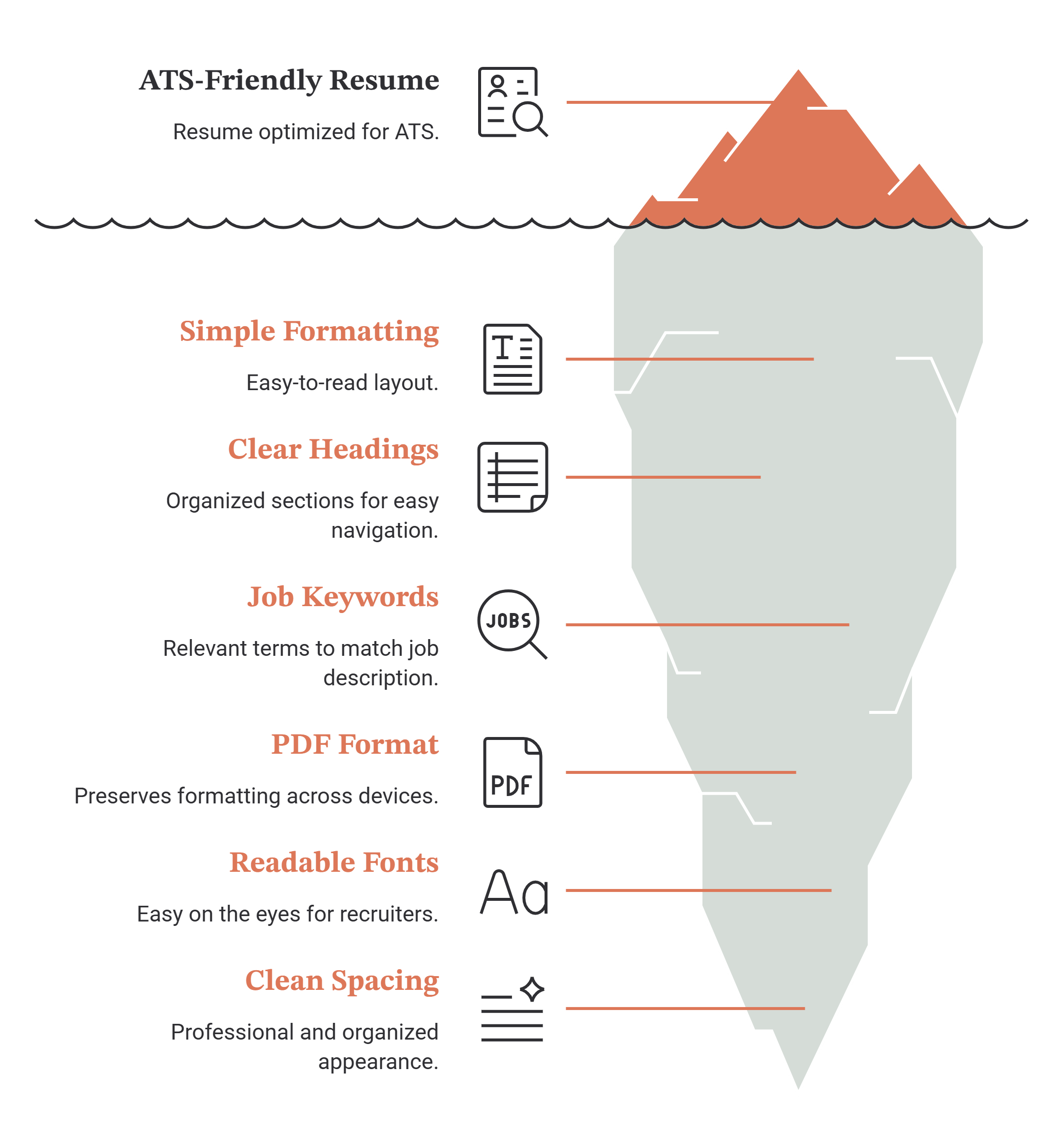
ATS means Applicant Tracking System. Some companies use software to scan resumes.
To make your resume ATS-friendly:
- Use simple formatting
- Use clear section headings
- Avoid heavy graphics
- Use job-related keywords naturally
- Save the resume as PDF
- Use readable fonts
- Avoid complex tables
- Keep spacing clean
Useful fresher resume keywords: Java, Python, SQL, DBMS, OOPs, React, Excel, Communication, Problem-solving, Teamwork, Internship, Project, Data analysis.
Do not stuff keywords. Use them only where they make sense.
It is worth being precise about this section, because a great deal of what circulates about applicant tracking systems is guesswork presented as fact. Nobody outside a company knows what software it uses, how it is configured, or whether a human reads every application anyway — and many campus drives collect resumes through the college's own portal rather than through a tracking system at all. Treat any specific claim about rejection percentages, scanning times, or secret formatting tricks as unverified, including claims you see repeated confidently.
What is actually checkable is whether your file can be read as text, and you can verify that yourself in a minute:
- Open your PDF and try to select the text with your cursor. If you can select it and copy it into a plain text editor and it comes out as readable words, any software can read it. If the text cannot be selected, your resume is an image and nothing can parse it.
- Check that no information exists only inside an image. Skill-level bars, icon-only contact details, a graphic showing your rating out of five, or a photo containing text all lose their meaning when the file is converted to text. If a piece of information matters, it must exist as written words.
- Use the standard section headings. Education, Skills, Projects, Experience, Certifications, Achievements. Creative headings like “My Journey” or “What I Bring” make sections harder to identify, for software and for a human skimming in ten seconds.
- Keep the layout single-column. Two-column designs, text boxes and sidebars can be read out of order when converted to text, which scrambles the sequence of your content. A single column top to bottom always converts predictably.
- Avoid putting essential content in headers and footers. Some converters drop them. Your phone number and email belong in the body of the page.
- Use the words the job description uses, where they are true of you. If the description says “SQL” and you wrote “MySQL queries”, add the word SQL. This is not a trick — it is simply matching your vocabulary to the reader's. Never add a keyword for a skill you do not have.
- Name the file with your own name. Rahul_Sharma_Resume.pdf is unambiguous when a recruiter has a folder of eighty files. Whether the file name affects any software is unknown; whether it helps the human who opens it is not in doubt.
- Send PDF unless the form asks for something else. PDF keeps your layout intact on every machine. If the application portal explicitly asks for .doc or .docx, follow the instruction — that is a real, stated requirement, unlike most advice on this topic.
Everything on that list either makes your resume easier for software to read or easier for a person to read, and usually both. That is the whole of what you can control.
Common Resume Mistakes
Freshers should avoid these mistakes:
- Making resume longer than two pages
- Using too many colors
- Writing fake skills
- Adding copied career objectives
- Using spelling or grammar mistakes
- Writing long paragraphs
- Not explaining projects clearly
- Adding irrelevant personal details
- Using unprofessional email ID
- Mentioning skills you cannot answer
A resume should make the interview easier, not risky.
Three more that this guide's examples have already illustrated, gathered in one place:
Describing the course instead of your work. “Learned about”, “gained exposure to”, “was given the opportunity to” — all describe things that happened to you. Replace each with a verb describing something you produced.
Hiding inside “we”. Team projects are good and should be presented as team projects, but every entry must make your own module or task explicit. If a reader cannot tell what you personally did, they will assume the smallest possible answer.
Numbers you cannot support. Accuracy figures without a test set, percentage improvements you never measured, “50+ projects”. Every unverifiable number on your resume is a question waiting in the interview, and the answer “I do not remember how we calculated that” is worse than never having written it.
Fresher Resume Checklist
Before submitting your resume, check:
- Is it one page?
- Is your phone number correct?
- Is your email professional?
- Are your skills honest?
- Are your projects explained clearly?
- Are there spelling mistakes?
- Is the formatting clean?
- Is the PDF file named properly?
- Can you explain every line?
Good file name example:
Rahul_Sharma_Resume.pdf
Avoid file names like:
finalresume_new_latest2.pdf
Add these final checks, which catch the errors that survive everything else:
- Can you select the text in the exported PDF with your cursor?
- Does every project entry name what you did, not only what the team built?
- Is there at least one number in each of the projects, internship and achievements sections — and is every one of those numbers true?
- Have you removed every skill you would not want to be questioned on?
- Have you read the whole thing aloud once? Reading aloud catches missing words and broken grammar that silent reading skips over.
- Has one other person read it? A friend will spot a wrong year or a repeated word in thirty seconds that you have looked past twenty times.
- Do the dates on the resume match your marksheets and certificates exactly?
Keep the source file, not only the exported PDF, so you can update it quickly between drives. If you build it in the FREEPARE resume builder, your sections stay saved and you can re-export after adding a new project instead of rebuilding the layout each time. Before a role-specific drive, the two lines worth editing are the summary and the order of your projects.
Conclusion
A good fresher resume is simple, clear, and honest.
You do not need to show that you know everything. You need to show that you understand your skills, projects, education, and learning properly.
Prepare your resume early. Update it regularly. Practice explaining every section before your campus placement interview.
Your resume should not just look good. It should help you speak confidently.
If you do only one thing after reading this, take your current resume and rewrite three lines using the pattern in every example above: say what you did, say what it involved, and attach a number that is true. Then read those three lines aloud and ask yourself what question they invite. That question is the one you will be asked — and now you will have an answer ready.
FAQs
1. What should a fresher resume include?
A fresher resume should include contact details, career summary, education, skills, projects, internships, certifications, achievements, and relevant links.
2. Should a fresher resume be one page?
Yes. For most freshers, a one-page resume is enough.
3. Can I add projects instead of internships?
Yes. Good academic or personal projects are valuable for freshers.
4. Should I add all my skills in resume?
No. Add only the skills you can explain confidently in an interview.
5. What is the best resume format for campus placements?
A clean, simple, and ATS-friendly format is best for campus placements.
6. Should I put a photograph on my resume?
It is not required for most campus roles in India, and it takes space that a project line could use. Include one only if the company or your placement cell asks for it.
7. What do I write if I have no internship and no major project?
Use what you have and describe it properly: course assignments, a lab project, a training course project, a college responsibility, volunteer work, or something you built while learning. A small honest project described in three specific lines is worth more than an empty experience section — and it gives you something to build on before the next drive.
8. How often should I update my resume?
After anything that changes what you can claim — a finished project, a completed course, a new semester result. Updating takes ten minutes when the change is fresh and an hour when you are trying to remember details from six months ago.
9. Is it acceptable to have different versions of my resume?
Yes, and it is sensible if you are applying to different kinds of roles. Change the summary, reorder the projects and skills for relevance, and keep the facts identical across every version. Different emphasis is fine; different facts are not.
Tags: campus-placement, freshers-placement-guide, resume-building