How to Use Mock Tests for Campus Placement Preparation
By FreePare Team · Wed Jun 17 2026 · 19 min read

Mock tests are one of the most useful parts of campus placement preparation. They help you understand your preparation level before the real exam.
But many students use mock tests in the wrong way.
They take a test, check the score, feel happy or disappointed, and then move to the next test. This does not improve performance.
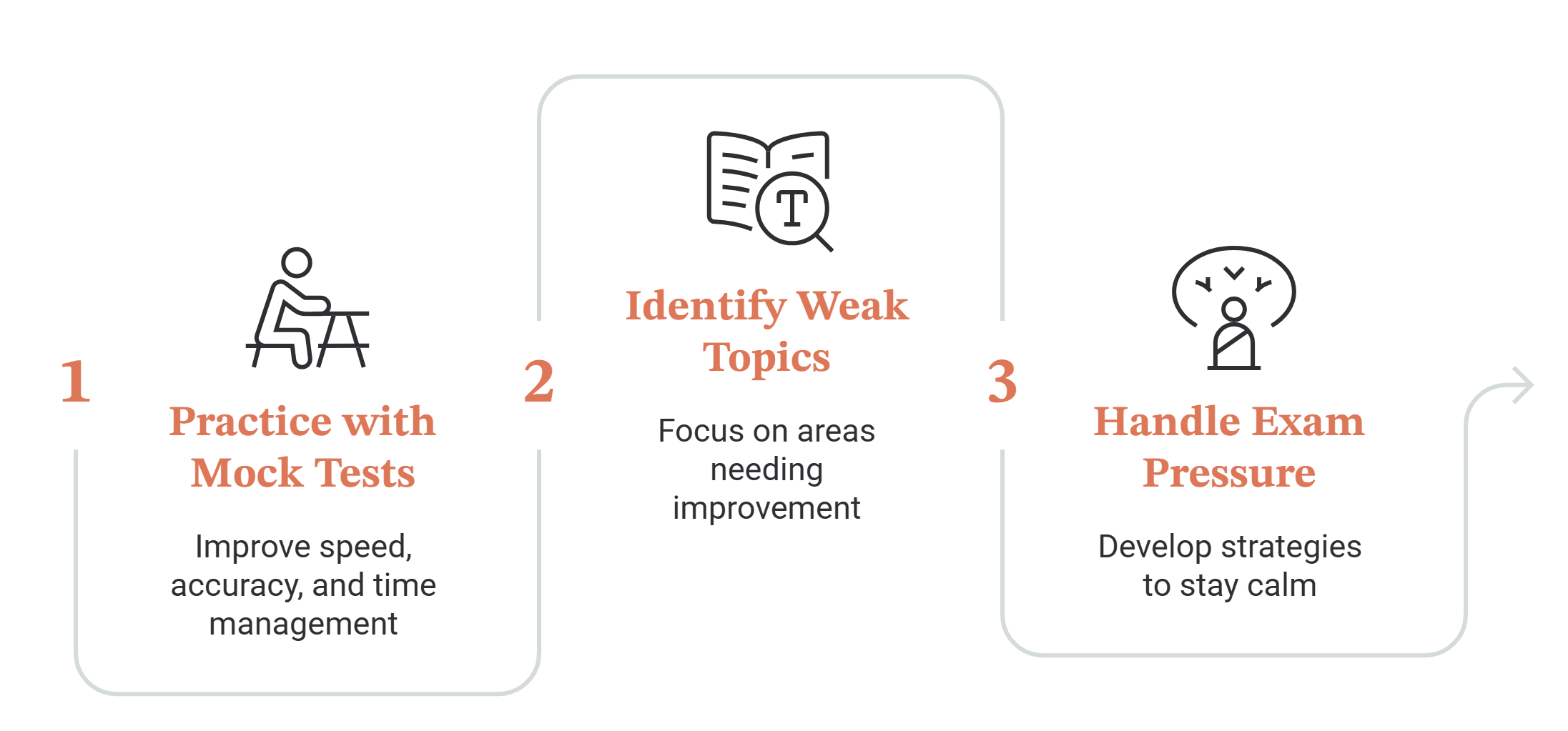
A mock test is not only for checking marks. It is for finding mistakes, improving speed, understanding weak topics, and building exam confidence.
This guide will help you use mock tests properly for campus placement preparation. It gives you an error log you can copy on paper, and the arithmetic that turns a raw score into a decision about what to do next week.
Why Mock Tests are Important
Campus placement tests are time-bound. You may know the topic, but the real challenge is solving questions accurately within limited time.
Mock tests help you improve:
- Speed
- Accuracy
- Time management
- Question selection
- Confidence
- Weak-topic identification
- Exam pressure handling
Mock tests also show whether your preparation is practical or only theoretical.
For example, you may know the formula for time and work, but can you solve the question quickly during the test? Mock tests help you check this.
There is one thing a mock test does that nothing else in your preparation can do: it tells you the difference between what you know and what you can retrieve in fifty seconds under a clock. Chapter-end exercises measure knowledge. A mock measures retrieval speed, and retrieval speed is what the placement paper actually pays for.
When Should You Start Mock Tests?
Do not start full mock tests on day one if your basics are weak.
Follow this order:
- Learn concepts
- Solve topic-wise questions
- Take topic-wise tests
- Take sectional tests
- Take full-length mock tests
If you start full mocks too early, you may score low and lose confidence.
Begin with small tests and slowly move to complete mock tests.
There is a practical test for whether you are ready to move up a level. Move from topic-wise to sectional tests when you can score 70% or better on topic tests without looking anything up. Move from sectional to full-length when your sectional accuracy is stable at 75% or better across two consecutive tests. Below those thresholds, a full mock will mostly measure things you already know are missing, and you will spend three hours discovering it.
Types of Mock Tests
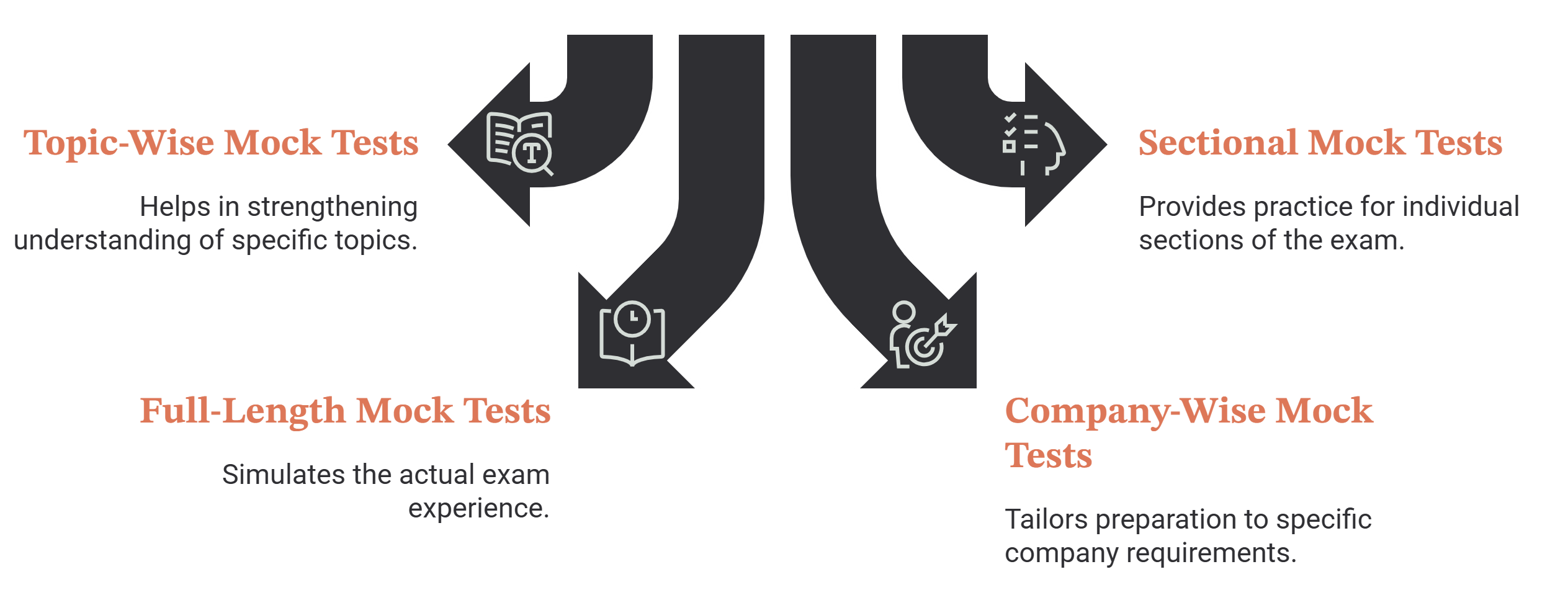
There are different types of mock tests for placement preparation.
1. Topic-Wise Mock Tests
These tests focus on one topic.
Examples:
- Percentage test
- Profit and loss test
- Blood relation test
- Reading comprehension test
- Array coding test
Best for beginners.
They are also the right tool at any level immediately after you find a weak topic, because a topic test gives you fifteen chances to apply one rule rather than one chance to apply fifteen.
2. Sectional Mock Tests
These tests focus on one full section.
Examples:
- Aptitude test
- Reasoning test
- Verbal ability test
- Coding test
Best when your basics are clear.
A sectional test adds the skill a topic test cannot teach: choosing which question to attempt when you do not know in advance which topic is coming.
3. Full-Length Mock Tests
These tests copy the actual placement exam format.
They include multiple sections and fixed time limits.
Best for final preparation.
The full-length mock exists to test stamina and cross-section time budgeting, which is why taking it in pieces defeats the point entirely.
4. Company-Wise Mock Tests
These tests are based on the general pattern of specific companies.
They help you understand the style of questions asked in different placement drives.
Use them last, in the two or three weeks before a drive, and use them for format rather than content — number of sections, time per section, and whether there is negative marking.
How to Attempt a Mock Test
A mock test should be attempted seriously.
Follow these steps:
- Sit in a quiet place
- Set a timer
- Do not pause the test
- Do not check formulas during the test
- Attempt easy questions first
- Skip very time-consuming questions
- Return to marked questions later
- Submit within time
Treat the mock test like the real placement exam.
Add one habit that costs nothing and makes the analysis far more useful: mark your confidence as you go. Next to each question number on your rough sheet, write one character — a tick if you were sure, a question mark if you worked it out but were not certain, and a G if you guessed.
Those three marks are what let you separate the four kinds of wrong answer later. Without them, every wrong answer looks the same when you open the solutions an hour later, and you will label almost all of them “careless” because the correct method looks obvious once you have seen it. A question you ticked and still got wrong is a very different problem from one you marked G. The first means your understanding is confidently wrong, which is the most dangerous state to be in, and the only way you will ever notice it is if you wrote the tick down at the time.
For the in-test decisions themselves — when to abandon a question, and when a guess earns marks — see exam day tips: how to attempt tests without panic.
How to Analyze Mock Tests
This is the most important part.
After every mock test, check every wrong answer.
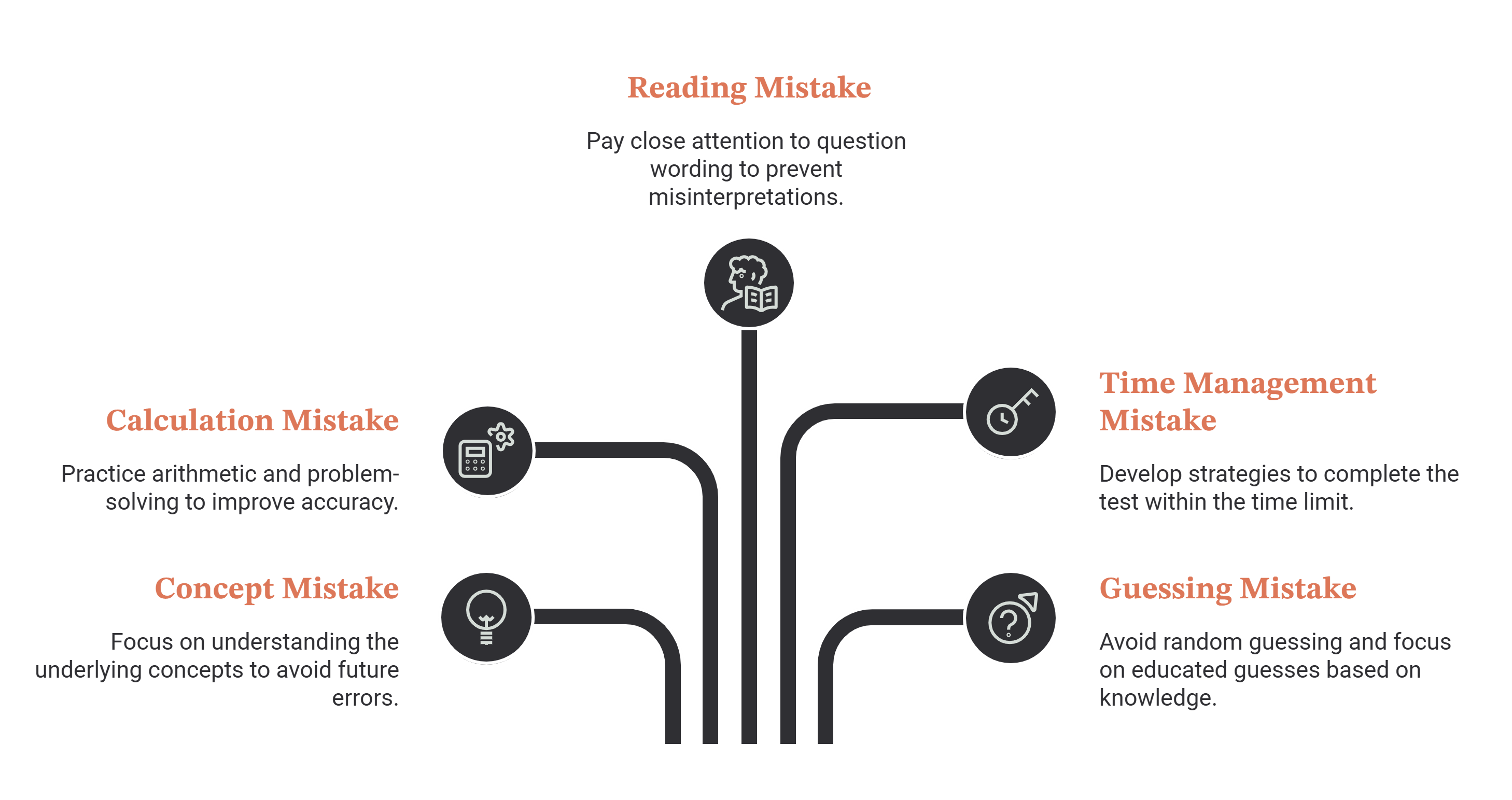
Divide mistakes into categories.
Analysis takes longer than the test. A 60-minute mock deserves 90 minutes of review, and if that sounds like too much, take half as many mocks. Five analysed mocks beat fifteen unanalysed ones, because the unanalysed ones only re-measure the same weaknesses.
The error log: the one table to copy
Keep a single running log across every mock, not a fresh page per test. The repeats across tests are the whole point, and they are invisible if each test lives on its own sheet.
| Q | Section and topic | My answer | Correct | Why wrong | Action | Retry on |
|---|---|---|---|---|---|---|
| 7 | Quant – Time and work | 12 days | 8 days | Concept — added rates instead of adding times | Re-read efficiency method, solve 15 questions | +7 days |
| 11 | Quant – Percentages | 250 | 200 | Careless — applied the increase to the wrong base | Write the base next to every percentage step | +7 days |
| 19 | Quant – Data interpretation | blank | 34% | Time — spent 4 minutes on Q18 of the same set | Cap any DI set at 4 minutes total | +3 days |
| 26 | Reasoning – Seating arrangement | C | A | Concept — did not know how to handle a facing-inward circle | Learn the inward/outward rule, do 10 puzzles | +7 days |
| 33 | Reasoning – Syllogism | B | D | Careless — answered “follows” for a question asking which does not follow | Re-read the last line of every stem | +3 days |
| 41 | Verbal – Sentence correction | B | C | Concept — missed subject-verb agreement across a prepositional phrase | Drill agreement rules, 20 questions | +7 days |
| 52 | Verbal – Reading comprehension | A | D | Guess — ran out of time, picked at random | Attempt RC before the last 5 minutes | +3 days |
Four rules make this log work rather than become another abandoned notebook:
- Exactly one reason per row. If a mistake feels like two reasons, write the one that came first in time. “Careless because I was rushing because I lost time earlier” is a time mistake.
- The action must be a thing you can do this week. “Be more careful” is not an action. “Write the base next to every percentage step” is.
- Log the questions you got right by guessing too. A lucky guess is a gap that your score is hiding from you, and it will not be lucky twice.
- Honour the retry date. Re-attempt the question cold, without looking at your notes. If you get it wrong again, it was never a careless mistake — it was a concept gap that you mislabelled because the solution looked obvious. Re-file it and re-learn the topic.
1. Concept Mistake
This happens when you do not understand the topic properly.
Example:
You got a time and work question wrong because you did not understand efficiency.
Solution:
Revise the topic and solve 15 to 20 similar questions.
How to recognise it: you cannot explain the correct solution in your own words even after reading it. If reading the solution produces “oh, of course,” it was probably careless; if it produces “where did that step come from,” it is a concept gap. This is the only category that needs study rather than habit change, and it is the one worth protecting your time for.
2. Calculation Mistake
This happens when your concept is correct but calculation is wrong.
Solution:
Practice mental maths, revise tables, and slow down slightly while solving.
How to recognise it: your method matches the official solution line for line and only the number differs. Track where in the working it broke — most people have one repeating failure point, usually decimals, negative signs, or reading a number off the wrong row of a table. Fixing one repeating failure point is worth more than general speed practice.
3. Reading Mistake
This happens when you read the question too quickly.
Example:
The question asks for a false statement, but you choose the true one.
Solution:
Underline important words mentally.
How to recognise it: you solved a real problem correctly — just not the one that was asked. The reliable fix is procedural: before selecting any option, re-read only the last line of the stem, because that is where the actual ask almost always lives.
4. Time Management Mistake
This happens when you spend too much time on one question.
Solution:
Learn when to skip.
How to recognise it: a question you left blank turns out to be one you can solve comfortably when you try it untimed afterwards. Every such question is a mark that your knowledge had already earned and your clock gave away. Count them — the count is the single most motivating number in your whole analysis.
5. Guessing Mistake
This happens when you randomly guess too many answers.
Solution:
Guess only when you can eliminate wrong options.
How to recognise it: the G marks on your rough sheet. Count both the wrong guesses and the right ones. If your guesses were right at roughly the rate chance predicts — about one in four with four options — they were genuinely random, and under a penalty of half a mark per wrong answer they were costing you marks. If they were right far more often, your elimination instinct is good and you can afford to guess more.
Accuracy vs Attempt Rate: How to Read Your Score
A total score is one number hiding two very different skills, and the two need opposite fixes. Separate them with two calculations that take thirty seconds.
attempt rate = questions attempted / total questions
accuracy     = questions correct   / questions attempted
Take a real-looking full mock: 60 questions in 60 minutes, one mark for a correct answer and a penalty of 0.25 for a wrong one. You attempted 42, got 30 right and 12 wrong, and left 18 blank.
- Attempt rate = 42 / 60 = 70.0%
- Accuracy = 30 / 42 = 71.4%
- Score = 30 − (12 x 0.25) = 30 − 3 = 27 out of 60
Note that only 30 of 60 questions were answered correctly, which is 50% of the paper — a third number, and the one most students confuse with accuracy. Accuracy is measured against what you attempted; it says nothing about what you skipped.
Now break it down by section, which is where the instruction actually appears:
| Section | Questions | Attempted | Correct | Wrong | Accuracy | Section score |
|---|---|---|---|---|---|---|
| Quantitative aptitude | 20 | 12 | 7 | 5 | 58.3% | 5.75 |
| Logical reasoning | 20 | 14 | 10 | 4 | 71.4% | 9.00 |
| Verbal ability | 20 | 16 | 13 | 3 | 81.3% | 12.25 |
| Total | 60 | 42 | 30 | 12 | 71.4% | 27.00 |
The picture is now unambiguous. Verbal is fine. Reasoning is acceptable. Quantitative aptitude is the problem, and specifically it is an accuracy problem rather than a speed problem — of 12 attempts, 5 were wrong. Attempting more quantitative questions next week would lower the score, not raise it, because at 58% accuracy each extra attempt is worth 0.583 − (0.417 x 0.25), which is about +0.48 marks, while the same minute spent in verbal at 81% accuracy is worth about +0.76. The fix is concepts in quantitative aptitude, not courage.
What each combination is telling you to do
| Accuracy | Attempt rate | What it means | What to change first |
|---|---|---|---|
| Below 75% | Any | You are attempting questions you do not reliably know. Extra attempts are losing marks. | Concepts. Deliberately attempt fewer questions in the next mock and aim only to raise accuracy. |
| 75–85% | Below 65% | You know more than your score shows. The loss is speed and selection, not knowledge. | Timed drills on the topics you skipped. This is the fastest score gain available. |
| Above 85% | Below 75% | You are being too cautious and leaving safe marks on the table. | Push the attempt rate up by 10 points and watch whether accuracy holds. |
| Above 85% | Above 80% | You are near the ceiling of this paper. | Move to harder or company-pattern papers. |
Here is why the middle row is worth so much. The same candidate takes a second mock and deliberately attempts less: 34 attempted, 29 right, 5 wrong.
- Attempt rate = 34 / 60 = 56.7%
- Accuracy = 29 / 34 = 85.3%
- Score = 29 − (5 x 0.25) = 29 − 1.25 = 27.75
Eight fewer questions attempted, and the score went up slightly. That result is the whole lesson: attempts are not marks. With accuracy now stable, the third mock pushes the attempt rate back up — 46 attempted, 39 right, 7 wrong:
- Attempt rate = 46 / 60 = 76.7%
- Accuracy = 39 / 46 = 84.8%
- Score = 39 − (7 x 0.25) = 39 − 1.75 = 37.25
That is a jump of more than ten marks from the first mock, and not one extra formula was learned between them. Accuracy first, then attempt rate. Doing it in the other order is why so many students take mock after mock with a flat score.
Two more numbers worth computing
The careless share. In the first mock, suppose the 12 wrong answers split as 5 concept, 4 careless, 2 time-pressure and 1 guess. The careless four are a third of all errors, and they are the cheapest marks in your preparation because they need no new learning. Converting a wrong answer to a right one is worth 1.25 marks under this scheme — you gain the mark and stop losing the penalty — so those four are worth 5 marks, taking the score from 27 to 32 with no studying at all.
The unattempted upside. Go back to the 18 blank questions and solve them untimed, with no notes. If you can solve 11 of them, that 11 is your realistic upside from pure speed and selection work, and the other 7 are genuine syllabus gaps. Two students with identical scores can have completely different numbers here, and they should be doing completely different things next week.
How to Improve Your Score
To improve mock test score, follow this cycle:
- Take a test
- Analyze mistakes
- Revise weak topics
- Practice similar questions
- Take another test
Do not take five mock tests without revision.
Score improves when you fix mistakes between tests.
Step 4 is where most cycles quietly break. “Practice similar questions” means going to the specific topic that failed and doing fifteen questions on that topic alone, not doing another mixed set. You can browse practice tests by subject and topic and pick out exactly the topic your error log names, which is what makes the log worth keeping in the first place.
Tips to Improve Score
- Revise formulas daily
- Practice reasoning patterns
- Read English passages regularly
- Solve coding questions consistently
- Improve calculation speed
- Avoid random guessing
- Track weak topics
- Repeat difficult topics
Progress may be slow at first, but consistent analysis improves performance.
One addition that outperforms all of these: fix the topic that appears most often in your error log, and fix only that one, before the next mock. Spreading a week thinly across eight weak topics changes nothing measurable. Taking one topic from 55% to 85% accuracy changes the score you can see.
Weekly Mock Test Plan
Beginner Level
- 2 topic-wise tests per week
- 1 short sectional test per week
Intermediate Level
- 2 sectional tests per week
- 1 full mock test per week
Final Preparation Level
- 2 to 3 full mock tests per week
- Daily weak-topic revision
Do not overload yourself with tests. Quality analysis matters more than quantity.
Budget the analysis into the plan or it will not happen. A full mock is 60 minutes of test and about 90 minutes of review, so “one full mock per week” is a two-and-a-half-hour commitment, not a one-hour one. Three full mocks a week at the final level is roughly seven and a half hours. If your week does not have that, take two and analyse both properly.
Mock Test Review Sheet
After every mock test, write this:
| Field | Worked example |
|---|---|
| Test name | Full mock 3 |
| Date | Week 5, Tuesday |
| Total score | 27 / 60 |
| Attempt rate | 42 / 60 = 70.0% |
| Accuracy | 30 / 42 = 71.4% |
| Aptitude score | 5.75 (12 attempted, 7 correct, 58.3% accuracy) |
| Reasoning score | 9.00 (14 attempted, 10 correct, 71.4% accuracy) |
| Verbal score | 12.25 (16 attempted, 13 correct, 81.3% accuracy) |
| Coding score | Not in this paper |
| Weak topics | Time and work, seating arrangement, percentages |
| Silly mistakes | 4 of 12 errors — worth 5 marks |
| Time-consuming questions | Q18 and Q19 of the DI set: 4 minutes for one mark |
| Unattempted but solvable | 11 of 18 — the realistic upside |
| Topics to revise | Time and work only, this week |
| Next test date | Week 6, Tuesday |
This simple review sheet will help you track improvement.
Keep every sheet and put the attempt rate and accuracy of each test side by side in one place. Two flat scores can hide real progress — the second mock above scored almost the same as the first while accuracy rose by fourteen points, and that rise was the thing that made the ten-mark jump possible a fortnight later. The score alone would have told you nothing was happening.
Common Mistakes to Avoid
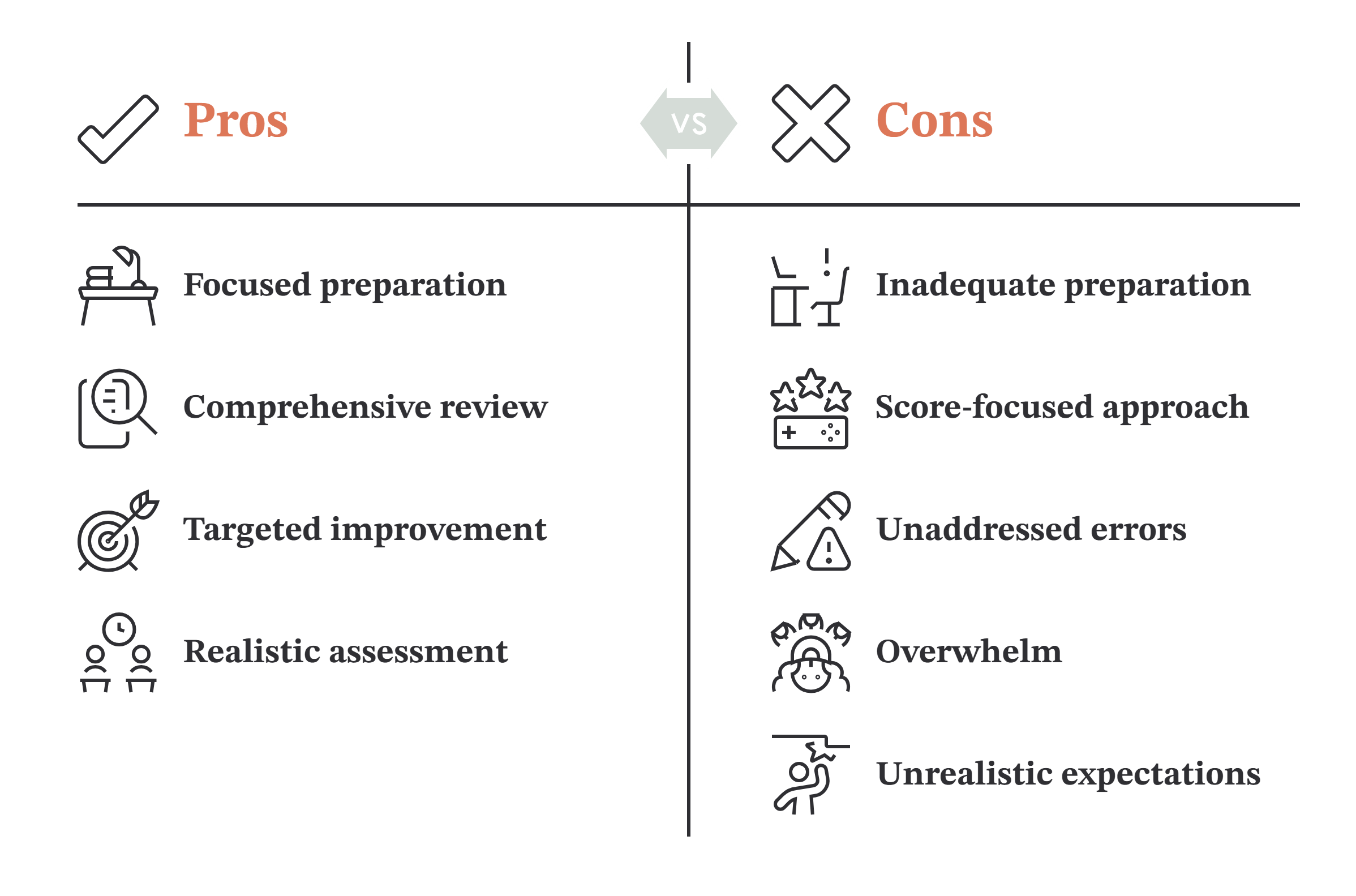
Avoid these mock test mistakes:
- Taking tests without preparation
- Checking only final score
- Not reviewing wrong answers
- Taking too many mocks together
- Ignoring weak topics
- Guessing randomly
- Not tracking progress
- Skipping verbal ability
- Not revising formulas
- Comparing scores with friends
Your real competition is your previous score, not someone else’s score.
Three more that specifically undo the analysis:
- Reviewing only the wrong answers. Correct answers you guessed, and correct answers that took four minutes, are both problems the score is concealing. Review them too.
- Labelling everything careless. Once you have read the solution the method looks obvious, so almost every error feels like a slip. The retry-after-seven-days rule exists precisely to catch this: if you fail the question again cold, it was never careless.
- Restarting the log for each test. A log that resets cannot show you that time-and-work has now cost you marks in four consecutive mocks, and that repetition is the most valuable thing in the whole exercise.
Conclusion
Mock tests are not just for checking preparation. They are part of preparation.
A low score in a mock test does not mean you cannot clear placements. It means you found your weak areas before the real exam.
That is a good thing.
Take mock tests seriously. Analyze every mistake. Revise weak topics. Track your progress. With the right strategy, mock tests can improve your speed, accuracy, and confidence.
If you take one thing from this guide, take the two divisions: attempt rate and accuracy. They turn a score you can only feel bad about into an instruction you can act on this week. Then use the error log to pick a single topic, and see how to convert weak subjects into strong topics for the way to work through it. If your log keeps naming the verbal section, the verbal ability preparation guide covers the rules those questions test.
FAQs
1. Are mock tests important for campus placement preparation?
Yes. Mock tests help improve speed, accuracy, time management, and exam confidence. They are the only part of preparation that measures how fast you can retrieve what you know, which is what the placement paper is actually testing.
2. When should I start taking mock tests?
Start with topic-wise tests first. Begin full-length mock tests after your basics are clear — in practice, once your sectional accuracy is stable at 75% or better across two consecutive tests.
3. How many mock tests are enough for placements?
At least 5 to 10 good mock tests with proper analysis can help freshers improve. Budget about 90 minutes of analysis for every 60-minute mock; if that does not fit your week, take fewer tests rather than skipping the analysis.
4. What should I do after a low mock test score?
Check your weak topics, revise them, practice similar questions, and take another test later. Before that, compute accuracy and attempt rate separately: below 75% accuracy the fix is concepts and fewer attempts, while good accuracy with a low attempt rate means the fix is timed practice.
5. Is mock test analysis important?
Yes. Mock test analysis is more important than simply checking the score. A running error log with one reason and one action per wrong answer, plus a retry date a week out, is what turns a test into preparation instead of just measurement.
Tags: campus-placement, freshers-placement-guide, mock-tests