How to Convert Weak Subjects into Strong Topics
By FreePare Team · Mon Jul 06 2026 · 8 min read

"I am weak in maths" is not a problem statement. It is a mood. Nothing follows from it, which is exactly why saying it for two years changes nothing.
A subject only becomes fixable once the sentence gets small enough to act on in one sitting. This article does that narrowing on a real aptitude paper — twenty questions, marked, classified, and reduced to a single sentence — and then repairs the thing that sentence names.
Build the audit before you build the plan
You cannot repair what you have not located, and a full-length mock is the wrong instrument: it tells you a score, which you already suspected.
Build a twenty-question audit instead. Two questions from each of ten subtopics, taken from past papers or the end-of-chapter exercises, easy to medium — not the hardest ones, because a hard question failing tells you nothing about whether you have the basics. Give yourself twenty-five minutes and no notes.
Then mark it, and against every wrong answer write one of exactly four causes:
- Concept — I did not know the method, or I knew a method and it was the wrong one.
- Forgotten — I have done this before and could not retrieve it under the clock.
- Careless — I knew it and misread, miscopied, or dropped a sign.
- Time — I could have done it and ran out of room.
Four causes, because each one has a different repair and mixing them is why "I will just practise more" so often produces no movement at all.
A real audit, marked
Here is one student's audit of a placement aptitude paper. Ten subtopics, two questions each.
| Subtopic | Score | Cause of the wrong answers |
|---|---|---|
| Percentages | 2 of 2 | — |
| Ratio and proportion | 2 of 2 | — |
| Number system | 2 of 2 | — |
| Averages | 1 of 2 | Careless: added nine values and divided by ten |
| Time, speed and distance | 1 of 2 | Time: correct method, ran out of minutes |
| Data interpretation | 1 of 2 | Time: spent six minutes reading the table |
| Simple and compound interest | 1 of 2 | Concept: applied the rate to the original sum in year two |
| Profit and loss | 0 of 2 | Concept: took the discount off the cost price |
| Time and work | 0 of 2 | Concept: added the days instead of the daily work |
| Permutations and combinations | 0 of 2 | Concept: could not tell whether order mattered |
Ten out of twenty. The instinct after seeing that is "I need to do more aptitude". Look again, though, because the paper is telling you something much narrower than that.
Read the audit, do not just total it
Three things fall out of that table, and none of them is visible in the score.
Two of the failures are not knowledge failures at all. The averages slip and both timing losses are execution, and no amount of re-studying averages will touch them. The averages fix is a checking habit — recount the values before dividing — and the timing fix is an order-of-attempt rule, not more theory. Treating these as "weak topics" is how students spend a month revising something they already know.
The concept failures are not four separate topics. Look at what interest, profit and loss, and time and work have in common: every one of them is a percentage or a rate applied to a base that changes. Compound interest fails because year two is a percentage of a new amount. Profit and loss fails because the discount is a percentage of the marked price, not the cost. Time and work fails because days do not add — the work done per day does.
And percentages scored 2 of 2. That is the most useful line in the whole table. The student is not weak at percentages. They are weak at identifying what a percentage is being taken on when the base moves, which never comes up in a bare percentage question and comes up in everything built on top of one.
Permutations and combinations is the one genuine standalone gap, and it is a different kind: the confusion is about whether order matters, which is a definition problem rather than a base problem.
The sentence you can actually act on
So "I am weak in maths" becomes two sentences, and both fit in one session:
"I lose marks when a percentage or a rate is applied to a base that changes — markup and discount, compound interest, combined work."
"I cannot reliably tell whether a counting question is a permutation or a combination."
That is the whole point of the audit. The first sentence covers six of the ten marks lost and points at one idea, not four chapters. The second is small and separate. Neither one is a mood.
Notice also what did not make the list. Averages, speed and data interpretation all lost marks and none of them needs studying — they need a checking habit and a stopwatch rule.
Repairing the first sentence, in three sessions
One idea, three sittings across a week. Nothing here is more than an hour.
Session one, one hour. Take the idea on its own, in the simplest chapter that shows it. A shopkeeper marks goods 40 percent above cost and gives a 25 percent discount: take cost as 100, marked price is 140, the discount comes off 140 so the selling price is 105, and the profit is 5 percent measured back against cost. Three different bases in one question. Write the sentence that generated it — markup from cost, discount from marked price, profit back against cost — and then do three more questions with the page turned over. The full hour is worked step by step in the study-rhythm guide, because it is the same hour.
Session two, forty minutes, two days later. Same idea, different chapter, so you are testing the idea and not the chapter. Compound interest: a sum at 10 percent for two years earns 10 percent of the original in year one and 10 percent of the grown amount in year two, which is why 10,000 rupees earns 2,100 rather than 2,000. Then combined work: two people finishing in 12 and 18 days do not average to 15, because rates add and days do not.
Session three, thirty minutes, four days later. Mixed set, closed book, timed. Six questions drawn from all three chapters in random order, because in the exam nothing announces which chapter it belongs to. This is the session that tells you whether the repair held.
How you know it is actually fixed
Re-run the audit. Not a new twenty questions on everything — the same two questions from each of the three repaired subtopics, plus two fresh ones of the same type.
Fixed looks like this: you get them right, and you can say out loud which quantity each percentage was taken on before you compute anything. If the answers come out right but you cannot say the second part, you have memorised three procedures and the fourth chapter that uses the same idea will catch you again.
Then put the repaired subtopic back into the rotation on the ordinary spacing — a week later, three weeks later, five minutes each time from a blank page. The reason retrieval beats re-reading, and what to memorise deliberately, is in why rote memorisation fails.
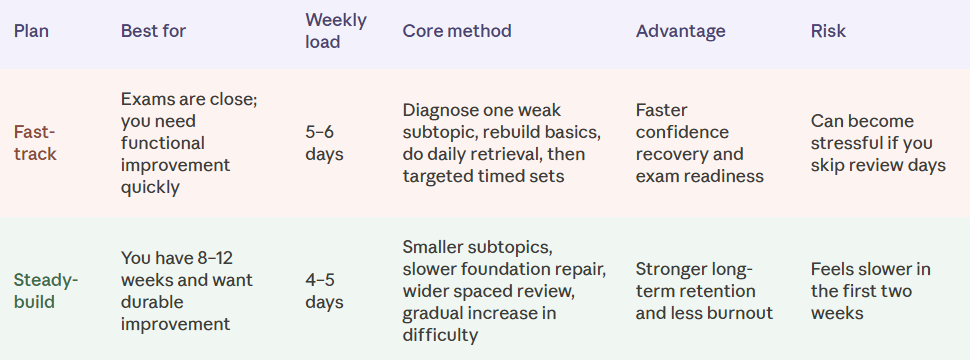
The part that is not about knowledge
Some of what makes a subject feel weak is not the subject. If every session with it has felt like evidence that you are behind, you will start the session late, rush it, and avoid the questions that would tell you the most.
Two things help, and neither is a pep talk. First, make the first session of a repair deliberately easy — easy to medium questions only — so the evidence in front of you is that you can do this, which happens to also be the correct pedagogy. Second, change what you are judging. For two weeks, judge yourself on whether the three sessions happened, not on the marks. Marks lag the repair by a fortnight and watching them daily tells you nothing except how you feel.
The label follows the evidence eventually. It just follows it slowly.
A twelve-week version, if the exam is not close
Everything above is one repair cycle: audit, narrow to a sentence, three sessions, re-test, back into spacing. A subject usually holds four or five such sentences, so a term is enough to work through them properly.
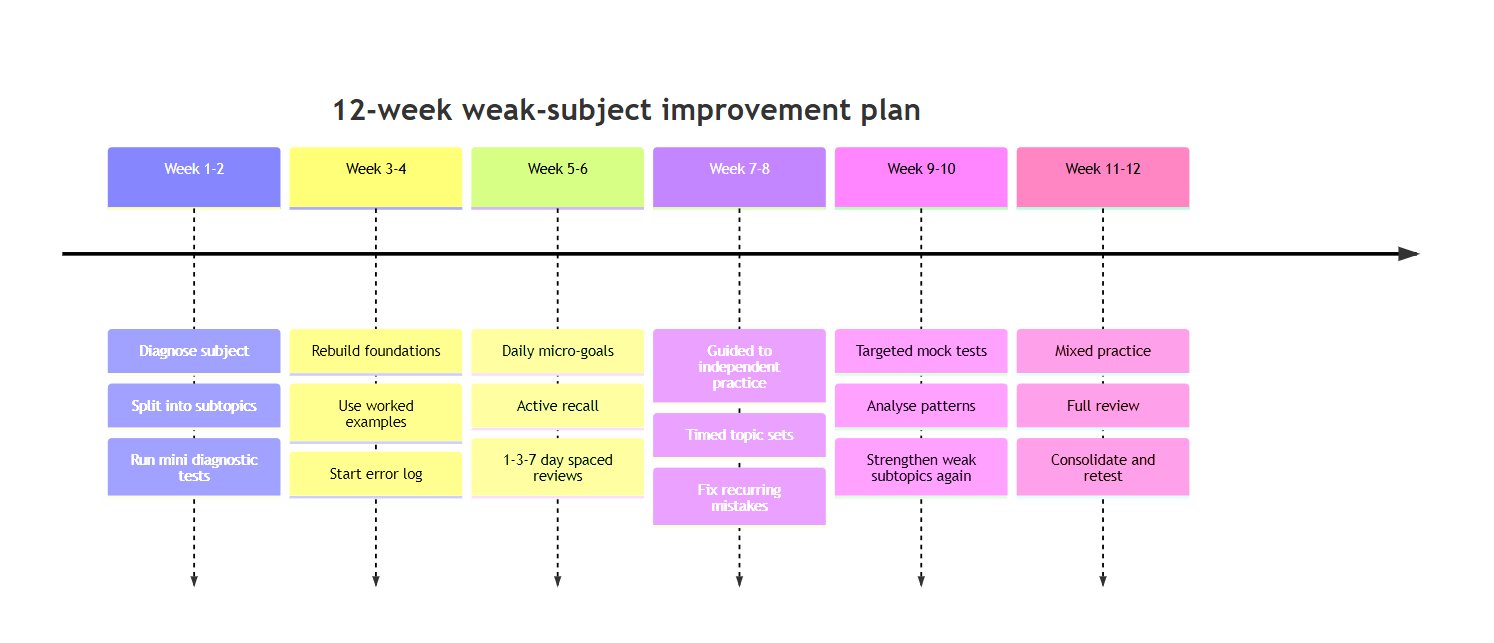
Start with the audit, tonight, on the subject you have been avoiding longest. Twenty questions and twenty-five minutes. Weak subjects stop being frightening at the point where they stop being vague, and that point arrives faster than most people expect — the ordering of aptitude topics in the aptitude guide is a reasonable place to draw the twenty from.
Tags: study-plan-for-weak-subjects, how-to-study-better, smart-study-tips, study-motivation-for-students, smart-study-strategies, daily-study-routine, student-learning-guide