30-Day Campus Placement Preparation Roadmap for Freshers
By FreePare Team · Tue Jun 16 2026 · 24 min read

If your campus placements are near and you have only 30 days left, do not panic. You can still prepare well if you follow a focused plan.
The goal is not to master every topic in one month. The goal is to cover the areas that get tested first, practise them under time pressure, take real mock tests, analyse them properly, and walk into the process knowing what you can and cannot do.
This roadmap is a calendar, not an overview. Every one of the 30 days below names a topic, a practice volume, and a revision item, so that you never open your books and spend the first twenty minutes deciding what to study. Follow the day; the deciding is already done.
One check before you start. This plan assumes the basics are already in place — you can do arithmetic without a calculator, you know the standard aptitude models even if you are slow at them, and you can write a small working program on your own. If that is not true, a 30-day calendar will bury you. Start instead with the diagnostic in how to start campus placement preparation from zero, which tells you where you actually stand and what to fix first, and come back to this page once the foundation holds.
What Can You Prepare in 30 Days?
In 30 days, with discipline, you can realistically get:
- Aptitude basics revised and made fast
- Logical reasoning patterns recognised on sight
- Verbal ability rules tightened
- Coding fundamentals fluent enough to write clean small programs
- A one-page resume you can defend line by line
- A project explanation you can deliver in 90 seconds
- Three full mock tests, each properly analysed
- HR answers rehearsed out loud
- Technical interview basics revised
It is equally worth being clear about what 30 days will not buy, because planning around a fantasy is how people lose the month. You will not become strong at advanced data structures and algorithms. You will not build a new project worth talking about. You will not repair a genuine gap in a core subject you never learned. If any of those is your real weakness, this month is for containing it, not fixing it — you prepare an honest answer for the question rather than pretending the gap is gone.
Use one structured plan and follow it properly. The single largest waste in a 30-day window is switching resources on day 12.
Before You Start the 30-Day Plan
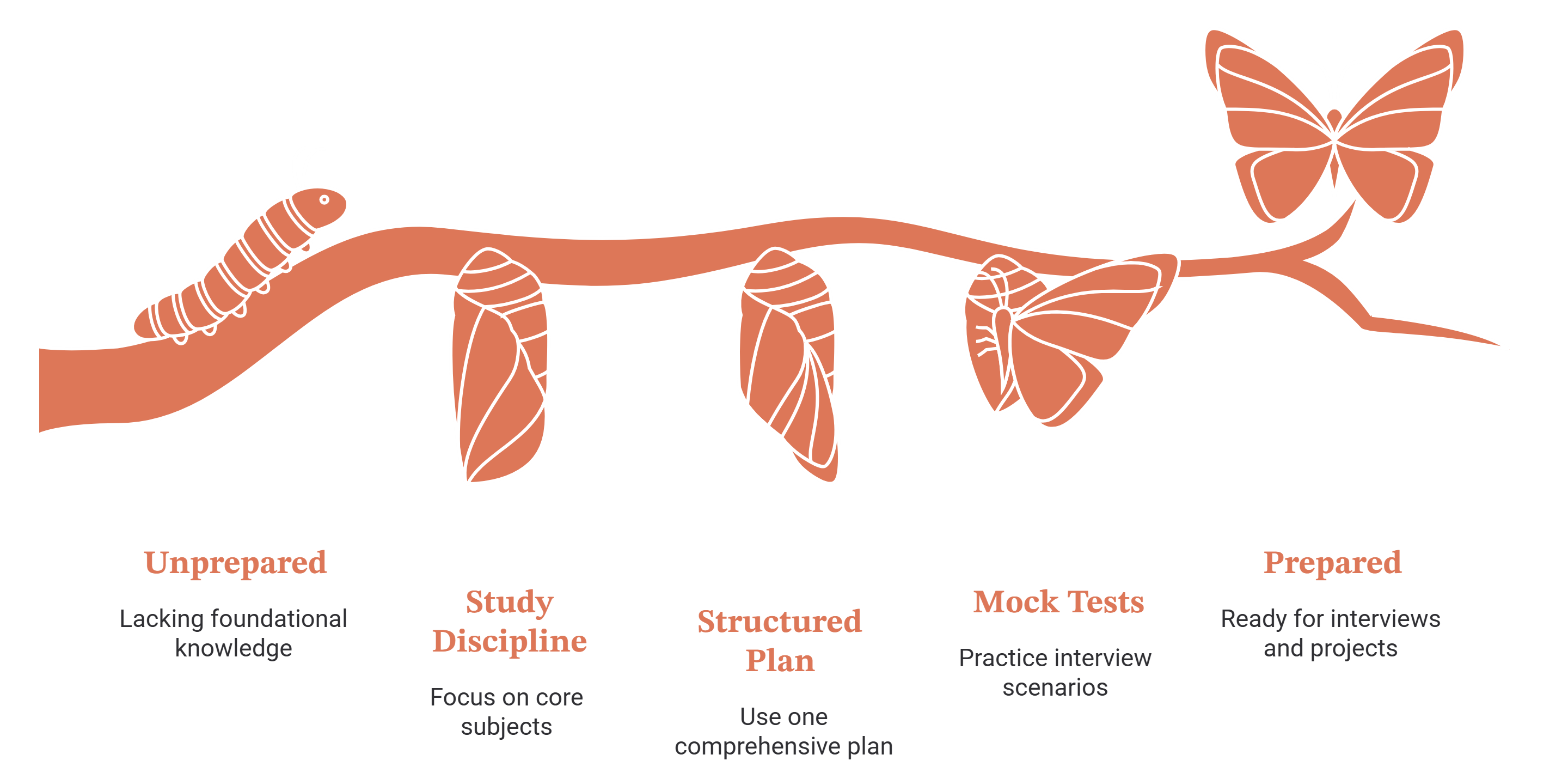
Spend one evening on these three things before Day 1. They cost about ninety minutes and they change what the whole month is worth.
1. Know Your Target Companies
Check which companies are coming to your college and what their process looks like. Different companies use different patterns: some weight aptitude heavily, some include a coding round, some test communication, some ask technical MCQs.
Your placement cell is the reliable source for this, not rumour and not a forum post from three years ago. Write down, on one page, the rounds you expect, the sections in the written test, and the duration if it is known. Anything the calendar below spends time on that your companies do not test is time you can move elsewhere — and anything they test that this plan under-weights, you add.
2. Check Your Current Level
Take one sectional or mini test before Day 1 and answer honestly:
- Are you weak in aptitude, or just slow?
- Are you slow in reasoning, or do you not know the patterns?
- Is your English section weak on grammar or on reading speed?
- Can you write a working program from a blank file, without help?
- Is your resume ready, and can you defend every line of it?
Write the five answers down. They decide where your spare time goes for the rest of the month. Weak-and-slow needs more days; slow-only needs more timed sets on days you already have.
3. Keep Study Material Limited
Do not collect PDFs, videos, websites and notes. Pick one source for concepts, one place to practise, and one notebook for errors. Then stop looking.
The one notebook matters more than it sounds. Every wrong answer this month gets logged with its cause: concept gap, calculation slip, misread the question, or ran out of time. Those four causes have four different fixes, and the weekly review at the end of each week is built entirely on that log.
Week 1: Build the Basics
Week 1 rebuilds the aptitude, reasoning and verbal foundations. It is deliberately untimed for the first three days: this week is for correctness, and Week 2 is for speed. Adding a clock now would only teach you to guess.
| Day | Topic to study | Practice volume | Revision item |
|---|---|---|---|
| Day 1 | Percentages: conversions, increase and decrease, successive change | 20 questions untimed — 10 easy, 10 medium — every step written | Write a formula card of fraction-to-percent values from 1/2 down to 1/12 |
| Day 2 | Ratio, proportion and averages, including weighted average | 20 questions untimed, 5 of them mixing ratio with averages | Re-solve the percentage questions you got wrong on Day 1, cold |
| Day 3 | Profit and loss, simple interest, compound interest | 20 questions untimed; mark every question that took over 3 minutes | Derive the profit-percent and SI formulas from scratch on paper, no notes |
| Day 4 | Reasoning: number series and alphabet series | 25 questions; write the rule you spotted next to each answer | Read your Day 3 formula card once, 5 minutes |
| Day 5 | Reasoning: coding-decoding, blood relations, direction sense | 25 questions, drawing a diagram for every blood-relation and direction item | List the series patterns you missed on Day 4 and re-solve those questions |
| Day 6 | Verbal: reading comprehension method — answer only from the passage | 2 passages, 10 questions; write a one-sentence summary of each before answering | 5 words from those passages, recorded with the sentence you met them in |
| Day 7 | Verbal: error spotting and sentence correction — subject-verb agreement, tense consistency, articles | 15 grammar questions, then a timed set of 25 percentage and ratio questions in 25 minutes | Log every error from that timed set by cause: concept, calculation, misread, or time |
Days 1 to 3: Aptitude Basics
Take one topic per day and finish it. Learn the formula, derive it once so it survives pressure, then solve until the standard shapes are familiar. Do not focus on speed in these three days; focus on getting the method right and written down.
The order in the table is deliberate. Percentages sit underneath profit, loss and interest, so learning them first makes Day 3 cheaper than it would otherwise be. If you need the underlying method on any of these topics rather than just practice, the quantitative aptitude preparation guide covers them in order.
Days 4 to 5: Reasoning Basics
These five patterns are the quick wins of the reasoning section: short, reliable, and fully learnable in two days. The single rule that matters is to write everything down. Use a diagram for every blood-relation and direction question, including the ones that look easy, because the habit has to be automatic before it helps you in a timed paper.
Mark any question that confused you rather than skipping past it, and re-solve those the next day instead of reading the explanation and moving on.
Days 6 to 7: Verbal Ability Basics
Verbal is usually the cheapest section to improve, because a small number of rules is tested repeatedly. Day 6 is comprehension: read once, summarise in one sentence, then answer only from the passage. If you cannot point to the line that supports your answer, you guessed.
Day 7 adds grammar and then closes Week 1 with the first timed set. That timed set is not a test of your worth — it is the input to the weekly review. Log every error by cause before you go to bed.
Week 2: Improve Speed and Accuracy
Everything is timed from here. The topics in Week 2 are the heavier aptitude models and the reasoning sets that carry several questions each, and the week ends with a full sectional test.
| Day | Topic to study | Practice volume | Revision item |
|---|---|---|---|
| Day 8 | Time and work, including pipes and cisterns and the efficiency method | 20 questions, timed at 90 seconds each | Redo the 3 slowest questions from the Day 7 timed set |
| Day 9 | Time, speed and distance: relative speed, trains, boats and streams | 20 questions timed; mark every one you could not start within 30 seconds | Write a formula card for relative speed in the same and opposite directions |
| Day 10 | Number system: divisibility rules, remainders, LCM and HCF | 20 questions timed, then a 25-question mixed set from Days 8 to 10 in 25 minutes | Log every error from the mixed set by cause, and name the one topic to repair |
| Day 11 | Reasoning: syllogism, including possibility cases | 25 questions, drawing a Venn diagram for every single one | Re-solve 5 blood-relation questions from Day 5, cold and timed |
| Day 12 | Reasoning: seating arrangement, puzzles, statement and conclusion | 6 full sets, timed at 8 minutes each; abandon any set that passes 10 minutes | Write down the clue notation you used on the set you solved fastest, and reuse it |
| Day 13 | Verbal: tenses, prepositions, articles, subject-verb agreement, modifier placement | 30 grammar questions in 20 minutes, plus 1 passage in 8 minutes | All vocabulary cards from Days 6 and 7, out loud |
| Day 14 | No new topic. Sectional test day | 25 aptitude, 20 reasoning, 15 verbal in 60 minutes, one sitting, phone away | The weekly review ritual below, and the three topics you will repair in Week 3 |
Days 8 to 10: Aptitude Practice
Start using a timer, and use it honestly: the clock runs even when you are stuck. The point of Week 2 is not to solve harder questions, it is to solve the same questions faster and to learn when to walk away from one.
Adopt a leaving rule and apply it from Day 8. If you have not found the method within about 30 seconds, mark the question and move on; come back only if time remains at the end. In a timed paper, question selection is worth as much as question solving, and it is a skill you can only build by practising it.
Take your topic-wise and mixed sets from the practice tests organised by subject and topic, so each day's set matches exactly what that day taught rather than being a random assortment.
Days 11 to 12: Reasoning Practice
Syllogism, seating arrangement and puzzles need patience and a written method. Draw a Venn diagram for every syllogism, even a two-statement one. Build a table for every arrangement, fix your own notation for confirmed and eliminated placements, and never change that notation mid-month.
The 10-minute abandon rule on Day 12 is deliberate. A puzzle set that eats twenty minutes in practice will eat twenty minutes in the real test, and learning to recognise and drop those sets is more valuable than eventually solving them.
Days 13 to 14: Verbal Practice and Revision
Day 13 targets the rules that appear most often in error-spotting questions. Day 14 is the first proper checkpoint of the month: a full sectional under real conditions.
After it, check your accuracy per section, your speed per section, which topics were weak, and how many questions you skipped. Then do the review ritual, because a sectional you do not analyse is just a stressful hour.
Week 3: Add Coding and Technical Basics
Week 3 is technical. Keep a 30-minute aptitude or reasoning set every day alongside it — skills built in Weeks 1 and 2 decay quickly if you drop them for a full week.
Choose one language and stay with it: C, C++, Java or Python. Pick the one your college already taught you. Switching now costs days and gains nothing.
| Day | Topic to study | Practice volume | Revision item |
|---|---|---|---|
| Day 15 | Language basics: input and output, variables, conditions, loops | Write 6 programs from a blank file: reverse a number, check prime, sum of digits, multiplication table, factorial, Fibonacci to n terms | Dry-run the prime check on 0, 1 and 2 and fix whatever breaks |
| Day 16 | Functions and arrays | 6 programs: largest element, second largest, count occurrences, reverse in place, rotate by k, check if sorted | Rewrite second-largest so it handles duplicates and arrays shorter than two |
| Day 17 | Strings | 6 programs: reverse, palindrome check, count vowels, remove duplicate characters, first non-repeating character, anagram check | Re-run palindrome on an empty string and on mixed case; correct the output |
| Day 18 | Searching and sorting | Implement linear search, binary search, bubble sort and insertion sort yourself, then solve 5 problems that use them | Say the time complexity of all four out loud, best and worst case |
| Day 19 | Stacks and queues | Implement both using an array, then solve balanced parentheses and next greater element | Rewrite Day 18 binary search from memory, without looking at your own code |
| Day 20 | OOPs and DBMS: class, object, inheritance, polymorphism, abstraction, encapsulation; keys, normalisation to 3NF, joins | Write 10 SQL queries: where, order by, group by with having, inner join, left join, subquery, count, max, distinct, update | Define all six OOPs terms in one sentence each, from memory, then check them |
| Day 21 | OS and networking basics, and your own project: process vs thread, deadlock, paging, scheduling; OSI layers, TCP vs UDP, DNS, HTTP status codes | Write your project explanation in full: the problem, your part, the technology choice, what broke | Say the project explanation aloud twice, under 90 seconds, without notes |
Days 15 to 17: Programming Basics
Write every program from a blank file. Reading a solution and understanding it is a different skill from producing one, and only the second skill is tested.
Test each program on three inputs that break most beginner code: an empty input, a single-element input, and an input containing duplicates. The revision items above are exactly those edge cases, deliberately, because the difference between a partially scoring submission and a zero is usually one unhandled case rather than a wrong idea.
If you want the shape of the round itself — how partial marks usually work, what to do when you are stuck at minute ten — read the coding round preparation guide for freshers on Day 15, once.
Days 18 to 19: Data Structure Basics
Implement the structures yourself rather than reading about them. Do not start advanced data structures and algorithms in a hurry this month: with 30 days, a solid grip on arrays, strings, searching, sorting, stacks and queues is worth far more than a shaky acquaintance with trees and graphs.
Be able to state the complexity of everything you write. It is asked in interviews more reliably than any single algorithm.
Days 20 to 21: Technical Subjects
Revise OOPs, DBMS, SQL, operating system and networking basics at the level of a clear one-sentence definition plus one example. Depth beyond that is not the best use of Day 20 with nine days left.
Then prepare your project explanation properly. You should be able to say, without notes: what your project does, which technologies you used, what your role was, what problem it solved, and what challenges you faced. Write it out before you rehearse it — the writing is what removes the rambling.
Week 4: Mock Tests and Interviews
Week 4 is not for learning. It is for measuring, repairing and rehearsing. Do not start a new topic this week, however tempting the gap looks.
| Day | Focus | Practice volume | Revision item |
|---|---|---|---|
| Day 22 | Full-length mock test 1, under real conditions | One full mock, full duration, one sitting, phone away, nothing looked up | Analyse it for as long as the test took; log every error by cause |
| Day 23 | Repair day: only the three weakest topics from mock 1 | 15 timed questions per topic, so 45 in total | Re-solve the 10 mock questions you got wrong, cold |
| Day 24 | Full-length mock test 2 | One full mock, same conditions as Day 22 | Compare cause counts with mock 1: did misreads and timeouts fall? |
| Day 25 | Resume: one page, built section by section | Write the whole thing, then delete every line you could not answer three follow-up questions about | Read it aloud; rewrite any sentence you stumble over |
| Day 26 | Skills and project defence | For each skill you listed, write two questions an interviewer could ask, and answer both in writing | Re-answer the weakest of those out loud, without the written version |
| Day 27 | HR interview answers | Write and rehearse five: tell me about yourself in 90 seconds, strengths, a real weakness with what you did about it, why this company, where you see yourself | Say each one to another person, or record and listen back |
| Day 28 | Technical interview practice and full-length mock test 3 | Mock 3 in the morning; in the evening, 20 technical questions asked aloud by a friend | Weekly review ritual, then pick exactly two things to fix in the last two days |
Days 22 to 24: Full-Length Mock Tests
Take mocks the way the real test will be taken: full duration, one sitting, no pausing. A mock taken in two comfortable halves measures nothing useful, because stamina and pacing are half of what it is testing.
After each mock, analyse wrong answers, time-consuming questions, weak topics, silly mistakes and skipped questions — and budget roughly the length of the test for that analysis. Then reduce it all to one decision: the two or three topics you will repair before the next mock. Day 23 exists for exactly that repair, which is why it is sandwiched between two mocks. Do not take mock tests without review; an unreviewed mock is a score, not information.
Days 25 to 26: Resume Preparation
Prepare a clean one-page resume: education, skills, projects, internships, certifications, achievements and contact details.
Apply one test to every line — could you answer three follow-up questions about this? If not, either learn it before Day 28 or delete it. Avoid fake skills and long paragraphs. A shorter honest resume outperforms a padded one, because every padded line is an invitation to a question you cannot answer.
Day 26 turns the resume into interview preparation. Every skill you kept becomes two probable questions, and writing the answers is what turns a listed skill into a defensible one.
Days 27 to 28: Interview Preparation
Prepare common HR and technical questions, and prepare them out loud. An answer rehearsed silently is not rehearsed.
The HR set to have ready: tell me about yourself, why should we hire you, your strengths, a genuine weakness and what you are doing about it, and why this company. For structure and worked examples of how these are answered honestly, use the HR interview questions and answers guide for freshers on Day 27.
The technical set: explain your project, what OOPs is, what DBMS is, what SQL is, what an array is, and what time complexity is — each answerable in two or three sentences, with one example, and with a deeper answer ready if the interviewer follows up.
Days 29 and 30: Final Two Days
| Day | Focus | Practice volume | Revision item |
|---|---|---|---|
| Day 29 | Aptitude formulas, reasoning patterns, grammar rules | One mixed 30-question set in 30 minutes — the last timed work of the month | Every formula card from Weeks 1 and 2, read once |
| Day 30 | Coding basics, resume, project explanation, HR answers, company details | Nothing new and nothing timed. Read your error log once, end to end | Sleep properly. Keep the day light and stop early |
Do not start a completely new topic in these two days. Anything learned on Day 30 is not available under pressure on Day 31, and the anxiety it creates costs more than the topic is worth.
The Weekly Review Ritual
Every Sunday of this plan — Days 7, 14, 21 and 28 — spend 30 minutes on this, and treat it as non-negotiable. It is the mechanism that makes the rest of the calendar adapt to you.
- Count. For each section, write attempted, correct, and time taken. Numbers, not impressions.
- Sort the errors into the four causes from your log: concept gap, calculation slip, misread the question, ran out of time.
- Apply the matching fix, because they are genuinely different problems. A concept gap sends you back to the theory for that one topic. A calculation slip means arithmetic drills, not more theory. A misread means a slower first read of the question, which costs seconds and is the cheapest fix available. Running out of time means more volume at the same difficulty, not harder questions.
- Pick exactly three topics to repair in the coming week. Three, not eight. An eight-item list never gets done, and an undone list teaches you to ignore your own analysis.
- Write those three where you will see them on the days ahead, and fold them into the 30-minute maintenance slot rather than adding a new hour.
If the same cause dominates two weeks running, that is the finding of the month. Change something structurally rather than repeating the week and hoping.
When You Miss a Day
You will miss at least one day out of thirty. Exams, illness, travel, a family event. This is normal, and the plan is built to survive it, so long as you follow three rules.
- Never merge two days into one. A six-hour catch-up day does not deliver two days of learning, and it is the single most common reason people abandon a 30-day plan in the second week. Take the next day at its normal length.
- Shift, do not delete — up to two days. Move everything one day later and absorb the slack from the maintenance slots. The plan has enough give for two missed days without changing the end date.
- Past two days, cut deliberately. Decide by priority rather than by whatever is next in the list. The load-bearing parts are the three mock tests, the weekly reviews, the resume, and the project and HR answers — these are what your remaining days protect. The compressible parts, in the order you should sacrifice them, are: the depth of Day 20 and Day 21 technical revision, then the second reasoning day, then Week 3 down from seven days to five by combining Days 18 and 19.
If you lose a whole week, do not attempt to compress 30 days into 23. Run Week 1, Week 2 and Week 4, and keep only Days 15 to 17 from Week 3. You will go in with weaker technical revision and intact screening-round preparation, which is the better trade when the screening round is what eliminates people first.
Daily Study Routine
If you have 2 hours daily:
- 40 minutes aptitude
- 30 minutes reasoning
- 20 minutes verbal ability
- 30 minutes coding or technical basics
If you have 3 hours daily:
- 60 minutes aptitude
- 45 minutes reasoning
- 30 minutes verbal ability
- 35 minutes coding
- 10 minutes revision
In Week 3 the proportions invert: coding and technical subjects take the largest block, and aptitude and reasoning drop to a 30-minute maintenance set to stop the earlier weeks decaying. In Week 4 the whole routine is replaced by whatever the day's table says.
Two genuinely focused hours beat four distracted ones, and the difference shows up first in the timed sections. If placements are very close, protect the mock analysis time before you protect the study time.
Final 3-Day Revision Plan
These are Days 28, 29 and 30 above, stated as a standalone sequence in case you arrive at this plan with only three days left.
Day 1
Revise aptitude formulas from your cards, then one mixed 30-question set in 30 minutes. Do not chase new topics — read the error log instead and re-solve two errors from it.
Day 2
Revise reasoning patterns and the six grammar rules, then one 20-question reasoning set and one comprehension passage. Re-draw the clue notation you use for arrangement puzzles so it is fresh.
Day 3
Revise coding basics by rewriting three small programs from memory, then read your resume aloud, then deliver your project explanation and your five HR answers out loud once each.
Keep the final day light and stop early. Do not overload your mind the night before.
Mistakes to Avoid
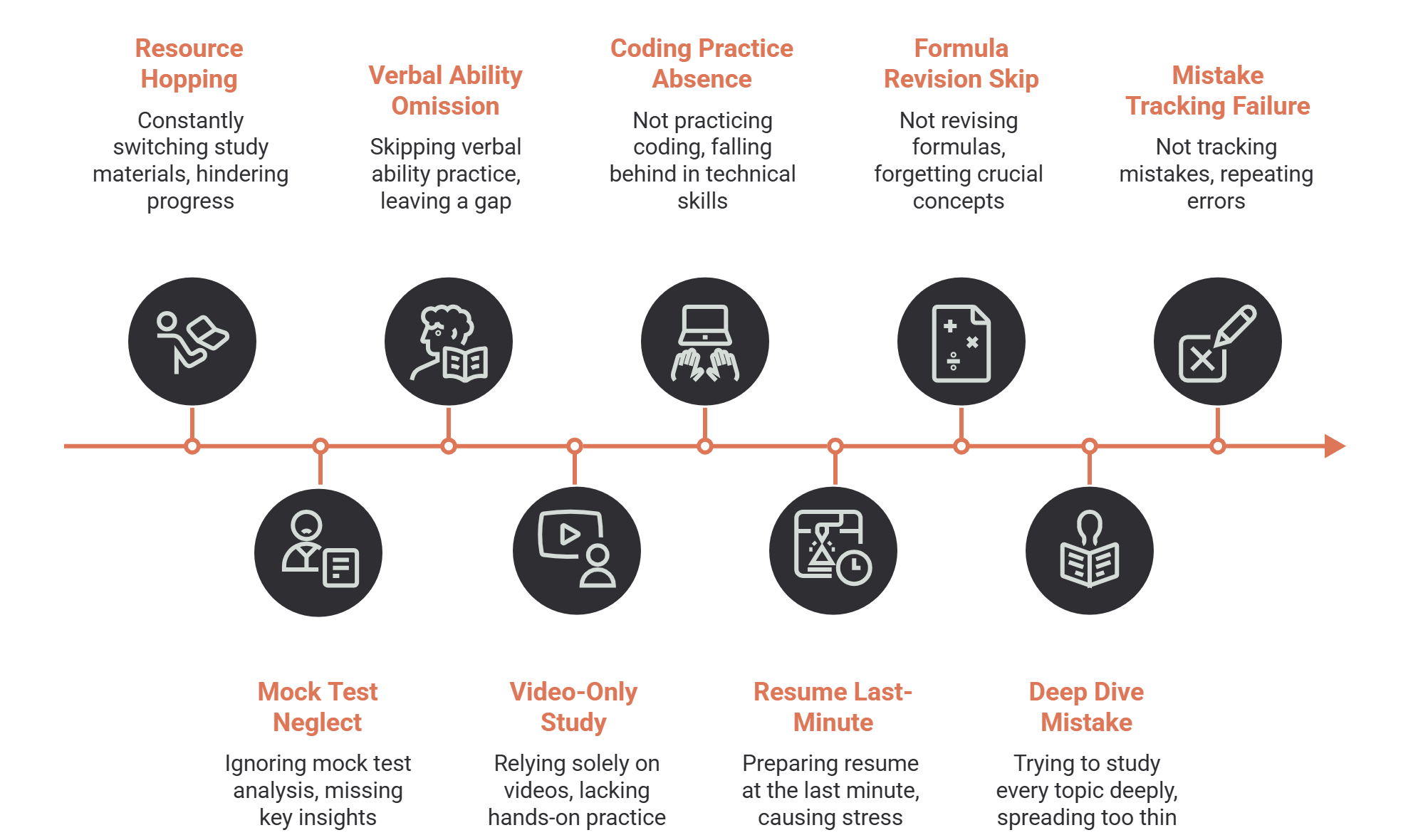
Avoid these during a 30-day preparation:
- Changing resources mid-plan. New material on Day 12 costs you the days you already spent getting used to the old material.
- Ignoring mock test analysis. A mock without analysis is an expensive score.
- Skipping verbal ability because it feels less serious than aptitude. It is usually the cheapest section to improve.
- Only watching videos. Passive input feels like progress and is not measurable. Every session in this plan ends with something written or timed for that reason.
- Not practising coding by writing code from a blank file.
- Preparing the resume at the last minute, when there is no time left to learn what it reveals you cannot defend.
- Not revising formulas, which is why every week here carries formula cards as revision items.
- Trying to study every topic deeply. In 30 days, breadth at a defensible level beats depth in two topics.
- Not tracking mistakes by cause, which leaves you applying the wrong fix to the wrong problem all month.
- Doubling up after a missed day, which is how a plan gets abandoned rather than recovered.
In 30 days, smart preparation matters more than unlimited preparation.
Conclusion
A 30-day plan works when it removes the daily decision about what to study. Week 1 rebuilds the basics untimed. Week 2 makes them fast and ends with a sectional. Week 3 adds coding and technical revision while keeping the earlier work alive with a 30-minute maintenance set. Week 4 measures with three mocks, repairs what they expose, and rehearses the resume, project and interview answers out loud. Days 29 and 30 revise and then stop.
Nothing here promises an outcome, and no honest plan can. What it does promise is that on Day 31 you will know exactly what you can do under time pressure and what you cannot, which is a far better position than walking in and finding out.
Do not try to become perfect in one month. Follow the day in front of you, review honestly at the end of each week, and repair the three things the review names.
FAQs
1. Is 30 days enough for campus placement preparation?
It is enough to revise and sharpen basics you already have, and to get comfortable under timed conditions. It is not enough to build a foundation from nothing — if that is your situation, start with the from-zero diagnostic linked at the top and treat this calendar as what comes next.
2. What should I study first in a 30-day plan?
Aptitude, in the Week 1 order: percentages, then ratio and averages, then profit, loss and interest. Each topic reuses the one before it, so this order costs you less than any other. Reasoning follows on Days 4 and 5, verbal on Days 6 and 7.
3. Should I prepare coding in 30 days?
Yes, if you are applying for technical roles — Week 3 is built for exactly that. Stay with one language and cover loops, functions, arrays, strings, searching, sorting, stacks and queues properly. Do not start advanced data structures and algorithms this month; a clean, tested solution to a simple problem scores better than a half-remembered advanced technique.
4. How many mock tests should I take in 30 days?
This plan schedules one sectional on Day 14 and three full-length mocks on Days 22, 24 and 28, with a dedicated repair day between the first two. Taking more than that is only useful if you have time to analyse each one for as long as the test itself took. Unanalysed mocks add stress, not score.
5. When should I prepare my resume?
Days 25 and 26 in this plan, but collect the raw material earlier — project details, what you actually built, dates, certificate names. Day 26 exists because a resume is not finished when it is written; it is finished when you can defend every line on it.
Tags: campus-placement, freshers-placement-guide, placement-roadmap