Quantitative Aptitude Preparation Guide for Campus Placements
By FreePare Team · Tue Jun 16 2026 · 31 min read

Quantitative aptitude is one of the most important sections in campus placement exams. Most companies use aptitude questions to check a student’s numerical ability, problem-solving speed, and accuracy.
For many freshers, aptitude feels difficult in the beginning. But campus placement aptitude is not advanced mathematics. It is mainly based on basic concepts, formulas, and regular practice.
If you prepare topic by topic, revise formulas, and take timed tests, quantitative aptitude can become one of your strongest scoring sections.
This guide will help you understand important aptitude topics, preparation strategy, daily routine, mock test plan, and common mistakes to avoid. Every topic below carries the actual formulas and at least one fully worked example, so you can learn the method here and then practise the same question types on FREEPARE.
What is Quantitative Aptitude?
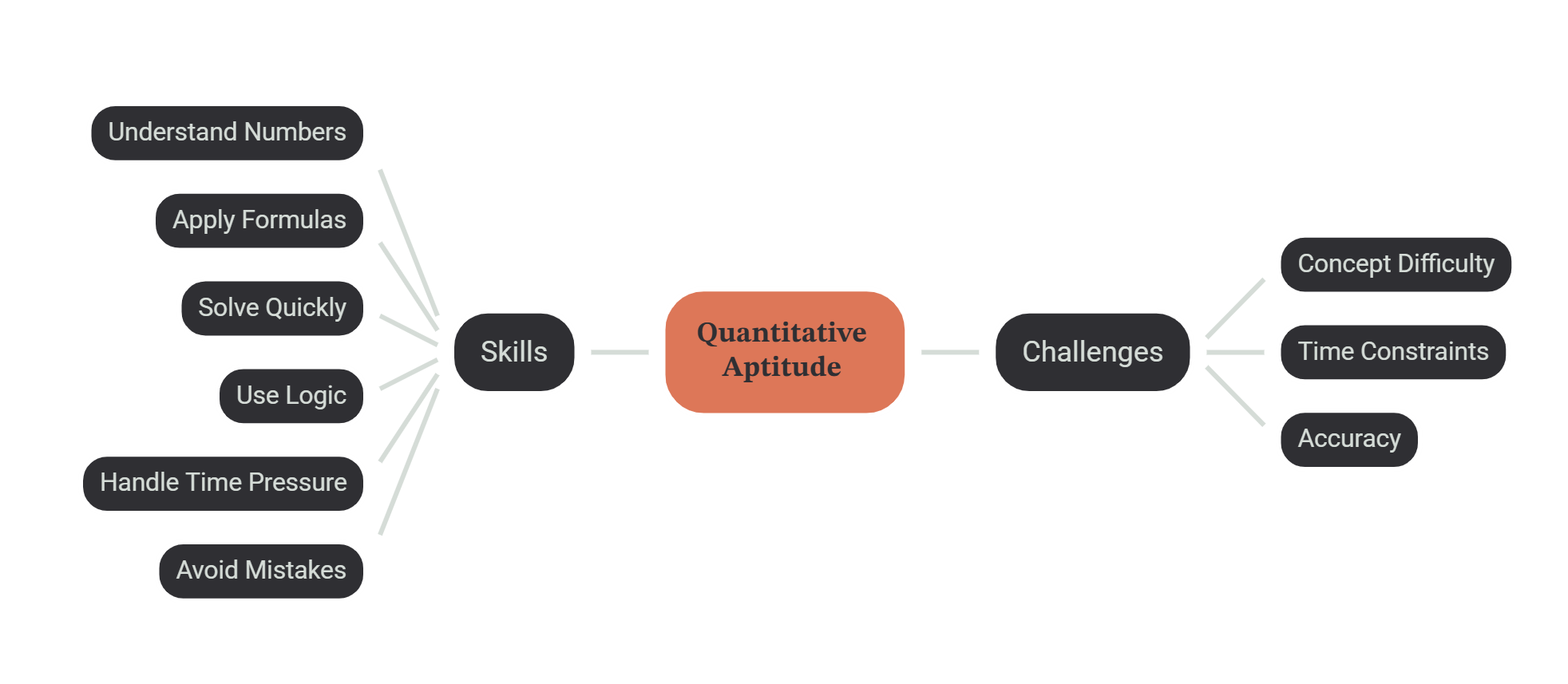
Quantitative aptitude is the section that tests your ability to solve number-based problems.
It checks how well you can:
- Understand numbers
- Apply formulas
- Solve problems quickly
- Use logic in calculations
- Handle time pressure
- Avoid silly mistakes
Most aptitude questions in campus placements are based on school-level mathematics. The challenge is not only the concept. The real challenge is solving accurately within limited time.
Why Aptitude is Important for Campus Placements
Aptitude is important because it is often used in the first screening round.
If you do not clear the aptitude round, you may not reach the coding round, technical interview, or HR interview.
A good aptitude score helps you:
- Clear the first round
- Improve your overall test score
- Build exam confidence
- Perform better in mock tests
- Reduce pressure during company exams
Even if you are good at coding or communication, ignoring aptitude can reduce your chances in campus placements.
Important Aptitude Topics for Placements
Here are the most important quantitative aptitude topics freshers should prepare.
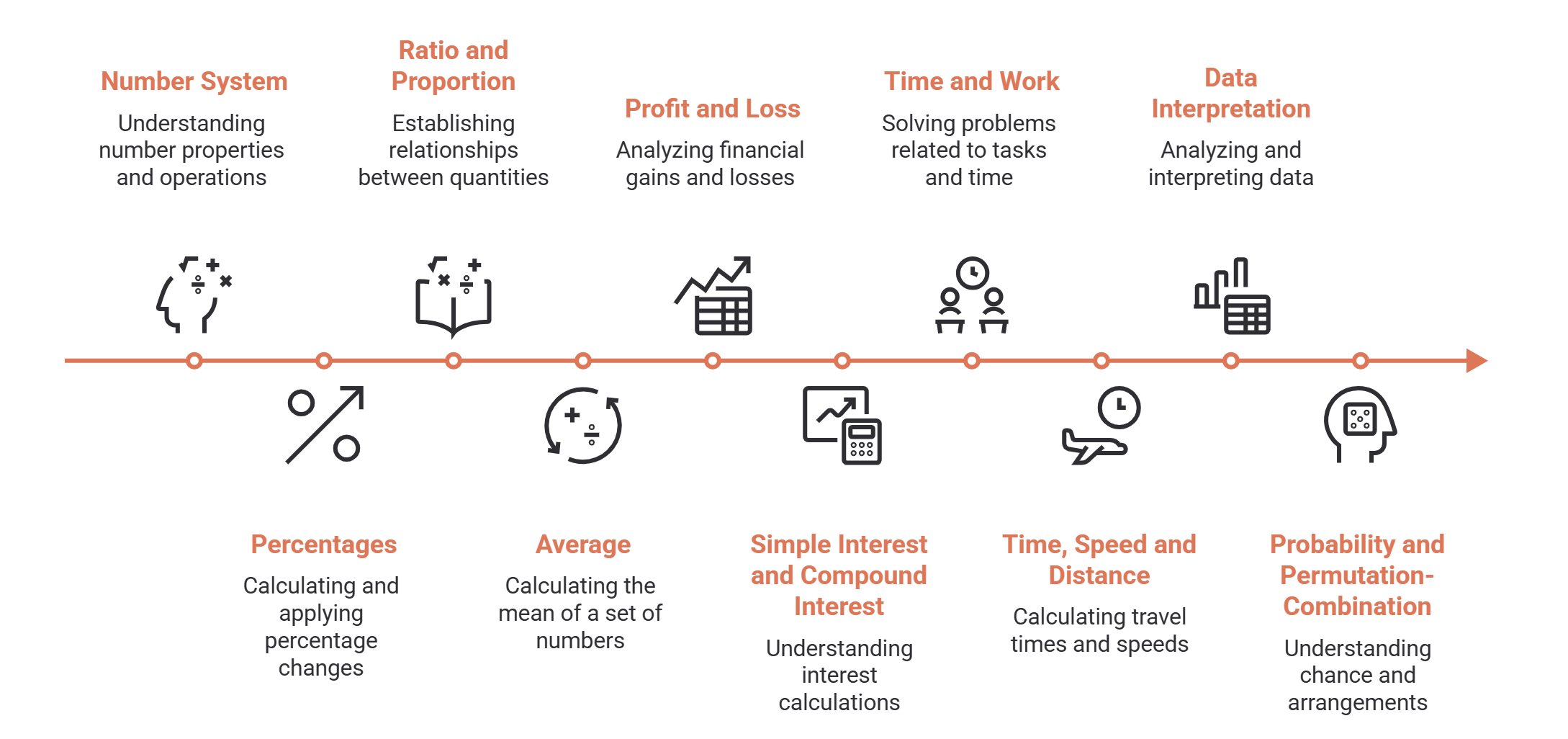
1. Number System
Number system builds your basic calculation ability.
Important areas:
- Divisibility rules
- Factors and multiples
- HCF and LCM
- Remainders
- Prime numbers
- Unit digit
- Last two digits
This topic is useful for many other aptitude problems.
Divisibility rules you should know by heart
| Divisor | Rule |
|---|---|
| 2 | Last digit is 0, 2, 4, 6 or 8 |
| 3 | Sum of all digits is divisible by 3 |
| 4 | Number formed by the last two digits is divisible by 4 |
| 5 | Last digit is 0 or 5 |
| 6 | Divisible by 2 and by 3 together |
| 8 | Number formed by the last three digits is divisible by 8 |
| 9 | Sum of all digits is divisible by 9 |
| 11 | (Sum of digits in odd places) − (sum of digits in even places), counted from the right, is 0 or a multiple of 11 |
Example: Test 41,328 against these rules.
- Last digit is 8, so it is divisible by 2.
- Digit sum = 4 + 1 + 3 + 2 + 8 = 18. Since 18 is divisible by 3 and by 9, the number is divisible by 3 and by 9. Check: 41,328 ÷ 9 = 4,592.
- Last two digits = 28, and 28 ÷ 4 = 7, so it is divisible by 4.
- Last three digits = 328, and 328 ÷ 8 = 41, so it is divisible by 8.
- Divisible by 2 and 3, so it is divisible by 6.
- For 11, take digits from the right: 8 − 2 + 3 − 1 + 4 = 12. Since 12 is not a multiple of 11, it is not divisible by 11.
HCF and LCM
Write both numbers as products of prime factors. The HCF takes each common prime raised to its lowest power; the LCM takes every prime that appears, raised to its highest power.
Key check: HCF × LCM = Product of the two numbers. Use it to catch mistakes.
Example: Find the HCF and LCM of 84 and 126.
- 84 = 2 × 2 × 3 × 7 = 2
^2× 3 × 7 - 126 = 2 × 3 × 3 × 7 = 2 × 3
^2× 7 - HCF = lowest powers of common primes = 2 × 3 × 7 = 42
- LCM = highest powers of all primes = 2
^2× 3^2× 7 = 4 × 9 × 7 = 252 - Verify: 42 × 252 = 10,584 and 84 × 126 = 10,584. They match, so the answer is right.
Unit digit questions
The unit digit of any power repeats in a cycle of at most 4. Divide the power by 4 and use the remainder to pick the position in the cycle. If the remainder is 0, take the last term of the cycle.
Example: Find the unit digit of 7^53.
- The unit digits of 7
^1, 7^2, 7^3, 7^4are 7, 9, 3, 1. The cycle length is 4. - 53 ÷ 4 gives quotient 13 and remainder 1, because 4 × 13 = 52 and 53 − 52 = 1.
- Remainder 1 means take the first term of the cycle.
- Unit digit = 7.
Remainder questions
Example: Find the remainder when 2^50 is divided by 7.
- 2
^1leaves 2, 2^2= 4 leaves 4, 2^3= 8 leaves 1. So the remainders cycle with length 3. - 50 ÷ 3 gives quotient 16 and remainder 2, because 3 × 16 = 48 and 50 − 48 = 2.
- Remainder 2 means take the second term of the cycle.
- Answer = 4.
2. Percentages
Percentages are used in many placement questions.
Important areas:
- Percentage increase
- Percentage decrease
- Successive percentage change
- Percentage to fraction conversion
- Fraction to percentage conversion
This is one of the first topics every fresher should study.
Formulas
- x% of y = (x × y) ÷ 100
- Percentage change = (New value − Old value) ÷ Old value × 100
- Successive change of a% and then b%: net change = a + b + (a × b) ÷ 100, where a decrease is entered as a negative number
- If A is x% more than B, then B is (100x) ÷ (100 + x) percent less than A
Example 1: A student scores 456 marks out of 600. What is the percentage?
- Percentage = 456 ÷ 600 × 100
- 456 ÷ 600 = 0.76
- 0.76 × 100 = 76%
Example 2 (successive change): The price of a laptop is increased by 20% and then decreased by 20%. What is the net change?
- Net change = a + b + (a × b) ÷ 100 with a = +20 and b = −20
- = 20 + (−20) + (20 × −20) ÷ 100
- = 0 + (−400) ÷ 100 = −4
- So the price falls by 4%. Verify with numbers: 1,000 → 1,000 × 1.20 = 1,200 → 1,200 × 0.80 = 960, which is 40 less than 1,000, and 40 ÷ 1,000 × 100 = 4%.
Example 3 (the "more than / less than" trap): A’s salary is 25% more than B’s. By what percent is B’s salary less than A’s?
- Assume B = 100. Then A = 125.
- Difference = 125 − 100 = 25.
- Now the comparison is with respect to A, so divide by 125, not by 100.
- 25 ÷ 125 × 100 = 20%. The two percentages are not the same, and this is the single most common careless mistake in this topic.
Percentage–fraction table worth memorising
| Fraction | Percentage | Fraction | Percentage |
|---|---|---|---|
| 1/2 | 50% | 1/9 | 11.11% |
| 1/3 | 33.33% | 1/10 | 10% |
| 1/4 | 25% | 1/11 | 9.09% |
| 1/5 | 20% | 1/12 | 8.33% |
| 1/6 | 16.67% | 1/16 | 6.25% |
| 1/7 | 14.28% | 1/20 | 5% |
| 1/8 | 12.5% | 1/25 | 4% |
Reading this table backwards saves real time. Instead of computing 37.5% of 640, recognise 37.5% as 3/8 and calculate 640 ÷ 8 × 3 = 80 × 3 = 240.
3. Ratio and Proportion
Ratio and proportion questions are common in campus placement exams.
Important areas:
- Basic ratio
- Equivalent ratio
- Partnership
- Proportion
- Mixture-based ratio problems
This topic is also useful in time and work, speed and distance, and data interpretation.
Formulas
- If a : b = 3 : 4, then a = 3k and b = 4k for some common multiplier k
- In a proportion a : b = c : d, the product of the extremes equals the product of the means: a × d = b × c
- To combine a : b and b : c, scale both so the value of b matches, then read off a : b : c
- Partnership profit share ratio = (Capital of each partner) × (Months invested)
Example 1 (dividing an amount): Divide ₹3,600 among three people in the ratio 4 : 5 : 9.
- Total parts = 4 + 5 + 9 = 18
- Value of one part = 3,600 ÷ 18 = 200
- Shares = 4 × 200 = ₹800, 5 × 200 = ₹1,000, 9 × 200 = ₹1,800
- Check: 800 + 1,000 + 1,800 = 3,600. Correct.
Example 2 (chaining two ratios): If a : b = 3 : 4 and b : c = 6 : 5, find a : b : c.
- b appears as 4 in the first ratio and as 6 in the second. The LCM of 4 and 6 is 12.
- Multiply the first ratio by 3: a : b = 9 : 12
- Multiply the second ratio by 2: b : c = 12 : 10
- Now b agrees, so a : b : c = 9 : 12 : 10
Example 3 (partnership): A invests ₹12,000 for 8 months and B invests ₹15,000 for 6 months. They earn a profit of ₹12,400. Find each share.
- A’s weight = 12,000 × 8 = 96,000
- B’s weight = 15,000 × 6 = 90,000
- Ratio = 96,000 : 90,000 = 96 : 90 = 16 : 15 (divide both by 6)
- Total parts = 16 + 15 = 31, so one part = 12,400 ÷ 31 = 400
- A gets 16 × 400 = ₹6,400; B gets 15 × 400 = ₹6,000
- Check: 6,400 + 6,000 = 12,400. Correct.
Example 4 (mixture): A 24-litre mixture contains milk and water in the ratio 5 : 3. If 8 litres of water is added, what is the new ratio?
- Total parts = 5 + 3 = 8, so one part = 24 ÷ 8 = 3 litres
- Milk = 5 × 3 = 15 litres; water = 3 × 3 = 9 litres
- After adding water: milk stays 15 litres, water becomes 9 + 8 = 17 litres
- New ratio = 15 : 17
4. Average
Average is a simple but high-scoring topic.
Important areas:
- Basic average
- Weighted average
- Combined average
- Average speed
- Change in average
With enough practice, average questions can be solved quickly.
Formulas
- Average = Sum of all values ÷ Number of values
- Sum = Average × Number of values (this rearrangement solves most questions)
- Combined average of two groups = (n1 × a1 + n2 × a2) ÷ (n1 + n2)
- Average speed for equal distances at speeds x and y = (2 × x × y) ÷ (x + y)
Example 1 (replacement): The average of 5 numbers is 42. One number, 28, is replaced by 58. What is the new average?
- Old sum = 42 × 5 = 210
- New sum = 210 − 28 + 58 = 240
- New average = 240 ÷ 5 = 48
- Shortcut: the sum rose by 30, spread over 5 numbers, so the average rose by 30 ÷ 5 = 6, giving 42 + 6 = 48.
Example 2 (combined average): Class A has 30 students with an average of 60 marks. Class B has 20 students with an average of 75 marks. Find the average of all 50 students.
- Total marks of A = 30 × 60 = 1,800
- Total marks of B = 20 × 75 = 1,500
- Combined total = 1,800 + 1,500 = 3,300
- Combined average = 3,300 ÷ 50 = 66
- Note that 66 is not 67.5, the plain average of 60 and 75, because Class A has more students. That pull is what "weighted" means.
Example 3 (average speed): A car travels to a town at 40 km/h and returns along the same road at 60 km/h. Find the average speed.
- Use (2 × x × y) ÷ (x + y) = (2 × 40 × 60) ÷ (40 + 60)
- = 4,800 ÷ 100 = 48 km/h
- Verify with a distance of 120 km each way: time out = 120 ÷ 40 = 3 h, time back = 120 ÷ 60 = 2 h, total 240 km in 5 h, so 240 ÷ 5 = 48 km/h. The plain average of 40 and 60 would have been 50, which is wrong.
Example 4 (change in average): The average age of 11 players is 30 years. A new player joins and the average becomes 31. Find the new player’s age.
- Old total = 30 × 11 = 330
- New total = 31 × 12 = 372
- New player’s age = 372 − 330 = 42 years
5. Profit and Loss
Profit and loss is one of the most repeated aptitude topics.
Important areas:
- Cost price
- Selling price
- Profit percentage
- Loss percentage
- Marked price
- Discount
- Successive discount
Learn the formulas clearly and practice different question types.
| Quantity | Formula |
|---|---|
| Profit | Selling Price − Cost Price |
| Loss | Cost Price − Selling Price |
| Profit % | (Profit ÷ Cost Price) × 100 |
| Loss % | (Loss ÷ Cost Price) × 100 |
| Selling Price from profit % | Cost Price × (100 + Profit%) ÷ 100 |
| Cost Price from selling price | Selling Price × 100 ÷ (100 + Profit%) |
| Selling Price after discount | Marked Price × (100 − Discount%) ÷ 100 |
| Two successive discounts a% and b% | Single equivalent discount = a + b − (a × b) ÷ 100 |
The one rule to burn in: profit percentage and loss percentage are always calculated on the cost price, while discount is always calculated on the marked price. Most wrong answers in this topic come from dividing by the wrong base.
Example 1: A shopkeeper buys an item for ₹640 and sells it at a 15% profit. Find the selling price.
- SP = CP × (100 + 15) ÷ 100 = 640 × 115 ÷ 100
- 640 × 115 = 73,600
- 73,600 ÷ 100 = ₹736
Example 2 (working backwards): An article is sold for ₹828 at a loss of 8%. Find the cost price.
- Here SP = CP × (100 − 8) ÷ 100 = CP × 92 ÷ 100
- So CP = 828 × 100 ÷ 92
- 828 ÷ 92 = 9, so CP = 9 × 100 = ₹900
- Check: 8% of 900 = 72, and 900 − 72 = 828. Correct.
Example 3 (successive discounts): A jacket is marked at ₹1,200 and sold after successive discounts of 20% and 10%. Find the selling price and the single equivalent discount.
- After the first discount: 1,200 × 80 ÷ 100 = ₹960
- The second discount applies to ₹960, not to ₹1,200: 960 × 90 ÷ 100 = ₹864
- Single equivalent discount = 20 + 10 − (20 × 10) ÷ 100 = 30 − 2 = 28%, not 30%
- Check: 1,200 × 72 ÷ 100 = 864. Correct.
Example 4 (the classic trap): A trader sells two articles at ₹990 each, gaining 10% on one and losing 10% on the other. What is the overall result?
- First article: CP = 990 × 100 ÷ 110 = ₹900
- Second article: CP = 990 × 100 ÷ 90 = ₹1,100
- Total CP = 900 + 1,100 = ₹2,000; total SP = 990 × 2 = ₹1,980
- Loss = 2,000 − 1,980 = ₹20, so loss % = 20 ÷ 2,000 × 100 = 1% loss
- The answer is never "no profit no loss". Whenever equal selling prices carry equal gain and loss percentages of x%, the result is always a loss of (x
^2÷ 100)%, here 100 ÷ 100 = 1%.
6. Simple Interest and Compound Interest
Interest-based questions are common in aptitude tests.
Important areas:
- Simple interest
- Compound interest
- Difference between SI and CI
- Rate and time questions
- Amount-based questions
These questions are formula-based, so revision is important.
| Quantity | Formula |
|---|---|
| Simple Interest (SI) | (P × R × T) ÷ 100 |
| Amount under SI | P + SI |
| Amount under CI | P × (1 + R÷100) raised to the power T |
| Compound Interest (CI) | Amount − P |
| CI compounded half-yearly | Halve the rate, double the number of periods |
| CI − SI for 2 years | P × (R ÷ 100) × (R ÷ 100) |
Here P is the principal, R is the rate per annum in percent, and T is the time in years.
Example 1 (simple interest): Find the simple interest and the amount on ₹12,000 at 9% per annum for 3 years.
- SI = (12,000 × 9 × 3) ÷ 100
- 12,000 × 9 = 1,08,000; 1,08,000 × 3 = 3,24,000
- 3,24,000 ÷ 100 = ₹3,240
- Amount = 12,000 + 3,240 = ₹15,240
Example 2 (compound interest): Find the compound interest on ₹20,000 at 10% per annum for 2 years.
- Amount = 20,000 × 1.1 × 1.1
- 20,000 × 1.1 = 22,000; 22,000 × 1.1 = 24,200
- CI = 24,200 − 20,000 = ₹4,200
- Year-by-year view: year 1 interest = 2,000; year 2 interest = 10% of 22,000 = 2,200. Total 4,200.
Example 3 (the difference): For the same principal, rate and time as above, SI = (20,000 × 10 × 2) ÷ 100 = ₹4,000. So CI − SI = 4,200 − 4,000 = ₹200. The formula agrees: 20,000 × (10÷100) × (10÷100) = 20,000 × 0.01 = 200. That ₹200 is simply the interest earned on the first year’s interest.
Example 4 (three-year shortcut): For 3 years at rate r%, the total effective growth is 3r + (3 × r^2) ÷ 100 + r^3 ÷ 10,000 percent. At r = 10 this gives 30 + 3 + 0.1 = 33.1%. So ₹20,000 becomes 20,000 × 1.331 = ₹26,620, and the 3-year CI is ₹6,620.
7. Time and Work
Many students find time and work difficult, but it becomes easier when you understand efficiency.
Important areas:
- Work efficiency
- One person work
- Combined work
- Alternate day work
- Pipes and cisterns
The LCM method can help solve many time and work questions faster.
The LCM method, explained properly
Instead of adding awkward fractions like 1/12 + 1/18, do this:
- Take the LCM of the given numbers of days and call it the total work, measured in units.
- Divide the total work by each person’s days to get that person’s units per day, which is their efficiency.
- Add or subtract efficiencies as the question requires.
- Divide the total work by the combined efficiency to get the answer in days.
Example 1 (two people together): A can finish a job in 12 days and B in 18 days. How long will they take working together?
- LCM of 12 and 18 = 36, so total work = 36 units.
- A’s efficiency = 36 ÷ 12 = 3 units per day.
- B’s efficiency = 36 ÷ 18 = 2 units per day.
- Together = 3 + 2 = 5 units per day.
- Time = 36 ÷ 5 = 7.2 days, that is 7 days and one-fifth of a day.
Example 2 (three people): A, B and C can do a work in 10, 15 and 30 days respectively. How long together?
- LCM of 10, 15 and 30 = 30 units of work.
- Efficiencies: A = 30 ÷ 10 = 3, B = 30 ÷ 15 = 2, C = 30 ÷ 30 = 1.
- Combined = 3 + 2 + 1 = 6 units per day.
- Time = 30 ÷ 6 = 5 days.
Example 3 (alternate days): A can do a work in 12 days and B in 18 days. They work on alternate days starting with A. In how many days is the work finished?
- Total work = 36 units; A = 3 units per day, B = 2 units per day.
- One pair of days (A then B) completes 3 + 2 = 5 units.
- 7 such pairs = 14 days and 7 × 5 = 35 units done.
- Remaining work = 36 − 35 = 1 unit, and day 15 is A’s turn.
- A needs 1 ÷ 3 of a day for that unit.
- Total time = 14 and 1/3 days.
Example 4 (pipes and cisterns): Pipe A fills a tank in 6 hours, pipe B fills it in 8 hours, and pipe C empties it in 12 hours. If all three are opened together, how long to fill the tank?
- LCM of 6, 8 and 12 = 24, so tank capacity = 24 units.
- A = 24 ÷ 6 = +4 units per hour; B = 24 ÷ 8 = +3 units per hour.
- C empties, so it counts as negative: C = 24 ÷ 12 = −2 units per hour.
- Net rate = 4 + 3 − 2 = 5 units per hour.
- Time = 24 ÷ 5 = 4.8 hours = 4 hours 48 minutes.
Example 5 (men and days): Use M1 × D1 = M2 × D2 when the work is the same. If 15 men complete a work in 20 days, how many days will 25 men take?
- Total effort = 15 × 20 = 300 man-days.
- Days for 25 men = 300 ÷ 25 = 12 days.
8. Time, Speed and Distance
This topic checks your understanding of speed, time, and distance.
Important areas:
- Basic speed formula
- Relative speed
- Trains
- Boats and streams
- Average speed
- Race-based questions
Do not only memorize formulas. Understand the relationship between speed, distance, and time.
Formulas
- Speed = Distance ÷ Time, so Distance = Speed × Time and Time = Distance ÷ Speed
- To convert km/h to m/s, multiply by 5 ÷ 18. To convert m/s to km/h, multiply by 18 ÷ 5
- Train crossing a pole or a man: distance covered = length of the train
- Train crossing a platform or bridge: distance covered = length of train + length of platform
- Two objects moving in opposite directions: relative speed = sum of speeds
- Two objects moving in the same direction: relative speed = difference of speeds
- Downstream speed = boat speed + stream speed; Upstream speed = boat speed − stream speed
Example 1 (unit conversion): Convert 72 km/h to m/s. 72 × 5 ÷ 18 = 360 ÷ 18 = 20 m/s.
Example 2 (train and pole): A 240 m long train runs at 72 km/h. How long does it take to cross a pole?
- Speed = 20 m/s (from Example 1).
- A pole has no length, so the distance is just the train’s own length, 240 m.
- Time = 240 ÷ 20 = 12 seconds.
Example 3 (train and platform): The same train crosses a 360 m platform. How long does it take?
- Distance = 240 + 360 = 600 m.
- Time = 600 ÷ 20 = 30 seconds.
Example 4 (relative speed): Two trains, 120 m and 180 m long, run in opposite directions at 54 km/h and 36 km/h. How long do they take to cross each other completely?
- Opposite directions, so relative speed = 54 + 36 = 90 km/h.
- 90 × 5 ÷ 18 = 450 ÷ 18 = 25 m/s.
- Distance to cover = 120 + 180 = 300 m.
- Time = 300 ÷ 25 = 12 seconds.
Example 5 (boats and streams): A boat travels at 12 km/h in still water and the stream flows at 3 km/h. Find the total time for a 45 km trip downstream and back.
- Downstream speed = 12 + 3 = 15 km/h, so time = 45 ÷ 15 = 3 hours.
- Upstream speed = 12 − 3 = 9 km/h, so time = 45 ÷ 9 = 5 hours.
- Total time = 3 + 5 = 8 hours.
9. Data Interpretation
Data interpretation is important in many company exams.
Important areas:
- Tables
- Bar graphs
- Line graphs
- Pie charts
- Caselets
- Percentage-based data questions
Data interpretation combines calculation, percentage, ratio, and average. There is almost no new theory here. What is tested is whether you can read the right cell, pick the right base, and calculate fast.
Work through this small table.
| Branch | Students appeared | Students placed |
|---|---|---|
| CSE | 240 | 180 |
| ECE | 200 | 130 |
| Mechanical | 160 | 96 |
| Civil | 120 | 66 |
| IT | 180 | 144 |
Question 1: Which branch has the highest placement percentage?
- CSE: 180 ÷ 240 = 0.75 → 75%
- ECE: 130 ÷ 200 = 0.65 → 65%
- Mechanical: 96 ÷ 160 = 0.60 → 60%
- Civil: 66 ÷ 120 = 0.55 → 55%
- IT: 144 ÷ 180 = 0.80 → 80%
- Answer: IT, at 80%. Note that IT placed fewer students than CSE in absolute numbers, yet has the higher percentage. Always check whether the question asks for a count or a rate.
Question 2: What is the overall placement percentage?
- Total appeared = 240 + 200 + 160 + 120 + 180 = 900
- Total placed = 180 + 130 + 96 + 66 + 144 = 616
- 616 ÷ 900 × 100. Since 900 × 0.68 = 612, the answer is a little above 68%.
- Exactly: 616 ÷ 900 = 0.6844, so 68.44% (about 68.4%).
- Do not average the five individual percentages. That would give a different, wrong number because the branches have different sizes.
Question 3: Find the ratio of students placed in CSE to those placed in IT.
- 180 : 144
- Divide both by 36: 180 ÷ 36 = 5 and 144 ÷ 36 = 4
- Ratio = 5 : 4
Question 4: Students placed in ECE are what percent of students placed in CSE?
- 130 ÷ 180 × 100
- 130 ÷ 180 = 13 ÷ 18, and 13 ÷ 18 = 0.7222
- Answer = 72.22% (about 72%)
In a real test, options are usually far apart, so approximate first. Reading 13/18 as "a bit above 0.7" is often enough to pick the option without a single long division.
10. Probability and Permutation-Combination
Some companies ask basic probability and counting questions.
Important areas:
- Basic probability
- Coins
- Dice
- Cards
- Arrangements
- Selections
- Counting principle
Start with basic questions before moving to difficult ones.
Formulas
- Probability of an event = Number of favourable outcomes ÷ Total number of outcomes
- P(event does not happen) = 1 − P(event happens)
- Permutation (order matters): nPr = n! ÷ (n − r)!
- Combination (order does not matter): nCr = n! ÷ [r! × (n − r)!]
- Arrangements of n letters where one letter repeats p times = n! ÷ p!
- Useful counts: a coin has 2 outcomes, a die has 6, a pack has 52 cards with 26 red, 26 black, 4 of each rank and 12 face cards
The single decision that matters is arrangement or selection. If rearranging the chosen items produces a different answer, it is a permutation. If it does not, it is a combination.
Example 1 (dice): Two dice are thrown. What is the probability that the sum is 9?
- Total outcomes = 6 × 6 = 36
- Favourable pairs: (3,6), (4,5), (5,4), (6,3) — that is 4 outcomes
- Probability = 4 ÷ 36 = 1/9
Example 2 (balls): A bag has 5 red, 4 green and 3 blue balls. Two balls are drawn at random. What is the probability that both are red?
- Total balls = 5 + 4 + 3 = 12
- Total ways to choose 2 from 12 = 12C2 = (12 × 11) ÷ 2 = 66
- Ways to choose 2 red from 5 = 5C2 = (5 × 4) ÷ 2 = 10
- Probability = 10 ÷ 66 = 5/33
Example 3 (using the complement): Three coins are tossed. What is the probability of getting at least one head?
- Total outcomes = 2 × 2 × 2 = 8
- "At least one head" is hard to count directly, so count the opposite: no head at all means all three tails, which is 1 outcome.
- P(no head) = 1 ÷ 8
- P(at least one head) = 1 − 1/8 = 7/8
Example 4 (arrangement with a repeated letter): In how many ways can the letters of the word PLACEMENT be arranged?
- PLACEMENT has 9 letters, and E appears twice.
- If all letters were different the answer would be 9! = 362,880.
- Because the two E’s are identical, every arrangement has been counted twice, so divide by 2! = 2.
- Answer = 362,880 ÷ 2 = 181,440
Example 5 (selection with a condition): From 6 men and 4 women, a committee of 3 is formed with exactly 1 woman. In how many ways?
- Choose 1 woman from 4 = 4C1 = 4
- Choose the remaining 2 members from the 6 men = 6C2 = (6 × 5) ÷ 2 = 15
- Multiply, because the two choices happen together: 4 × 15 = 60 ways
Example 6 (permutation): In how many ways can 3 books be arranged on a shelf from a set of 7? Order matters here, so use 7P3 = 7 × 6 × 5 = 210.
Best Order to Prepare Aptitude Topics
Do not study aptitude randomly.
Follow this order:
- Percentages
- Ratio and proportion
- Average
- Profit and loss
- Simple interest and compound interest
- Number system
- Time and work
- Time, speed and distance
- Data interpretation
- Probability
- Permutation and combination
This order works because many advanced topics use concepts from earlier topics. Profit and loss is percentages applied to a cost price. Compound interest is successive percentage change repeated. Data interpretation is percentage, ratio and average read off a chart. If percentages are shaky, six later topics stay shaky with them. If you are building a full schedule around this, the 30-day campus placement preparation roadmap shows where each of these weeks sits alongside coding and interview prep.
How to Prepare Quantitative Aptitude
Step 1: Understand the Concept
Do not start with shortcuts immediately.
For every topic, first understand the basic idea.
For example, before solving profit and loss questions, understand cost price, selling price, profit percentage, loss percentage, marked price, and discount. Specifically, be able to say out loud why a 20% profit means SP = CP × 1.2 while a 20% discount means SP = MP × 0.8. Both are "20%", but they sit on different bases, and a shortcut learned before that distinction will fail you under time pressure.
Step 2: Write Important Formulas
Maintain a small formula notebook.
Write formulas for:
- Percentage
- Profit and loss
- Simple interest
- Compound interest
- Time and work
- Speed and distance
- Average
- Probability
Revise this notebook daily. Next to every formula, write one line saying what each letter stands for and one worked line with real numbers. A formula copied without a number attached to it is the first thing you forget in an exam hall.
Step 3: Solve Easy Questions First
Start with easy questions.
This builds confidence and helps you understand how formulas are applied.
Step 4: Move to Medium-Level Questions
After basics, solve medium-level placement questions.
This is where real application begins. A medium question usually chains two ideas: a ratio question that ends in a percentage, or a time-and-work question that first asks you to derive one worker’s efficiency from a partial job.
Step 5: Practice with Timer
Campus placement tests are time-bound.
Start solving questions with a timer once you understand the topic. As a rough target, a direct formula question should take under 45 seconds, a two-step question about 60 to 90 seconds, and a full data interpretation set of 4 or 5 questions about 5 minutes.
Step 6: Analyze Mistakes
After every test, check your mistakes.
Ask yourself:
- Was it a formula mistake?
- Was it a concept mistake?
- Was it a calculation mistake?
- Was it a time management mistake?
Mistake analysis is the fastest way to improve. Each of the four has a different fix: a formula mistake means more revision, a concept mistake means re-reading the topic, a calculation mistake means drilling tables and squares, and a time mistake means changing which questions you attempt first, not studying harder.
Aptitude Formula Revision Strategy
Formula revision should be short but regular.
Daily revision plan:
- Revise 5 formulas
- Solve 5 formula-based questions
- Mark confusing formulas
- Revise mistakes before sleeping
Weekly revision plan:
- Revise all formulas once
- Take one mixed aptitude test
- Update your formula notebook
- Repeat weak topics
Do not wait until the exam day to revise formulas.
How to Improve Calculation Speed
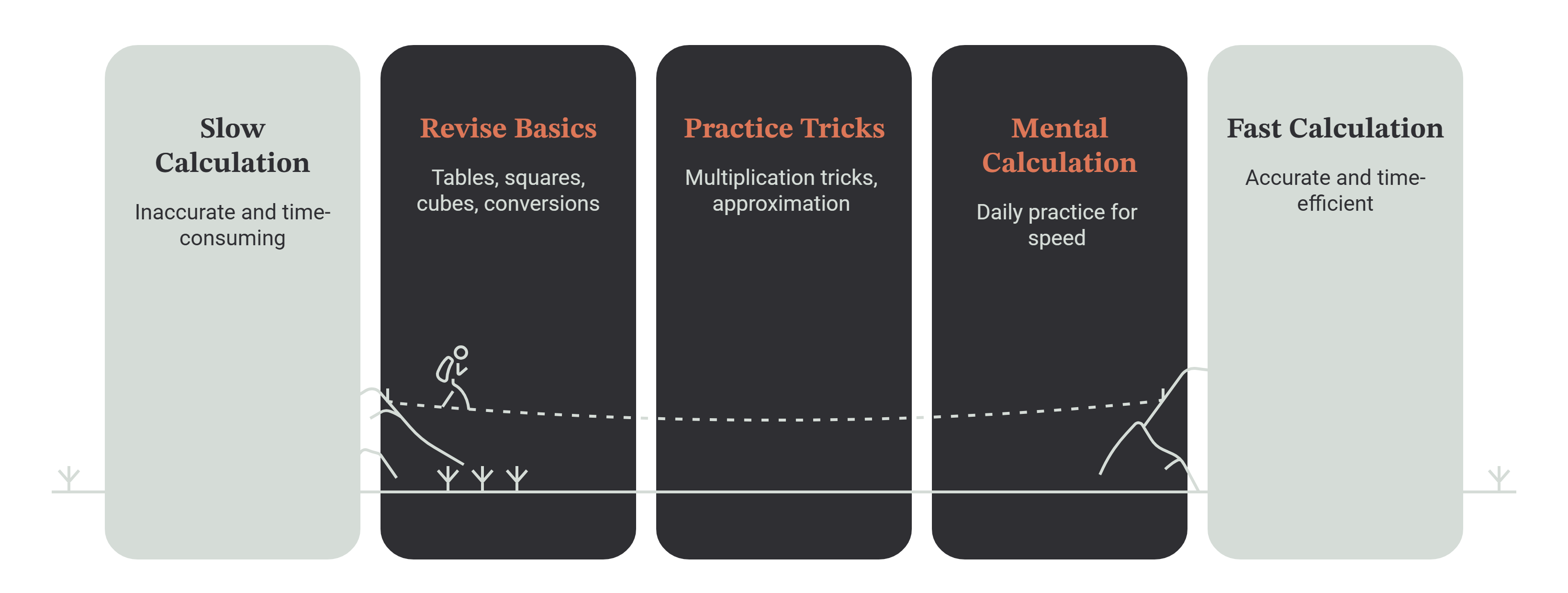
Aptitude speed improves with practice.
To improve calculation speed, revise:
- Tables up to 20
- Squares up to 30
- Cubes up to 15
- Percentage-fraction conversions
- Basic multiplication tricks
- Approximation techniques
| n | n squared | n | n squared | n | n cubed |
|---|---|---|---|---|---|
| 11 | 121 | 21 | 441 | 6 | 216 |
| 12 | 144 | 22 | 484 | 7 | 343 |
| 13 | 169 | 23 | 529 | 8 | 512 |
| 14 | 196 | 24 | 576 | 9 | 729 |
| 15 | 225 | 25 | 625 | 10 | 1000 |
| 16 | 256 | 26 | 676 | 11 | 1331 |
| 17 | 289 | 27 | 729 | 12 | 1728 |
| 18 | 324 | 28 | 784 | 13 | 2197 |
| 19 | 361 | 29 | 841 | 14 | 2744 |
| 20 | 400 | 30 | 900 | 15 | 3375 |
Four calculation tricks that actually pay off
- Squaring a number ending in 5. Multiply the leading part by the next whole number and write 25 after it. For 45: 4 × 5 = 20, so 45
^2= 2025. For 65: 6 × 7 = 42, so 65^2= 4225. - Multiplying by 11. Write the first digit, then the sum of the digits, then the last digit. 43 × 11 → 4, (4+3)=7, 3 → 473. If the middle sum crosses 9, carry: 78 × 11 → 7, (7+8)=15, 8 → carry the 1 into the 7 to get 858.
- Multiplying by 25 or 5. To multiply by 25, multiply by 100 and divide by 4: 68 × 25 = 6,800 ÷ 4 = 1,700. To multiply by 5, multiply by 10 and halve.
- Difference of squares. a
^2− b^2= (a − b) × (a + b). So 52^2− 48^2= 4 × 100 = 400, with no squaring at all.
Also practice mental calculation daily.
But remember, speed without accuracy is dangerous. First focus on correct answers, then improve speed.
Daily Aptitude Practice Plan
If you have 45 minutes daily:
- 10 minutes formula revision
- 25 minutes question practice
- 10 minutes mistake analysis
If you have 60 minutes daily:
- 10 minutes formula revision
- 35 minutes topic-wise practice
- 15 minutes timed test or review
If you are preparing seriously for placements, try to solve at least 20 to 30 aptitude questions daily. You can pick a subject and topic on FREEPARE and run a short set every evening rather than hunting for fresh questions each day.
Mock Test Strategy for Aptitude
Mock tests help you understand your real preparation level.
Start with:
- Topic-wise aptitude tests
- Then sectional aptitude tests
- Then full placement mock tests
After every mock test, check:
- Which topic was weak?
- Which question took too much time?
- Where did I make calculation mistakes?
- Which formulas did I forget?
- Did I skip easy questions?
Do not take mock tests only to check scores. Use them to improve your weak areas. A structured way to run this review loop is described in the guide on how to use mock tests for campus placement preparation.
Common Mistakes to Avoid
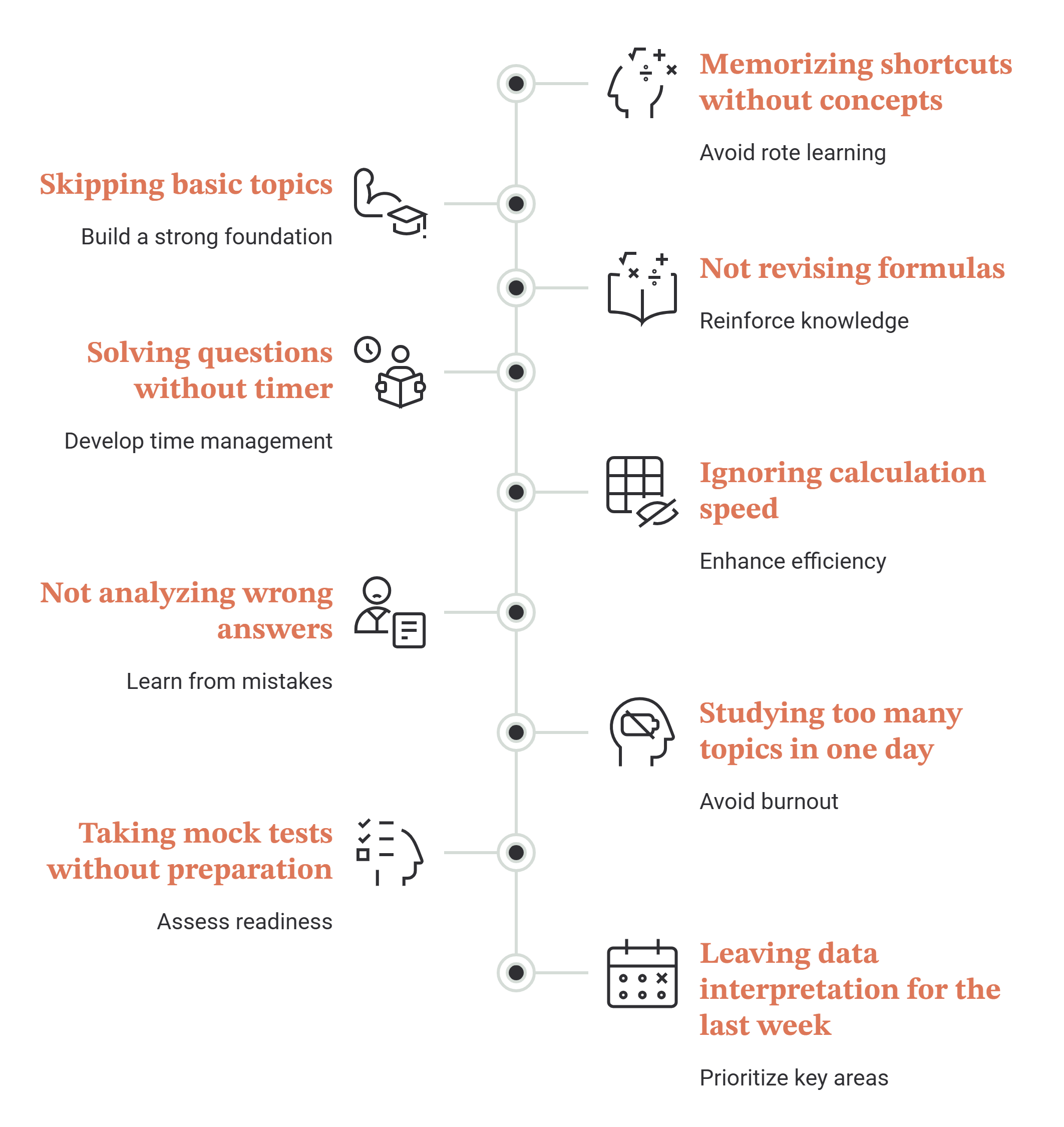
Freshers should avoid these aptitude preparation mistakes:
- Memorizing shortcuts without concepts
- Skipping basic topics
- Not revising formulas
- Solving questions without timer
- Ignoring calculation speed
- Not analyzing wrong answers
- Studying too many topics in one day
- Taking mock tests without preparation
- Leaving data interpretation for the last week
Three specific errors deserve their own warning, because they cost marks even when the method is right:
- Using the wrong base for a percentage. Profit is on cost price, discount is on marked price, and "B is less than A" divides by A, not by B.
- Averaging percentages. Five branch placement rates cannot be averaged to get the overall rate unless the branches are equal in size.
- Adding successive percentages. Two discounts of 20% and 10% are not 30%. They are 28%.
Aptitude improves slowly with regular practice.
Conclusion
Quantitative aptitude is not difficult if you prepare step by step.
Start with basic topics like percentages, averages, ratio, and profit-loss. Then move to number system, time and work, speed-distance, and data interpretation. Maintain a formula notebook, practice daily, and take timed tests.
A strong aptitude score can help you clear the first round of many campus placement exams.
Do not try to finish everything in one day. Build speed and accuracy slowly. Once aptitude feels steady, give the same treatment to the pattern-based section next to it, using the logical reasoning preparation guide.
FAQs
1. Is quantitative aptitude important for campus placements?
Yes. Quantitative aptitude is one of the most common sections in campus placement exams and is often used in the first screening round.
2. Which aptitude topics should I prepare first?
Start with percentages, average, ratio and proportion, profit and loss, and number system.
3. How can I improve my aptitude score?
Revise formulas, practice daily, take timed tests, and analyze mistakes after every mock test.
4. How many aptitude questions should I solve daily?
Freshers should try to solve at least 20 to 30 aptitude questions daily.
5. Is aptitude difficult for placements?
No. Most placement aptitude questions are based on basic maths. They become easier with regular practice.
Tags: campus-placement, freshers-placement-guide, quantitative-aptitude