How to Start Campus Placement Preparation from Zero
By FreePare Team · Mon Jun 15 2026 · 24 min read

Starting campus placement preparation from zero can feel confusing. You may not know whether to begin with aptitude, coding, reasoning, English, resume, or interview preparation.
This happens with many freshers. The good news is that you do not need to prepare everything on the first day. You need two things: an honest picture of where you stand today, and one thing to fix first.
That is what this guide gives you. It is a diagnostic, not a calendar. In the next thirty minutes you can find out which of six areas is actually holding you back, and the rest of the article tells you exactly what to open first depending on that answer. There is no fixed day-by-day schedule here, on purpose: a schedule written around someone else's weak areas spends your evenings on topics you already know.
Which of the two guides is for you? If you have never taken a placement-style test, and you cannot say whether your aptitude is weak or merely slow, stay on this page. If you already have the basics working, can clear a sectional test, can write a small program without help, and your placement season starts in roughly a month, you do not need a diagnostic. You need an execution calendar, so read the 30-day campus placement preparation roadmap for freshers instead, which lays out what to do on each specific day.
What Does Starting from Zero Mean?
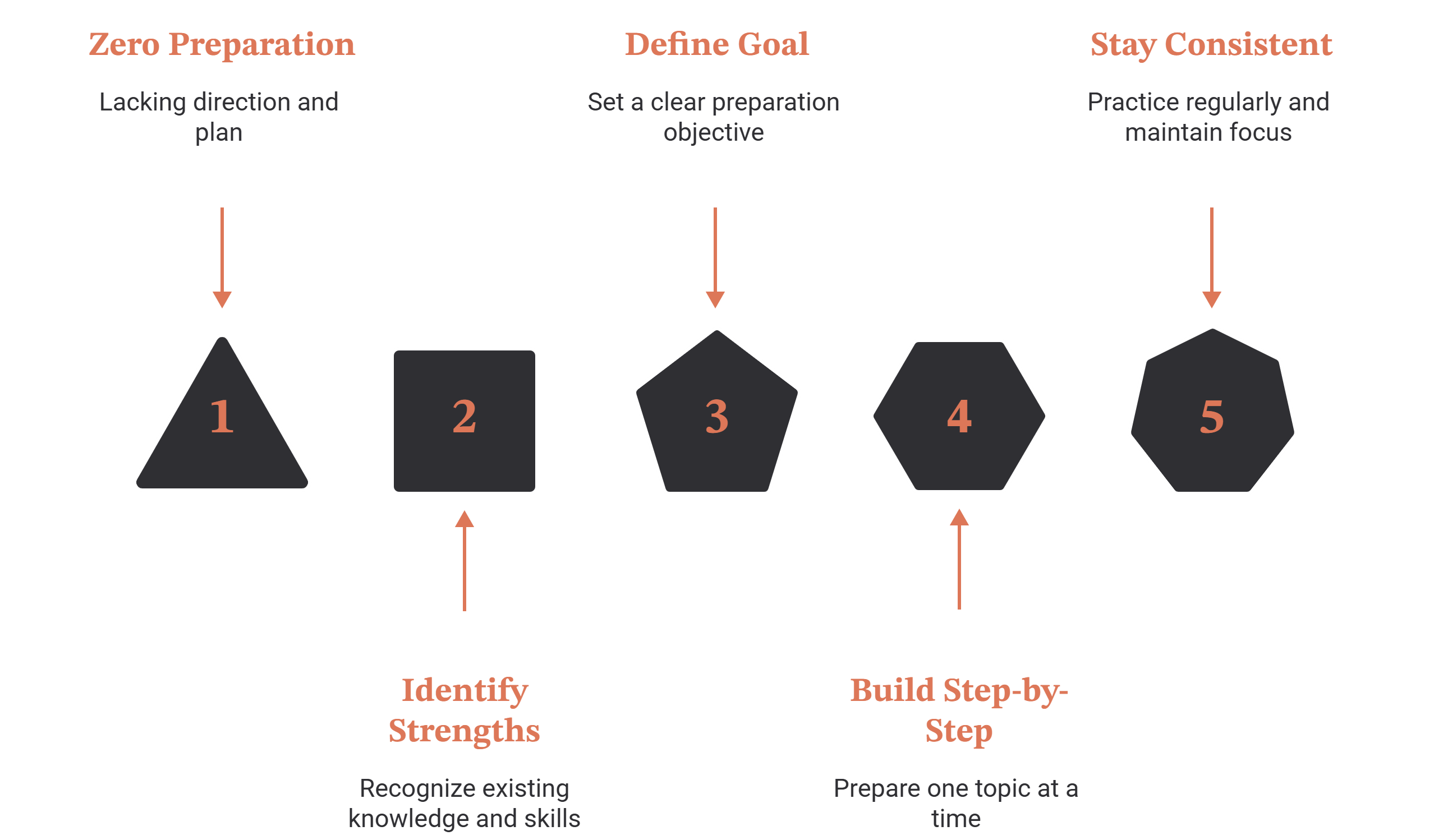
Starting from zero does not mean you are weak. It only means you have not followed a proper preparation plan yet.
You may already know some topics. Maybe you are good at English but weak in aptitude. Maybe you know coding basics but have never taken a placement mock test. Maybe you have projects but do not know how to explain them.
So, zero preparation simply means you need direction. And direction is cheap to get: it costs one honest test sitting, not a month of guessing.
There is a second thing worth naming early. "Zero" is usually not zero across the board. Almost every fresher arrives with an uneven profile, and the whole point of the assessment below is to stop you from treating four strong areas and two weak ones as though they all need the same number of hours.
The areas that campus recruitment actually draws on are these:
- Aptitude
- Logical reasoning
- Verbal ability
- Coding basics
- Resume
- Technical interview
- HR interview
- Mock tests
Do not try to master everything together. Start small, start where the gap is, and stay consistent.
Understand the Campus Placement Process
Before studying, understand how campus placements usually work, because the shape of the process tells you what a wasted hour looks like.
A common sequence of rounds is:
- Aptitude test — usually the first screening filter. It is scored on speed as much as on knowledge, so someone who can solve every question but only at three minutes each is still filtered out.
- Logical reasoning test — often combined into the same paper as aptitude. It rewards a written method more than mental arithmetic.
- Verbal ability test — grammar, comprehension and usage. Often the smallest section, and often the cheapest marks in the paper.
- Coding round — for technical roles. Typically a small number of problems where a partially working solution can still earn partial marks, so submitting something beats submitting nothing.
- Technical interview — your project, your listed skills, and core subjects. It is a conversation, so a memorised answer that collapses under one follow-up question is worse than a short honest one.
- HR interview — fit, communication and motivation.
Some companies also include group discussion, essay writing, a communication round, or technical MCQs. The exact process varies by company and by role, and your placement cell is the only reliable source for what is actually coming to your campus. Ask them rather than assuming.
The practical consequence for a beginner is this: the early rounds are elimination rounds. Nothing you prepare for the interview matters if the aptitude test filters you out first. That is why the assessment below weights the screening areas heavily.
The 30-Minute Self-Assessment
Do this before you study anything. Sit with a blank sheet, a pen and a clock. No calculator, no phone, nothing looked up. Thirty minutes, six checkpoints. Score yourself strictly, because the only person who loses from a generous score is you.
| Area | What to attempt | Pass mark |
|---|---|---|
| Calculation speed (4 min) | Without a calculator: find the LCM of 12, 18 and 24; convert 3/8 into a percentage; find 15 percent of 240; find the average of 12, 17, 19 and 24. | All four correct inside four minutes. |
| Aptitude concepts (5 min) | An item is bought for 800 and sold for 920 — what is the profit percent? One tap fills a tank in 6 hours and another in 12 hours — how long do both take together? A sum doubles in 8 years at simple interest — what is the rate? | At least two correct, with your working written down, inside five minutes. |
| Reasoning (5 min) | Complete the series 3, 7, 15, 31, ? Then: pointing to a man, a woman says "he is the son of my mother's only son" — how is he related to her? Then: walk 4 km north, turn right, walk 3 km — how far are you from the start, and in which direction? | All three correct inside five minutes. |
| Verbal ability (6 min) | Read any 400-word news or opinion article once. Write a one-sentence summary of what it claims. Then find the error in: "Each of the students have submitted their assignment before the deadline." | Your summary states the article's actual claim, not merely its topic, and you found the error. |
| Coding (8 min) | On paper, with no editor and no autocomplete, write a function that takes an array of integers and returns the second largest value. | It runs correctly in your head on [4, 9, 9, 1], on [7, 7], and on an array with one element. |
| Your own story (2 min) | Out loud, with no notes, say what your main project or internship did. | You finish inside 60 seconds and you name the problem it solved, not just the technologies used. |
Two notes on scoring. First, "nearly right" is a fail — in a real test a nearly right answer earns nothing. Second, record how long each checkpoint took even when you passed it, because being correct but slow is a different problem with a different fix, and the table below treats them differently.
What Your Result Tells You to Do First
Find the row that matches your pattern. Start there, and ignore the rest of this article until that gap is closed.
| Your result | What it actually means | What to do first |
|---|---|---|
| Failed the calculation checkpoint | Your bottleneck is arithmetic speed, not concepts. Topic study will not fix it and will feel unproductive until it is fixed. | Ten days of drills before any topic: tables up to 20, squares to 30, cubes to 15, and the fraction-to-percent values from 1/2 down to 1/12. Fifteen minutes a day, written and timed. Then start Step 1. |
| Passed calculation, failed aptitude concepts | You can compute but you do not yet know the standard question models. This is the most common beginner profile and the fastest to fix. | Go to Step 1 and work topic by topic in the order given there. Do not skip ahead to mock tests. |
| Passed aptitude, failed reasoning | Almost always a method problem rather than an ability problem. Reasoning punishes people who try to hold the puzzle in their head. | Go to Step 2. The single change that matters is writing a diagram or table for every question, including the easy ones. |
| Failed only verbal | Usually reading speed and grammar rules, not vocabulary. Ignore anyone who tells you to memorise word lists first. | Go to Step 3. Start with comprehension and the six grammar rules named there, not with vocabulary. |
| Failed only coding | If you could not start at all, it is a language-fluency gap. If you started but produced a broken solution, it is a testing-habit gap. | Go to Step 4. Fluency gap: write ten tiny programs from scratch before touching problems. Testing gap: dry-run every program on an empty input, a single-element input and an input with duplicates before calling it done. |
| Failed only the story checkpoint | Your preparation is fine and your presentation is not. This costs offers late in the process, where they are most expensive to lose. | Go to Step 6 now rather than in your final month, and write the project answer down before you rehearse it. |
| Passed everything, or failed only on time | You are not starting from zero. You are starting from unpractised. | You need volume and a calendar, not a diagnostic. Move to the 30-day roadmap linked at the top of this page. |
If you failed three or more checkpoints, do not try to repair them in parallel. Take the earliest one in the table, fix it, and re-run only that checkpoint two weeks later.
Step 1: Start with Aptitude Basics
Aptitude is usually one of the first screening rounds in campus placements, which makes it the highest-value area for a beginner even when it is not the most interesting one.
Start with easy and common topics, in this order, because each one reuses the last:
- Percentages
- Average
- Ratio and proportion
- Profit and loss
- Simple interest and compound interest
- Time and work
- Time, speed and distance
- Number system
The order is not arbitrary. Percentages sit underneath profit and loss, interest, and most data interpretation. Ratio sits underneath time and work, and underneath speed. Learning them in this order means each new topic costs you less than the one before. Learning them in a random order means learning percentages four times.
Do not start with difficult questions immediately. First understand the concept, then solve basic questions, then move to medium-level questions, and only then add a timer. Adding the timer too early teaches you to guess.
For the underlying method on each of these topics, work through the quantitative aptitude preparation guide for campus placements alongside this step.
How to Study Aptitude as a Beginner
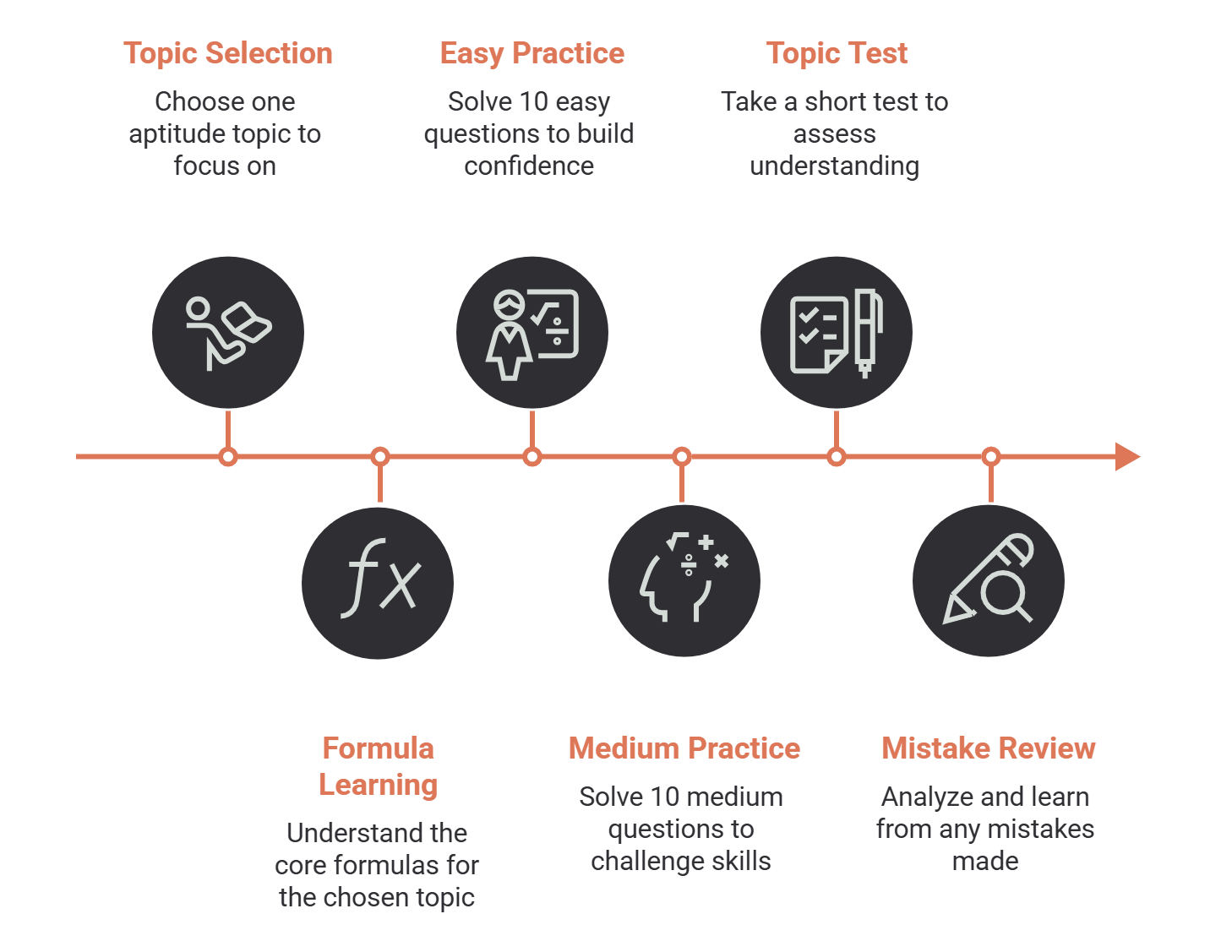
One topic per session. Six steps, roughly 45 minutes:
- Pick one topic — one only, even if that feels slow.
- Learn the formula, and derive it once. Write down where it comes from. A formula you have derived once survives exam pressure; a formula you have only copied does not.
- Solve 10 easy questions untimed, writing every step.
- Solve 10 medium questions, still untimed. Mark any question that took more than three minutes.
- Take one short topic test of 10 to 15 questions with a clock running.
- Review your mistakes by cause, not by question.
That last step is the one beginners skip, and it is the one that makes the difference. Every wrong answer belongs in one of four buckets: I did not know the concept, I knew it and slipped in the arithmetic, I misread the question, or I ran out of time. Write the bucket next to each error.
The four causes have four different fixes. A concept gap means going back to the theory. A calculation slip means drills, not theory. A misread means slowing down on the first read of the question, which is almost free. Running out of time means more volume at the same difficulty, not harder questions. If you never label the cause, you will apply the wrong fix and then conclude that practice does not work.
Keep this log in one notebook or one file from day one. By the time you reach mock tests it is the most useful document you own.
Step 2: Practice Logical Reasoning
Logical reasoning improves with practice. You cannot become good at reasoning only by reading theory, because there is very little theory to read — what you are building is a set of recognisable patterns and the habit of writing things down.
Start with these topics:
- Number series
- Alphabet series
- Coding-decoding
- Blood relation
- Direction sense
- Syllogism
- Seating arrangement
- Puzzles
The first five are quick wins: a few days each, and they appear reliably. Syllogism, seating arrangement and puzzles take longer and carry more questions per set, so treat them as the second half of this step rather than the start of it.
Try to solve at least 15 to 20 reasoning questions daily. Consistency matters more here than volume in any one sitting, because pattern recognition decays quickly when you stop.
The detailed treatment of each pattern is in the logical reasoning preparation guide for campus placements.
Reasoning Preparation Tips
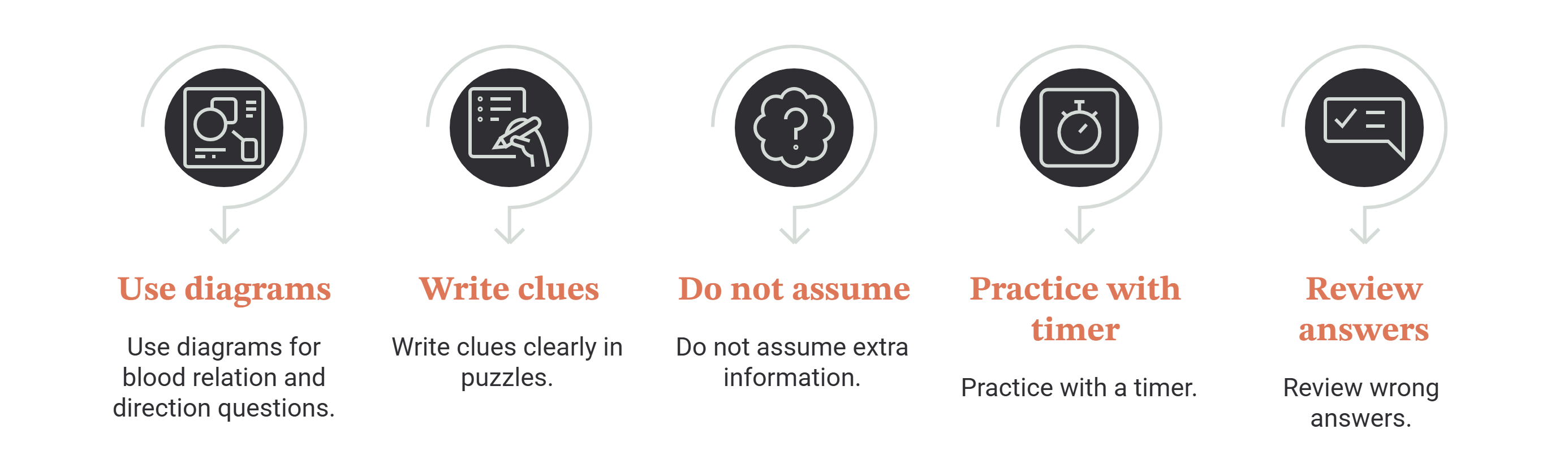
- Use diagrams for blood relation and direction questions every time, including on questions you think are easy. The habit has to be automatic before it helps you under time pressure.
- Write clues clearly in puzzles using a fixed notation of your own. Decide once how you will mark a confirmed placement and how you will mark an eliminated one, then never change it.
- Do not assume extra information. Most wrong syllogism answers come from importing real-world knowledge into a question that gave you only two statements.
- Practise with a timer, but only once you can solve that type correctly untimed.
- Review wrong answers by re-solving them cold two days later, not by reading the explanation and nodding at it.
At first, reasoning may feel tricky. After regular practice you start recognising patterns faster, and that recognition is most of the speed.
Step 3: Improve Verbal Ability
Many freshers ignore verbal ability because they think aptitude and coding are more important.
This is a mistake, and an expensive one. Verbal ability is tested in written rounds and used in interviews, group discussions and ordinary professional communication. It is also, for most students, the cheapest section to improve, because the rules are finite and the same handful of errors is tested again and again.
Important topics include:
- Reading comprehension
- Error spotting
- Sentence correction
- Fill in the blanks
- Jumbles
- Grammar
- Vocabulary
If you are short of time, six grammar rules cover a large share of error-spotting and sentence-correction questions: subject-verb agreement, tense consistency, pronoun agreement, article usage, preposition usage, and modifier placement. Learn those six properly before touching anything else.
Verbal Ability Preparation Tips
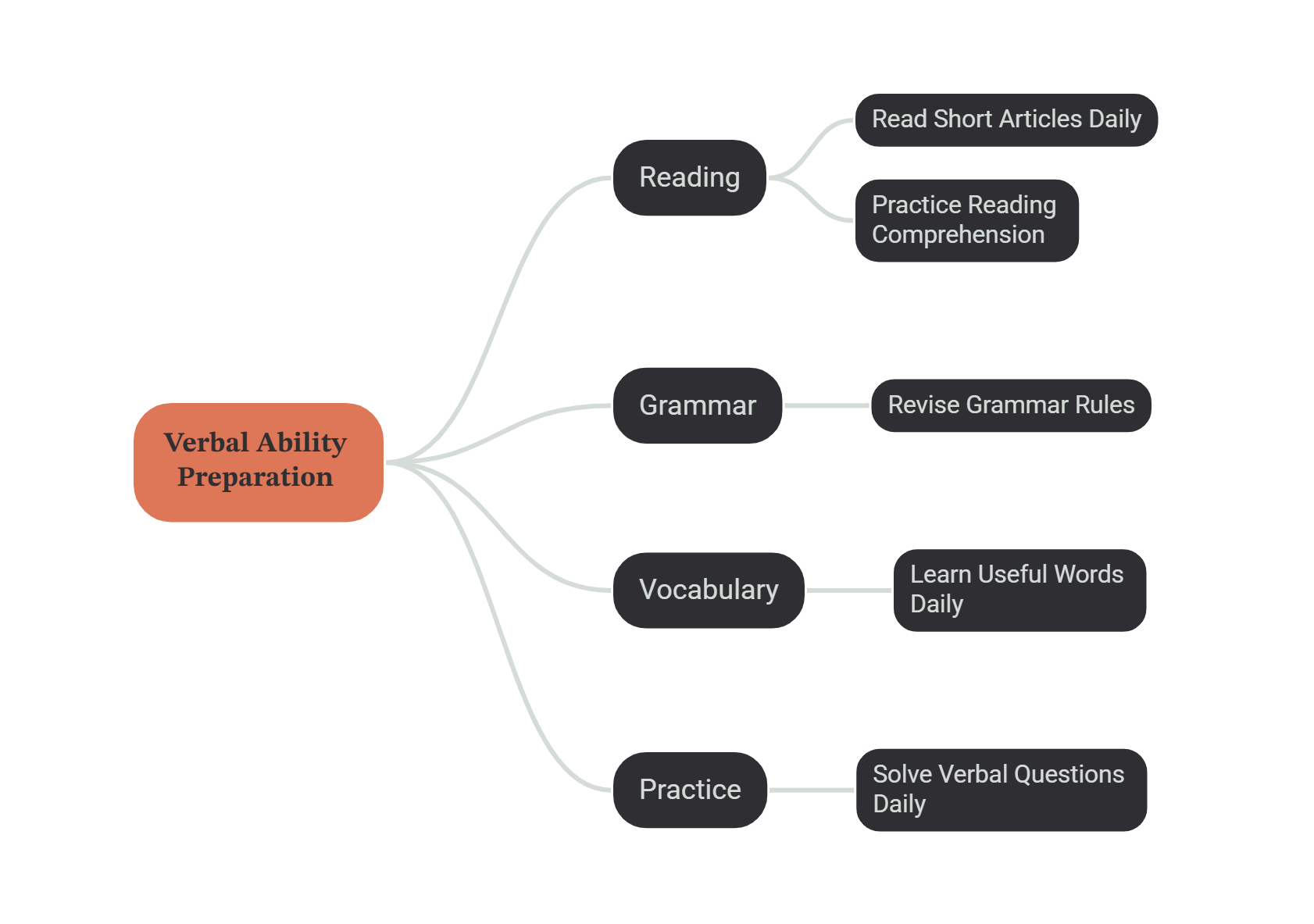
- Read one short article daily, and write a one-sentence summary of what it claims. The summary is the exercise; the reading alone does very little.
- Revise grammar rules one at a time, and after each rule solve questions that target only that rule.
- Solve 10 verbal questions daily.
- Learn 5 useful words daily, always recorded with the sentence you met them in. Words learned inside a sentence survive; words learned from a list do not.
- Practise reading comprehension by answering from the passage only. If you cannot point to the line that supports your answer, it is a guess.
You do not need to memorise difficult words. Focus on understanding sentences, grammar and meaning.
Step 4: Start Coding with One Language
If you are preparing for technical roles, coding is important.
But many beginners make one mistake: they try to learn several languages at once. Do not do that. Choose one language and stay with it for the whole of your preparation:
- C
- C++
- Java
- Python
Any of the four is normally acceptable in a campus coding round. Pick the one your college already taught you, because switching costs weeks and buys you nothing at this level.
Then become comfortable with the basics, in this order:
- Input and output
- Variables
- Conditions
- Loops
- Functions
- Arrays
- Strings
- Searching
- Sorting
- Recursion basics
A concrete target for a beginner: be able to write, from a blank file and without help, programs that reverse a number, check whether a number is prime, find the largest and second largest element of an array, reverse a string, count vowels, and count the frequency of each element. If you can write all six without looking anything up, your basics are in place and you are ready for problems rather than exercises.
The coding round preparation guide for freshers covers what the round itself looks like once you are past that point.
Coding Preparation Tips
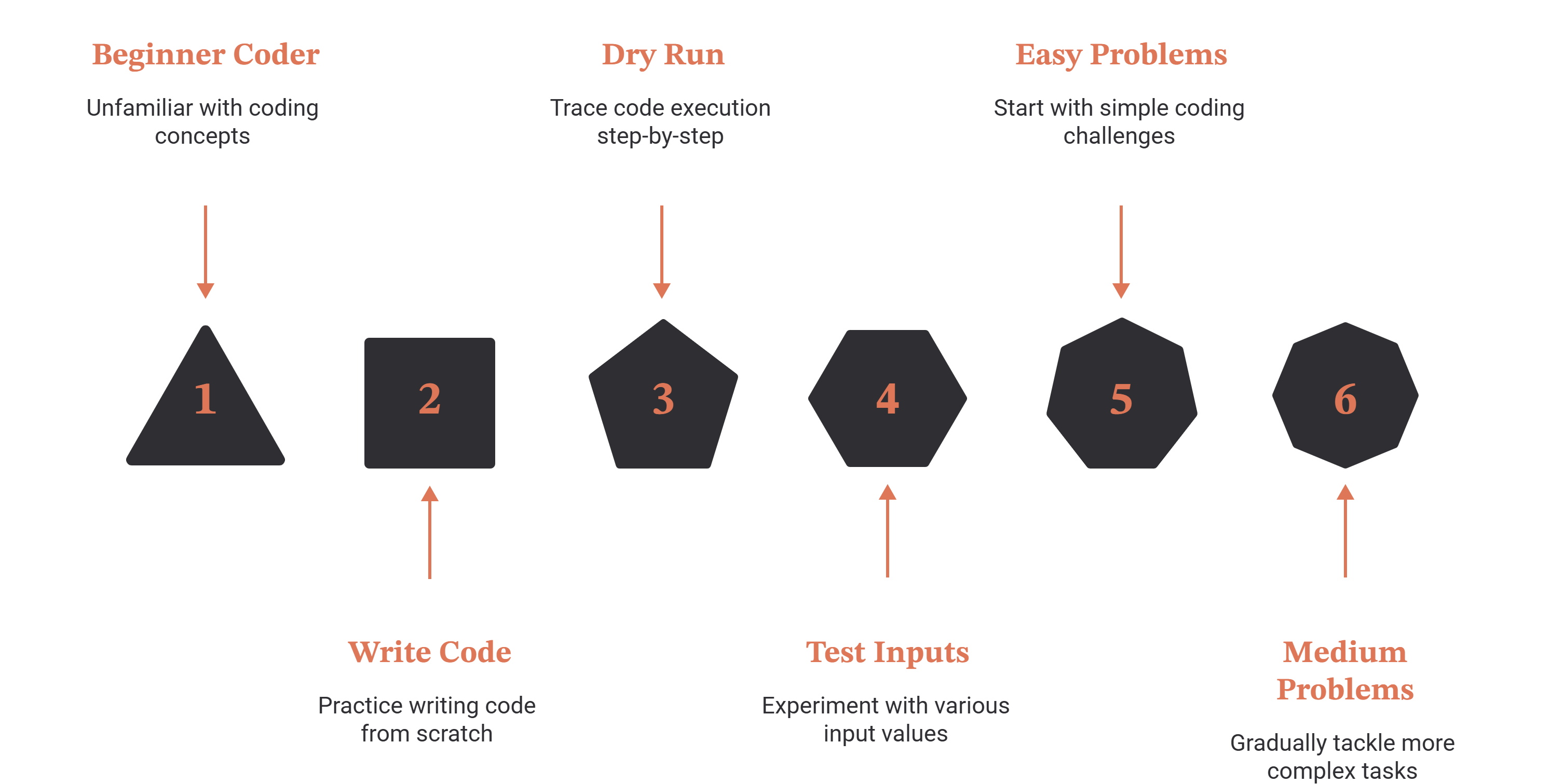
- Write code yourself. Reading a solution and understanding it is not the same skill as producing one.
- Do not copy solutions directly. If you are stuck, read only until you have the idea, then close the page and write it from memory.
- Dry run your code on paper before running it, tracing the value of every variable through at least two iterations.
- Test different inputs — specifically the three that break most beginner code: an empty input, a single-element input, and an input containing duplicates.
- Start with easy problems and move slowly to medium ones.
For beginners, strong basics beat advanced data structures and algorithms. A candidate who writes a clean, working, well-tested solution to a simple problem does better in a coding round than one who half-remembers an advanced technique.
Step 5: Take Topic-Wise Tests
Do not go straight to full-length mock tests if your basics are weak. A full mock taken too early tells you only that you are weak everywhere, which you already know, and it costs you two hours to learn it.
Take topic-wise tests first. Browse the practice tests by subject and topic and pick the exact topic you studied that day — percentages, blood relations, reading comprehension, arrays, profit and loss, syllogism, and so on.
Topic-wise tests tell you something a mock cannot: whether the specific thing you studied this week actually went in. Use a simple rule for what to do with the result. Below roughly 60 percent, the concept has not landed and you should re-study the theory before doing more questions. Between 60 and 80 percent, the concept is there and what you need is volume. Above 80 percent, move on and schedule a revisit two weeks later rather than grinding the topic further.
Set those thresholds before you take the test, not after. Deciding afterwards is how people talk themselves into leaving a topic they have not actually learned.
Step 6: Prepare Your Resume
Do not wait until the company arrives to prepare your resume. Writing it early does something more useful than producing a document: it shows you which projects and skills you cannot yet talk about, while there is still time to fix that.
Your fresher resume should include:
- Name and contact details
- Education
- Skills
- Projects
- Internships
- Certifications
- Achievements
- LinkedIn or GitHub profile
Keep it to one page and keep it honest. Apply one test to every line: could you answer three follow-up questions about this? If not, either learn it or delete it. If you write Java, SQL, Python, React or DBMS, expect to be asked from it, and expect the interviewer to go one level deeper than the answer you give.
For each project, be able to state in one sentence each: what problem it solves, what you personally built, which technology you chose and why, and what broke along the way. That last one is asked more often than students expect, and "nothing went wrong" is not a believable answer.
Step 7: Start Mock Tests
Once your basics are clear, start taking mock tests under real conditions: full duration, one sitting, phone away, no pausing to look anything up.
Mock tests build:
- Speed
- Accuracy
- Time management
- Question selection
- Exam confidence
- Weak area identification
Of those, question selection is the one that stays invisible until you practise it. In a timed paper, knowing which question to leave alone is worth as much as knowing how to solve it. A workable rule for beginners: if you have not found the method within about 30 seconds, mark it and move on, and return only if time remains.
Mock tests are useful only when you analyse them, and the analysis takes longer than most people expect — budget roughly the length of the test itself. After each one, check:
- Which topics were weak?
- Which questions took too much time?
- Where did I make silly mistakes?
- Did I guess too much?
- What should I revise next?
Then reduce all of that to one decision: the two topics you will repair before the next mock. Two, not six. A list of six repairs never gets done, and an undone list quietly teaches you to ignore your own analysis.
Your First Week
This is the only fixed schedule in this guide, and it exists because the first week is where most beginners stall. After it, your own assessment result decides what you study; the shape of the week stays the same.
| Day | Time | What to open first | Finish the session with |
|---|---|---|---|
| Day 1 | 1 hour | Blank paper and a clock. Take the 30-minute self-assessment, score it strictly, then read the decision table and write your first action at the top of a fresh page. | One sentence: "My first job is ___." Nothing else. |
| Day 2 | 1 hour 30 min | Whatever your decision-table row named. If it named percentages, learn the concept and derive the formulas before solving anything. | 10 easy questions, untimed, every step written out. |
| Day 3 | 1 hour 30 min | The same topic as Day 2 — do not move on yet. Medium-level questions this time. | A 10-question topic test against a clock, then label every error by cause. |
| Day 4 | 2 hours | Second aptitude topic (averages, if you are following the Step 1 order), then 20 minutes of reasoning: number series only. | 10 series questions, and one Day 3 error re-solved cold. |
| Day 5 | 2 hours | Third aptitude topic, then reasoning: blood relations, with a diagram drawn for every question. | 15 reasoning questions, and 5 vocabulary words with the sentences you met them in. |
| Day 6 | 2 hours | Verbal: one 400-word article and a one-sentence summary, then subject-verb agreement and tense consistency. | 15 grammar questions targeting only those two rules. |
| Day 7 | 1 hour 30 min | No new topic. Open your error log and read it end to end. | One topic-wise test on your Day 2 topic, then the weekly decision: the two things you repair next week. |
That is around eleven hours for the week. It is deliberately below what you could manage, because a first week you comfortably complete is worth far more than an ambitious one you abandon on Day 3.
If you are also weak in coding, do not add it to this week. Add it from week two, in the 30-minute slot below. Starting aptitude and coding in the same week is the most common way beginners lose both.
Beginner Weekly Study Plan
From week two onward, repeat this shape. The topics change; the shape does not.
Monday to Friday
- 40 minutes aptitude — one topic per session, never two
- 30 minutes reasoning — one pattern, with diagrams
- 20 minutes verbal ability — one grammar rule, or one passage
- 30 minutes coding or technical basics — writing code, not reading it
Saturday
- Take topic-wise tests on everything you studied that week
- Revise the weak areas those tests exposed
- Update your notes and your formula cards
Sunday
- Take one mini mock test
- Analyse the mistakes by cause, and pick two repairs for next week
- Spend the remaining time on your resume or your interview answers
Two hours on weekdays is enough for a beginner, provided it is genuinely two focused hours. Four distracted hours are worth less than two undistracted ones, and the difference shows up first in the timed sections.
How to Build the Habit
Most preparation fails on consistency, not on content. Four rules make it survivable:
- Fix the slot, not the duration. Choose one specific time — after your last class, or before dinner — and defend it. A slot that moves around the day is a slot you will eventually skip, because it always competes with something else.
- One topic per session. Switching topics mid-session feels productive and is not. You will remember one topic studied for forty minutes far better than four topics studied for ten.
- End every session with something timed. Ten questions against a clock is enough. It turns passive study into a measurement, and it means you never finish a session without knowing whether it worked.
- Keep one error log, permanently. One notebook or one file, every mistake, each labelled with its cause. It is the only record that shows you improving, and on the days when preparation feels pointless it is the evidence that it is not.
Add one more rule for the days when it falls apart: if you miss a day, do not repay it. Do not study four hours the next day to make up for zero. Take the next session at its normal time and its normal length. Missing one day costs almost nothing; abandoning the plan because you have fallen behind costs everything, and the doubled-up catch-up session is usually what triggers the abandonment.
Once this rhythm holds for three or four weeks, you have what the other article assumes you have. That is the point at which the 30-day roadmap becomes useful to you rather than overwhelming.
Common Mistakes to Avoid
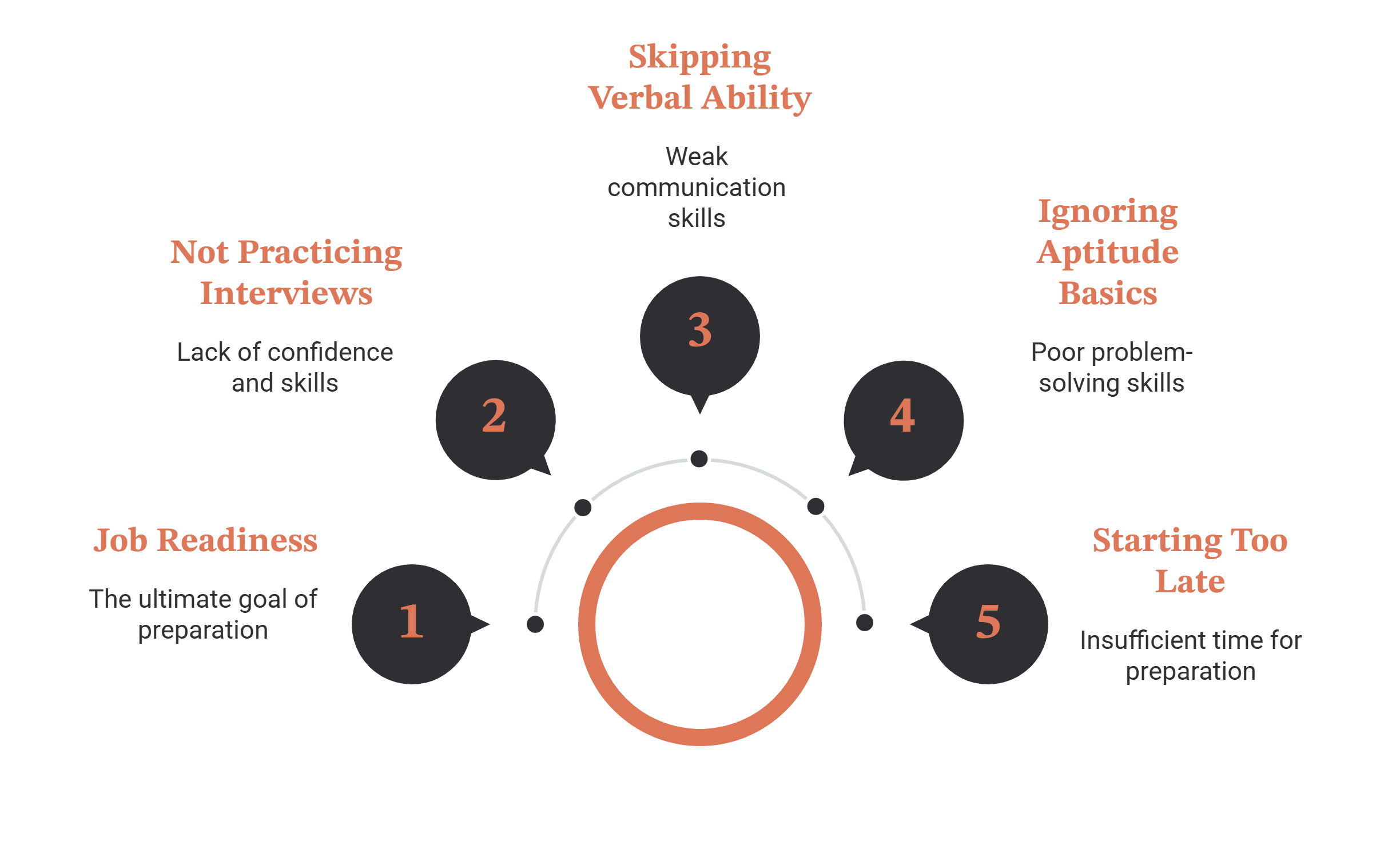
Freshers should avoid these mistakes:
- Starting too late — specifically, starting after the placement calendar is announced rather than before it.
- Studying without a plan, solving whatever question appears next from whatever source is open.
- Ignoring aptitude basics because they feel less interesting than coding.
- Skipping verbal ability, which is usually the cheapest section to improve.
- Learning too many programming languages instead of becoming fluent in one.
- Taking mock tests without analysis, which turns a diagnostic into a scoreboard.
- Preparing the resume at the last moment, when it is too late to fix what writing it reveals.
- Writing skills you cannot defend. One collapsed follow-up question costs more than the line ever gained.
- Not practising interview answers out loud. An answer rehearsed silently is not rehearsed.
- Comparing with others, especially on hours studied rather than on errors fixed.
Campus placement preparation is not about studying everything in one day. It is about consistent improvement that you can actually measure.
Conclusion
Starting campus placement preparation from zero is possible, and it is mostly a sequencing problem rather than an ability problem.
Take the thirty-minute assessment today. Read your row in the decision table. Do that one thing for a week before you consider anything else. Then add reasoning and verbal, add coding once the aptitude habit holds, take topic-wise tests to confirm that each week actually landed, write your resume early enough that it can still change what you prepare, and only then start full mock tests.
Do not wait for the final semester or for the company announcement. Start with one assessment, one topic and one test today. When your basics hold and the season is a month away, switch to the day-by-day roadmap and execute it.
FAQs
1. Can I start campus placement preparation from zero?
Yes. Start by finding out where you actually stand — the thirty-minute assessment above does that — then fix one area at a time instead of all of them at once. How long it takes depends on which areas are weak and how many hours you can genuinely give each week, so no honest guide can promise you a fixed number of weeks or a particular outcome.
2. What should I study first for campus placements?
Whichever checkpoint you failed earliest in the assessment table. For most beginners that is calculation speed or aptitude concepts, because aptitude is usually the first elimination round. If you have not tested yourself yet, start with percentages, since ratio, profit and loss, interest and data interpretation all build on it.
3. How many hours should I study daily?
Two focused hours daily is enough for a beginner if it is regular and structured — roughly 40 minutes aptitude, 30 reasoning, 20 verbal and 30 coding. In your first week, aim lower than you think you can manage. A week you complete is worth more than a week you abandon.
4. Is coding necessary for campus placements?
It is necessary for technical roles and usually not for others. For non-technical roles, aptitude, reasoning, communication and domain knowledge matter more. If you do need it, one language and the ten basics listed in Step 4 take you further than a wide, shallow tour of several languages.
5. When should I start mock tests?
Take topic-wise tests from your first week, since they check whether that week's study actually worked. Start full-length mocks only once you can score above roughly 60 percent on topic tests across most of the aptitude topics in Step 1. Before that point, a full mock mostly measures how much you have not studied yet.
Tags: campus-placement, freshers-placement-guide, placement-roadmap