Daily Study Routine That Actually Works
By FreePare Team · Fri Jul 03 2026 · 8 min read
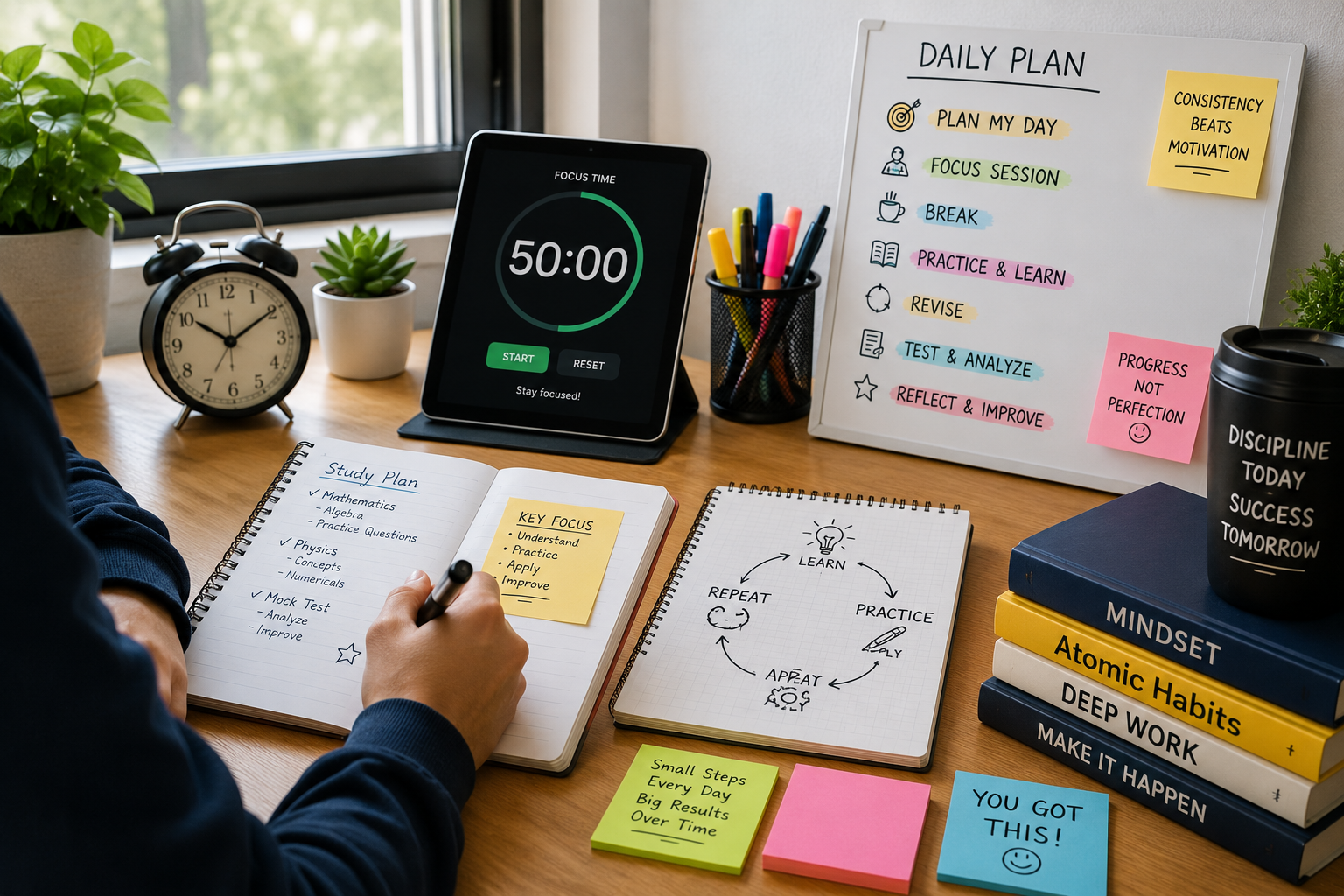
A good study routine is not a heroic timetable.
It is a system you can still follow on an ordinary Tuesday when you are tired, mildly distracted, and not feeling remotely inspired. Most timetables fail not because the student is lazy but because the timetable was built for somebody who does not exist — somebody with no commute, no surprise assignment, and no bad nights.
This article builds one the other way round: starting from a real week with real constraints, and ending with a routine that survives it. There is a worked construction in the middle, for a student with a three-hour daily commute, because that is the case where "just study more" is most obviously useless.
Start with the fixed parts of your life, not the subjects
Do not begin with a subject list. Begin with anchors: the things that already happen on most days and that you do not control. Classes, commute, work shift, meals, family responsibilities, the time you actually fall asleep.
Write down three things before anything else:
- when your day reliably starts, not when you wish it started;
- the hour of the day you are most alert;
- the one or two windows that are genuinely free on most weekdays.
If your only reliable weekday window is 7.00 to 8.15 pm, that is your routine. A 75-minute block you actually use beats a four-hour plan you never start, and it beats it every single week.
Building one, for a student with a three-hour commute
Here is the construction on a hard case. Priya is in her third year, has classes from 9.00 to 4.00, and travels ninety minutes each way by bus.
Step 1 — the anchors. Leaves at 7.30, on the bus until 9.00, classes until 4.00, on the bus until 5.30, home and free from 6.30, dinner at 8.30, asleep by 11.30. Written out like that, the free time is obvious and so is its shape: two 90-minute bus journeys and roughly two hours in the evening.
Step 2 — match the work to the quality of the window, not just its length. This is the step that gets skipped, and it is the reason commuters conclude they have no study time. Three hours a day on a bus is not three hours of study time, but it is not zero either.
| Window | Conditions | What fits |
|---|---|---|
| Bus, 7.30 to 9.00 | Noisy, seated, phone in hand, alert | Recall from flashcards, reading a worked example, listening to a recorded explanation |
| Bus, 4.00 to 5.30 | Noisy, tired | Re-testing this morning's cards, planning the evening block |
| Evening, 6.30 to 8.30 | Quiet, desk, moderately alert | The real block: new material, practice questions, error review |
| Saturday morning | Quiet, fresh, unhurried | Depth: a full topic, a timed set, the weekly review |
Step 3 — write the block, not the subject. Priya's weekday evening is one block with one job, decided the night before: solve twelve time-and-work questions and name the cause of every wrong one. Not "do aptitude", which is not a job and will be answered by re-reading.
Step 4 — the minimum version, written down now. On a bad day: fifteen minutes of flashcards on the evening bus and one line naming tomorrow's first task. That is the whole rescue routine, and having it decided in advance is what stops a bad Tuesday from becoming a bad fortnight.
Add it up. Priya has roughly ten focused hours in a normal week without waking up earlier or sleeping less, and about four of them are on a bus that she previously counted as lost. Nothing about her constraints changed.
Choose your minimum routine before your full one
Most students plan the ideal day and never plan the bad one, which is backwards: the bad days are the ones that decide whether a routine survives.
Decide yours now, in one line, small enough to be almost embarrassing:
- School student: twenty minutes reviewing today's classes, plus tomorrow's priorities written down.
- College student: twenty-five minutes of closed-book recall, plus ten minutes planning.
- Working student: fifteen minutes of flashcards and a calendar check.
A routine with a low-friction fallback restarts after a rough week. One without a fallback ends there, and the ending is always described afterwards as a motivation problem when it was a design problem.
Blocks built around attention
Most students do not need longer sessions. They need clearer ones.
If you are easily distracted, start with 25 minutes of focus and a 5-minute break. If your focus is already decent, 60 to 90 minutes of deep work followed by a proper break away from the screen works better. Either way the rule is one block, one job — not "study chemistry and maybe reply to messages and also tidy my notes".
Inside the block, the shape that works is the same everywhere:
- First two minutes: write the exact goal for this block.
- The middle: twenty to sixty minutes of active work — retrieval from memory, practice questions, past papers, or explaining the topic aloud.
- Last five to ten minutes: check mistakes, name the cause of each, and schedule the next review.
Active is the load-bearing word. A block spent re-reading can run for weeks and return very little, which is not an opinion — it is what the audit in studying smarter without adding hours measures directly.
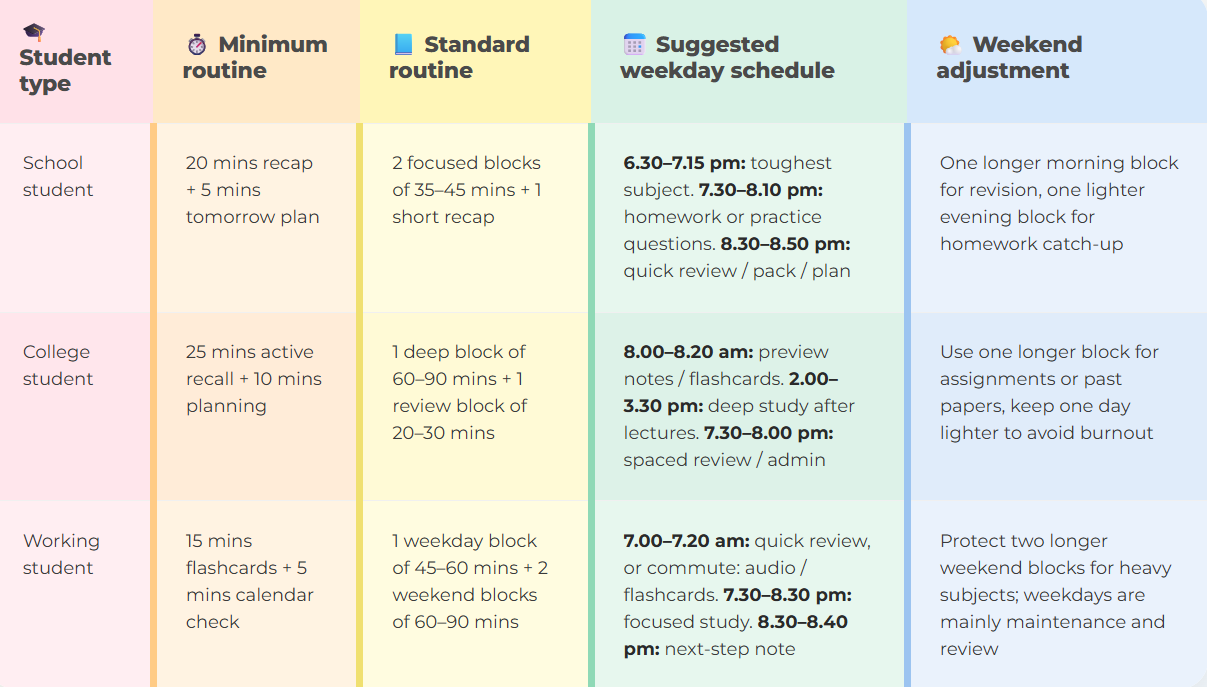
One rule covers all three: if weekday time is short, use weekdays for maintenance and momentum, and weekends for depth.
Sleep is part of the routine, not the reward for it
Students treat sleep as optional admin, and it is the one input that quietly degrades every other one. The US Centers for Disease Control and Prevention recommends 8 to 10 hours for teenagers aged 13 to 17 and at least 7 for adults, and links adequate sleep to attention and memory.
The practical version: pick a wind-down time and a wake time and keep them roughly constant, including at weekends. A routine that depends on erratic hours and late cramming is not a routine, it is damage control — and it borrows from exactly the attention and memory the studying was meant to build.
Review it weekly, and unemotionally
Once a week, ten minutes, four questions:
- Which blocks actually happened?
- Which ones kept getting skipped?
- Was the cause timing, energy, difficulty, or distraction?
- What is the one change for next week?
Notice what is not being asked. Not why am I like this — that question has never once produced a schedule change. The skipped blocks are data about the design: a block skipped four times is in the wrong slot, and moving it is a five-second decision once you have written it down.
Making it easier to start
Motivation is pleasant when it arrives and is a poor foundation. What helps more is lowering the cost of starting.
Reduce friction: books in one place, tomorrow's task written tonight, the document open before you stop for the day, the same desk when possible. Attach the block to a cue that already exists — after tea, after the last lecture, after dinner and before the phone. And protect the first five minutes, which are almost always the hard ones: tell yourself it is ten minutes, and start.
If you miss a day, do not restart on Monday. Restart at the next available slot, using the recovery rule:
- Missed one day — do the minimum version tomorrow.
- Missed two days — halve the routine and restart it.
- Missed a week — rebuild from the minimum version, not the full one.
One missed day is normal. Missing four because one wobble became a personal drama is the actual failure, and the recovery rule exists to make that decision for you in advance.
Common pitfalls and quick fixes
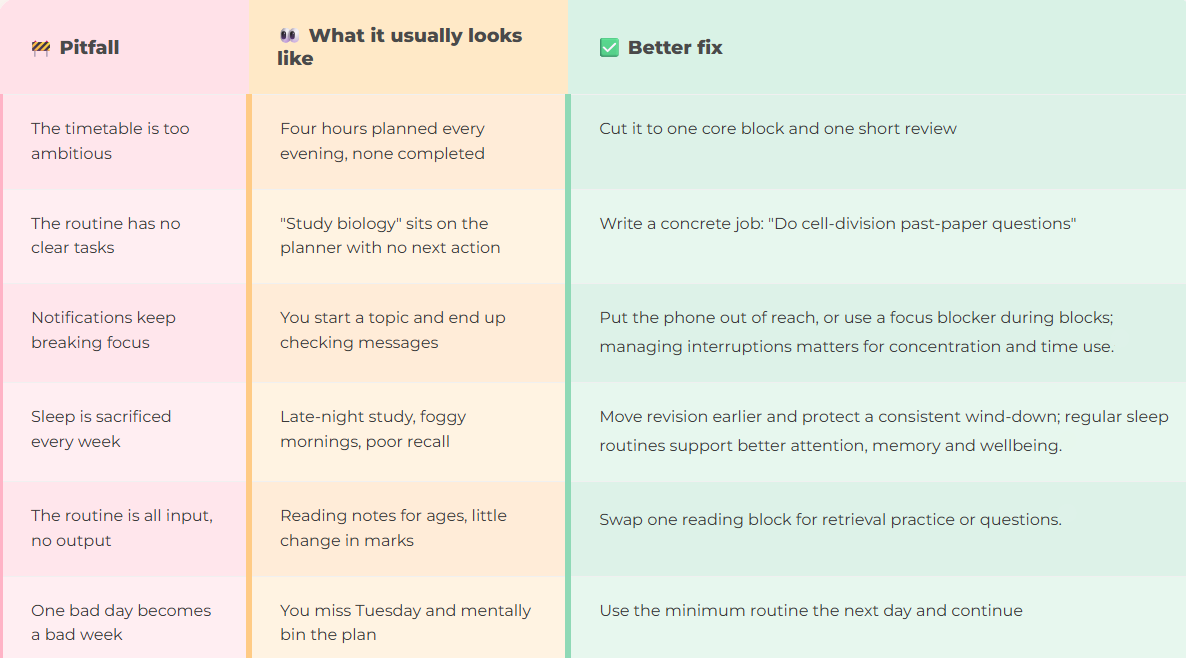
Your starter week
If you have no routine at all, do not build the whole machine. Build the frame and prove it holds.
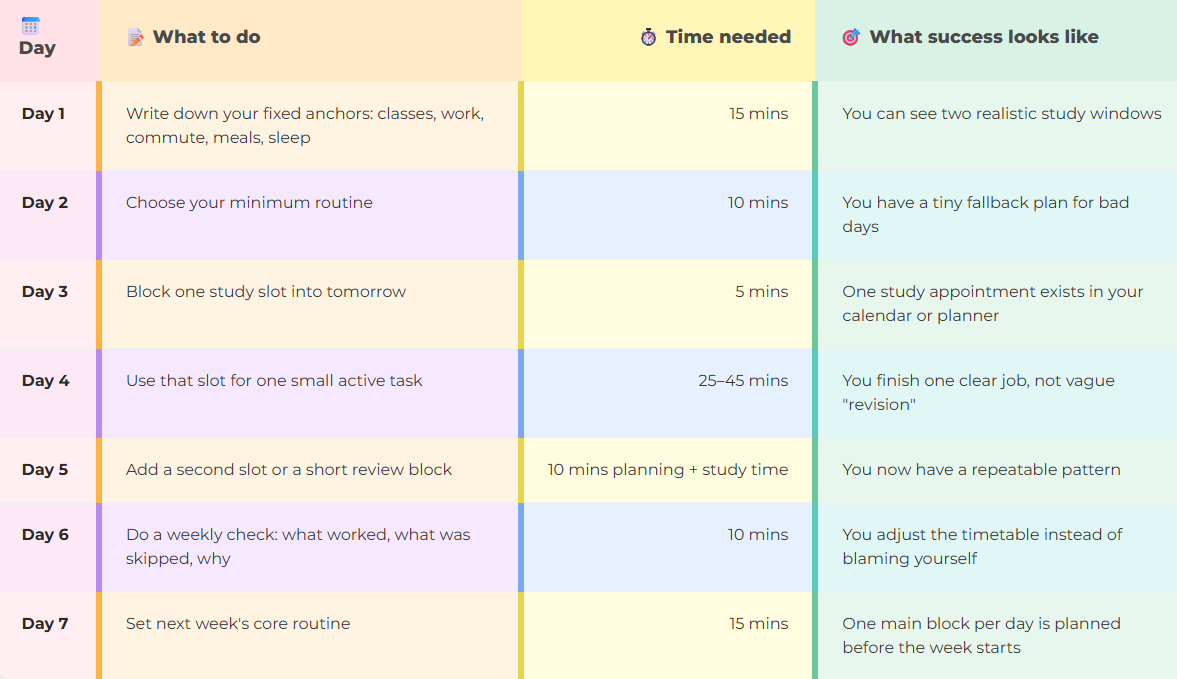
By Sunday the target is not perfection. It is evidence: that you can show up at a fixed time, do one small active thing, and come back the next day.
Tools, and how few you need
Keep the stack boring. A calendar is for time blocks. A list is for specific tasks. A timer is for protecting attention. A flashcard app is for spaced review of facts and formulas. Four jobs, and you probably do not need four apps to do them.
Paper is a completely reasonable answer to all of this: a weekly planner, one notebook, index cards, a kitchen timer. The tool has never been the constraint. If you want the longer argument about giving every tool one job instead of collecting them, it is in building a student learning system.
Then a short checklist, used once a week rather than admired:
- I know my fixed study windows for weekdays.
- I have a minimum routine written down for bad days.
- Each block has a start time, a finish time, and one job.
- At least one method inside the block is active, not reading.
- My phone is out of reach during focus time.
- I have a regular wind-down and wake time.
- I review the routine once a week and change one thing.
Start with the anchors tonight. Fifteen minutes, on paper. Everything above is built on that one list, and it is the step most people skip on the way to designing a timetable for somebody they are not.
Tags: freepare-exam, exam-preparation-tips, smart-study-tips, student-learning-guide, study-tips-for-students, career-readiness, digital-skills-for-students, self-learning-skills