Study Smarter Without Spending More Hours
By FreePare Team · Mon Jul 13 2026 · 6 min read

The advice you get when marks drop is always the same: put in more hours. It is the one variable most students have already maxed out, and it is almost never the one that is wrong.
The useful question is not how many hours you study. It is what those hours contain — because two students can both log fourteen hours in a week and one of them can be doing roughly three times as much learning. This article shows how to find out which one you are, using a week of your own data, and then how to make the swap without adding a single hour.
Audit one real week first
Do not plan anything yet. For seven days, log what you actually do while studying, in a single line per block. Three columns, nothing more:
- How long — round to the nearest fifteen minutes, honestly, including the time the phone took.
- What I did — the activity, not the subject. "Re-read chapter 4", not "chemistry".
- What came out of it — something you produced or found out. A solved question. A gap you discovered. If nothing came out, write nothing.
That third column is the whole audit. It is uncomfortable, and it is the only column that separates a working hour from an hour that felt like work.
A real week, logged
Here is one such week. Fourteen hours, which is a genuinely reasonable amount of study.
| Activity | Hours | What came out of it |
|---|---|---|
| Re-reading notes and the textbook | 6.0 | Nothing recorded. It all felt familiar. |
| Rewriting notes neatly, highlighting | 3.0 | A tidier notebook. |
| Practice questions | 2.0 | Fourteen questions, nine right. |
| Going through wrong answers | 1.0 | Three causes named. Two were the same cause. |
| At the desk, on the phone | 2.0 | — |
Now total the rows where something came out: two hours of practice and one of review. Three hours of the fourteen produced anything at all. The other eleven were spent recognising material and improving the appearance of a notebook.
This is not a lazy week. It is a normal one, and the person who studied it will describe it accurately as fourteen hours of work. That is what makes the audit worth doing — the problem is invisible from the inside, because re-reading feels like learning while you are doing it. Familiarity and recall are different things, and only one of them is on the paper.
The swap, with the arithmetic
Keep the fourteen hours exactly as they are. Change only what sits in them.
| Activity | Before | After |
|---|---|---|
| First read of new material | 0.0 | 3.0 |
| Closed-book recall | 0.0 | 2.0 |
| Practice questions | 2.0 | 5.0 |
| Reviewing mistakes by cause | 1.0 | 2.0 |
| Re-reading and rewriting notes | 9.0 | 0.0 |
| Phone | 2.0 | 2.0 |
| Hours that produce something | 3.0 | 9.0 |
Same fourteen hours. Same phone time, left in deliberately, because a plan that assumes you become a different person is the plan you abandon on Wednesday. Active work goes from three hours to nine.
Nothing here is about discipline or motivation. It is a reallocation, and it is available to you this week.
What each activity actually returns
The swap above only makes sense if you know which activities pay. This is the short version.
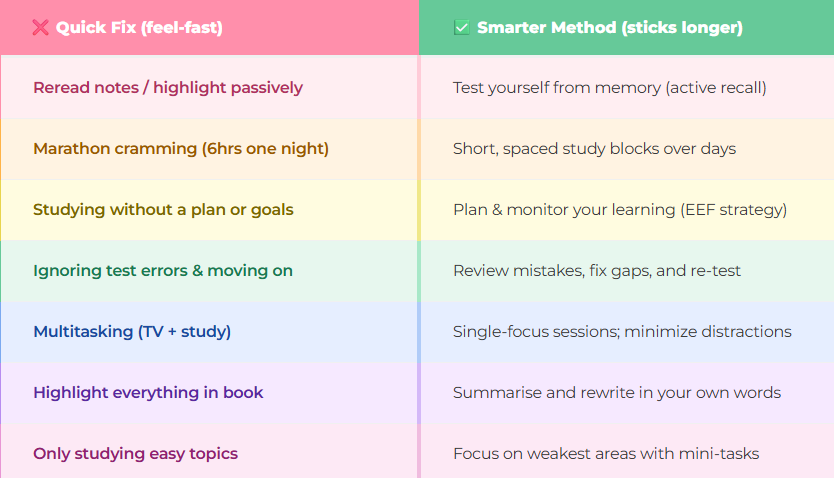
The evidence behind the top row is worth naming rather than gesturing at. Henry Roediger and Jeffrey Karpicke, in Psychological Science in 2006, compared students who re-read a passage against students who tested themselves on it. Five minutes later the re-readers did better. Two days later, and a week later, the self-testers did substantially better. That gap is the reason re-reading feels so convincing and performs so badly: you are measuring it at the wrong moment.
Three swaps worth making first
You do not need to reorganise everything. These three move the most.
Swap re-reading for closed-book recall. Before opening anything, spend five minutes writing what you remember of yesterday's topic. Then open the notes and mark the gaps. It costs less time than re-reading and it produces a list, which re-reading never does.
Swap neat notes for a page somebody else could use. Rewriting notes is the most convincing way to spend three hours learning nothing. If you are going to write, write the version you would hand to a classmate before their exam — every line has to help them solve something. That constraint turns copying into compressing, which is a different mental operation entirely.
Swap "check the score" for "name the cause". After a practice set, do not count. Against each wrong answer write concept, forgotten, careless, or time. In the logged week above, three wrong answers produced two identical causes — which means one repair, not three. You cannot see that from a score.
Fit the nine hours into a week
Once the contents are right, the arrangement matters less than people think. These are starting points rather than prescriptions.
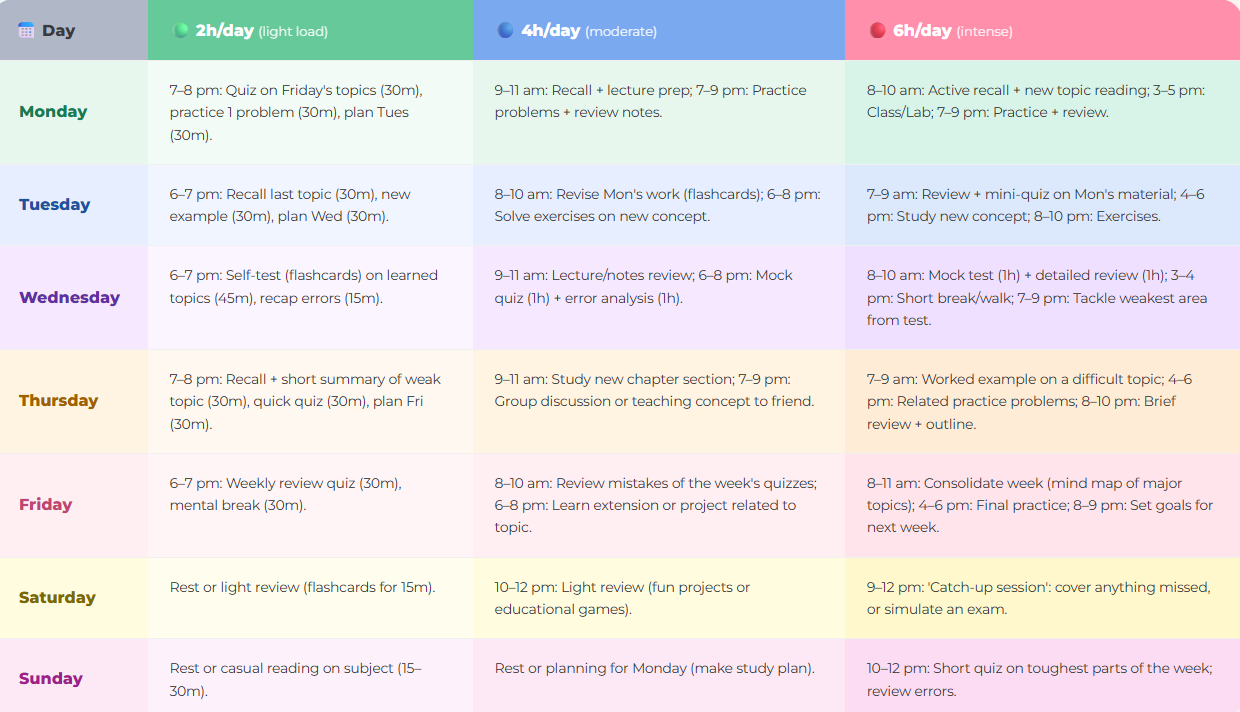
Two rules make any of them work. Put the weakest topic in your most alert slot rather than your leftover one — weak topics get the worst hour in almost every timetable, which is precisely backwards. And give each block one job, written down before it starts, because a block with no target defaults to re-reading.
How to build the surrounding routine around your actual timetable, with a version small enough to survive a bad day, is in the daily study routine.
Ramping up when a date is fixed
If an exam is about six weeks out, the mix changes as it approaches: more learning early, more retrieval and timed practice late.
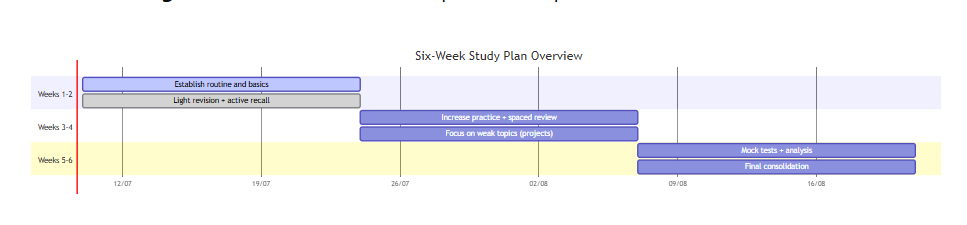
The last fortnight is where most of the time is wasted, and always in the same way: full-length mocks taken back to back with no repair in between. A mock you have not reviewed has told you a number and taught you nothing. One mock plus a proper review beats three mocks and a tally — which is most of what using mock tests properly is about.
When more hours really is the answer
Sometimes it is, and it is worth being honest about when.
If your audit already shows most of your hours producing something, and you are still short, then the constraint is genuinely time and you need more of it. If you have never seen a chapter at all, no technique substitutes for reading it. And in the last week before a paper, volume of timed practice does matter, because speed only comes from repetition.
The point is not that hours are worthless. It is that adding hours to a week that is 21 percent productive gets you very little, and fixing the contents first makes every hour you add afterwards worth roughly three times as much.
Do the audit this week
Three columns, seven days, one line per study block. At the end, add up only the rows where the third column has something in it.
Most people find that number is smaller than they expected, and that finding out costs nothing except the honesty of the third column. Then make one swap — recall instead of re-reading is the cheapest — and log the week again. The hours will not have moved. What they contain will have.
Tags: smart-study-tips, career-growth-skills, exam-preparation-tips, student-learning-guide, effective-study-techniques, study-tips-for-students, daily-study-routine, digital-skills-for-students