A Six-Week Plan to Fix Your Study Routine
By FreePare Team · Fri Jul 10 2026 · 9 min read

A daily study routine works best when it is simple enough to repeat, strong enough to survive bad days, and built around methods that actually improve memory, not just the feeling of productivity. Research consistently points students towards retrieval practice, spaced repetition, structured reflection, and useful feedback as more reliable strategies than endless rereading or last-minute cramming.
In real life, that means your study routine should not begin with “how many hours can I force today?” It should begin with “when will I sit down, what will I recall from memory, and when will I revisit it?”
Why most study routines break after three days
Most students do not fail because they are lazy. They fail because they build study plans for an imaginary version of themselves the one who wakes up inspired, has perfect focus, never checks the phone, and happily studies for four straight hours. Then real life happens, and the plan falls apart.
There is also a more uncomfortable reason. Some study routines feel productive without being very effective. Rereading notes, highlighting pages, and sitting with a book open for a long time can create familiarity, but familiarity is not the same as being able to remember and use the material later. Repeated studying looks better in the short term, but repeated testing led to stronger delayed retention. Practice testing and distributed practice are higher-utility techniques than rereading and highlighting.
So if your current routine is mostly “read, underline, hope for the best”, the problem may not be your discipline. The problem may be the design.
Take a common example.
A student decides to study maths every day for two hours starting at 5 am. On day one, it feels powerful. On day four, they sleep through the alarm, feel they have “broken the routine”, and give up. A better routine would have started with a realistic anchor maybe 7.30 pm after dinner a 25-minute floor, and a plan for what to do even on low-energy days. That is how habits become repeatable.
What learning science says a strong routine should include
A good study routine is not just a timetable. It is a system. And the strongest systems usually contain four ingredients.
- Retrieval practice, also known as active recall. Instead of rereading the answer, you try to pull it out of memory: solve the question without looking, explain the topic aloud, write the steps from memory, or quiz yourself with flashcards. Testing does more long-term retention than additional restudying, and Retrieval practice should be used by students every time they study.
- Spacing. A topic studied once and abandoned is easy to forget. A topic studied, revisited tomorrow, checked again in a few days, and tested again next week is much more likely to stick. Distributed practice has high utility, and better performance can be found with in one week.
- Interleaving. This means mixing related topics or question types instead of doing twenty nearly identical questions in a row. It feels harder, which is exactly why many students avoid it. But that little bit of difficulty can improve discrimination you get better at noticing which method a question needs, not just repeating the last method you used. Interleaving is promising.
- Feedback. Not vague feedback like “needs improvement”, but specific feedback that tells you what went wrong and what to do differently next time. Effective feedback tends to focus on the task, the process, and self-regulation strategies, rather than empty praise.
A useful daily study routine should help you recall, revisit, mix, and correct.
The routine formula that works in real life
Here is the part students usually need most: what to do when you actually sit down.
A study routine that lasts is usually built from the same few moving parts:
- Pick one fixed anchor. Study after something that already happens every day: after dinner, after your commute, after evening tea, after the gym, or right after your last class. The less decision-making involved, the better.
- Lower the starting size. If you are rebuilding consistency, start embarrassingly small. Twenty-five focused minutes is better than a grand three-hour fantasy you repeat twice and abandon. The goal is to make starting feel normal.
- Begin with recall, not reading. Before opening notes, ask: “What do I already remember?” Spend two to five minutes writing key points from memory, solving one question cold, or explaining yesterday’s topic aloud. That switches your brain from passive recognition to active learning.
- Do one main block and one review block. The main block is for new learning or deliberate practice. The review block is for older material on a spaced repetition cycle. That second block matters more than most students realise, because it is what turns studying into memory instead of short-term exposure.
- End by planning the next touchpoint. Good routines do not end with “done”. They end with “when am I seeing this again?” That tiny planning step is metacognition in action: planning, monitoring, and evaluating your own learning.
Here is a simple session flow you can use:
Recall from memory, then focused practice, then check answers and review the mistakes, then plan the next review. The fourth step is the one that gets dropped when a session runs long, and it is the one that decides whether the first three happen again.
A quick example makes this clearer. Imagine Priya is preparing for both school exams and placement aptitude tests. Her old habit was to open random chapters and study whatever felt urgent. Her new routine is tighter: 7.30 pm every weekday, phone in another room, five minutes of active recall, twenty minutes of one priority topic, ten minutes of older-topic review, and five minutes to log mistakes plus tomorrow’s first task. Same student, same syllabus, but a much better system.
A six-week plan you can actually follow
You do not need to “fix your life” in one Monday morning burst. Build the routine in layers.
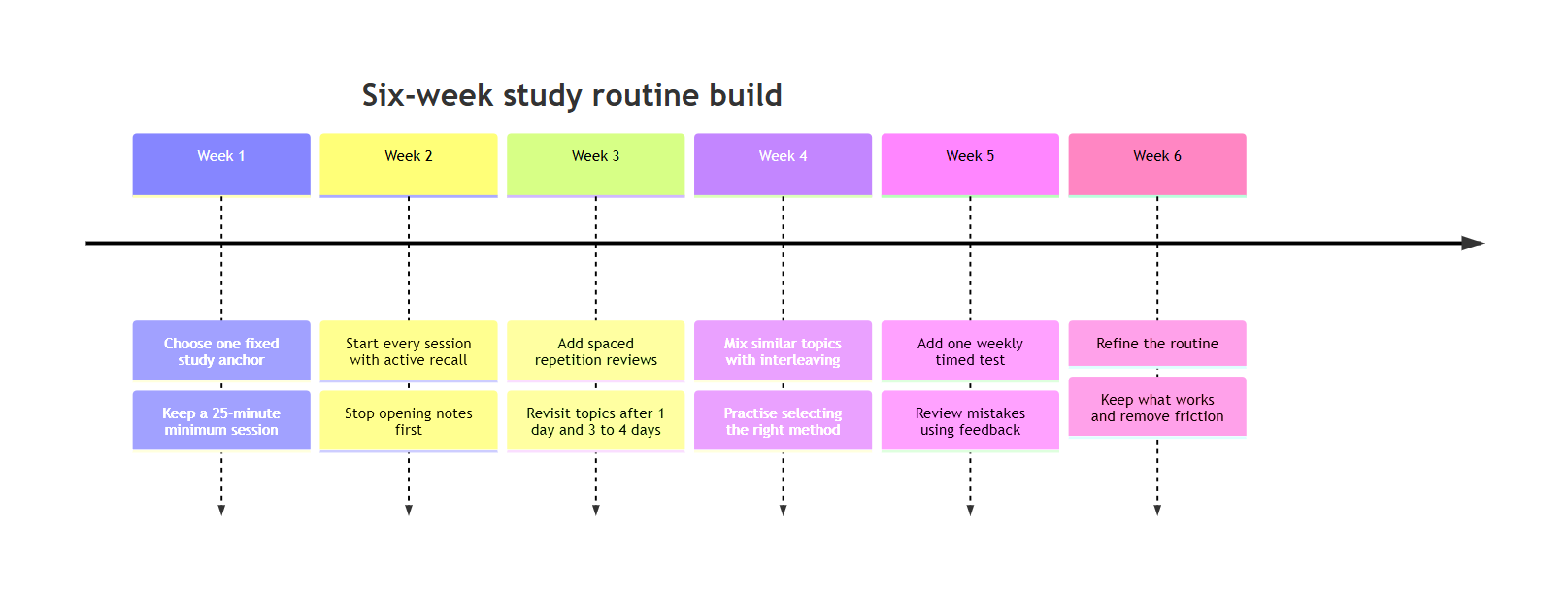
During the first week, focus only on the anchor and the minimum version. Your job is not to cover massive content. Your job is to show up at the same time and finish one short session. Keep the bar low enough that missing feels silly.
During the second week, add active recall at the start of every session. Use Retrieval practice every time you study, and this is where that principle becomes a habit rather than a theory.
During the third week, create a spaced repetition loop. Revisit yesterday’s work briefly, then re-check important topics three or four days later. This is the week where your routine starts compounding.
During the fourth week, begin interleaving. Mix two related subjects or two question types inside the week. For example, do algebra on Monday and Wednesday, data interpretation on Tuesday and Friday, then combine a few mixed questions on Saturday.
During the fifth week, start weekly feedback reviews. Do a mini test, a past paper section, or a timed aptitude set. Then spend at least as much care on error review as on the score itself. Specific feedback is where improvement becomes visible.
During the sixth week, adjust the routine based on evidence, not mood. Which study window gave you the best concentration? Which subject needs morning energy? Which topic keeps coming back into your mistake log? This is self-regulated learning: you are no longer just studying; you are managing your own learning process.
Sample daily schedules you can steal
These are templates, not rules. The point is to give structure without making your day feel like military training.
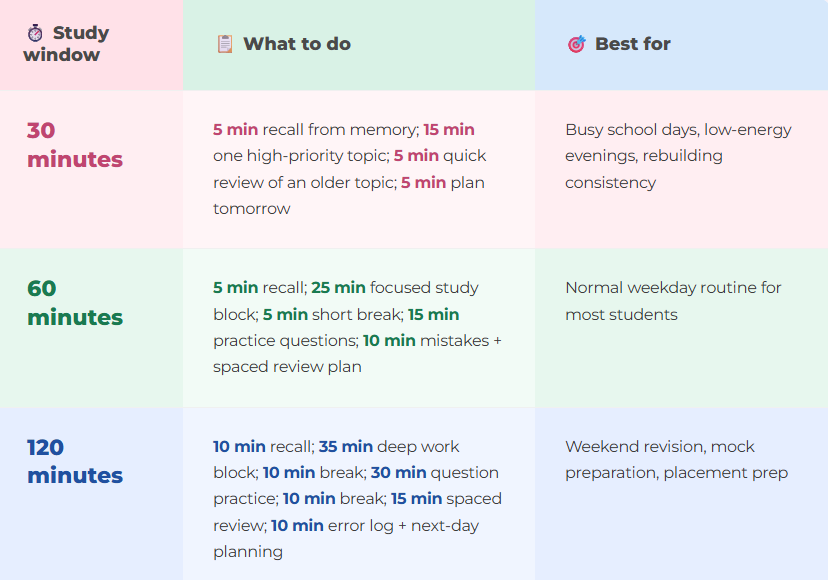
If you are wondering which one is “best”, start with the smallest version you can repeat for seven straight days. Consistency beats ambition in the early stage.
A useful trick here is to match the time window to the day. On hectic weekdays, use the 30- or 60-minute version. On calmer days, use the 120-minute version. That keeps the routine flexible without making it random.
Printable checklist, common mistakes and FAQ
Below is a one-page checklist you can print, keep in a notebook, or turn into a simple A4 download for your readers. If you are publishing this post, this is the section worth converting into a downloadable checklist image or PDF.
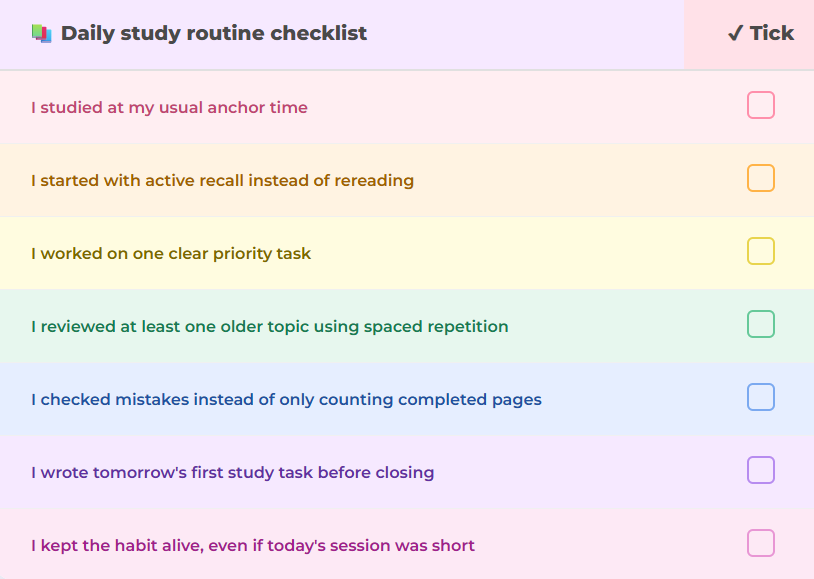
The most common mistakes are surprisingly predictable. Students often make the routine too large, rely only on mood, keep switching study times, count hours instead of recall, and mistake neat notes for solid learning. Research reviews consistently suggest that techniques like practice testing and distributed practice are more dependable than rereading-heavy routines, so if your schedule looks tidy but your recall is weak, change the method before blaming yourself.
FAQ
What if I miss a day?
Do not “restart next Monday”. Just resume at the next study slot. A missed day is a scheduling issue, not a personality diagnosis.
Should I study every subject every day?
Not necessarily. Spacing and interleaving matter more than trying to touch everything daily. It is usually better to rotate subjects across the week and revisit them intelligently than to do a tiny, shallow bit of everything every day.
How do I know my routine is working?
Look for better recall, fewer repeated mistakes, quicker starts, and clearer error patterns not just longer hours. If your feedback is specific and you are reviewing it regularly, you should start to see weaker topics becoming less shaky over time.
Final thoughts
A daily study routine that actually works is usually a little boring. It is not dramatic, not perfect, and not based on sudden motivation. It is built on repetition, smart method choices, and a structure you can return to even after a messy week.
So do not build a routine to impress yourself on day one. Build one you can still follow on a tired Wednesday. Pick a time. Make the first session short. Start with recall. Revisit old material. Review mistakes properly. Then do it again tomorrow.
If you want a simple challenge, start tonight: choose your anchor time, write tomorrow’s first task, and commit to one 25-minute session. That is how a real daily study routine starts.
Tags: career-growth-skills, smart-study-tips, student-learning-guide, exam-preparation-tips, study-tips-for-students, how-to-study-better, daily-study-routine, career-readiness