Build a Study Rhythm You Can Actually Keep
By FreePare Team · Wed Jul 08 2026 · 8 min read

If your current routine is mostly “study when stressed, panic when tired”, you are not lazy; you probably just do not have a system yet. A routine that works is usually boring in the best way: a fixed start time, a short recall warm-up, one hard task while your brain is fresh, one older topic on a spaced schedule, and a quick review of mistakes before you stop.
This article gives you that structure, and then works one full session end to end so you can see what an hour is actually supposed to contain.
Why most study routines collapse
Most students do not fail because they lack motivation. They fail because the plan was unrealistic, and a plan that depends on mood will always lose to one that depends on a cue.
Expecting a routine to feel automatic after four dramatic days is the first mistake. In a study by Phillippa Lally and colleagues at University College London, published in the European Journal of Social Psychology in 2010, the median time for a new daily behaviour to become automatic was 66 days, and the range across people was very wide. Repetition in a consistent context is what builds it, which is the practical reason to study at roughly the same time in the same place.
There is also a learning problem hidden inside the planning problem, and it is the reason revision that feels good so often disappoints. Henry Roediger and Jeffrey Karpicke, in Psychological Science in 2006, compared students who re-read material against students who tested themselves on it. Five minutes later, the re-readers did better. Two days later and a week later, the self-testers did better — and by a wide margin. What feels smooth today is not what is still there next week.
That is also why long hours with the book open are a trap. Working memory is narrow while material is still new, an idea usually credited to John Sweller's cognitive load theory, so a session containing twenty tabs, messy notes, random chapter switching and a phone within reach spends part of its capacity managing the chaos rather than learning.
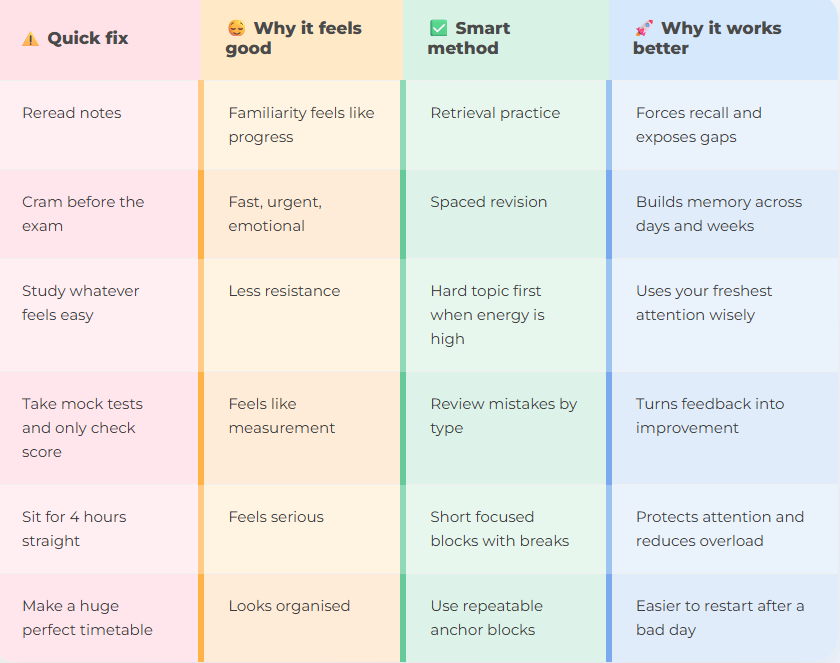
Quick fixes versus smart methods
The left side of this table feels productive. The right side performs better over a fortnight.
What a realistic study day looks like
A useful routine has five parts.
It starts at a predictable time rather than whenever you feel ready. It begins with recall rather than re-reading — pulling material out of memory before opening anything. It puts weak subjects in your best slot rather than your most exhausted one. It includes one older topic every day or two, so revision runs in the background instead of arriving as an emergency. And it has a stop point, because sleep is part of studying rather than a reward for it: the US Centers for Disease Control and Prevention recommends 8 to 10 hours for teenagers aged 13 to 17 and at least 7 for adults, and links adequate sleep to attention and memory.
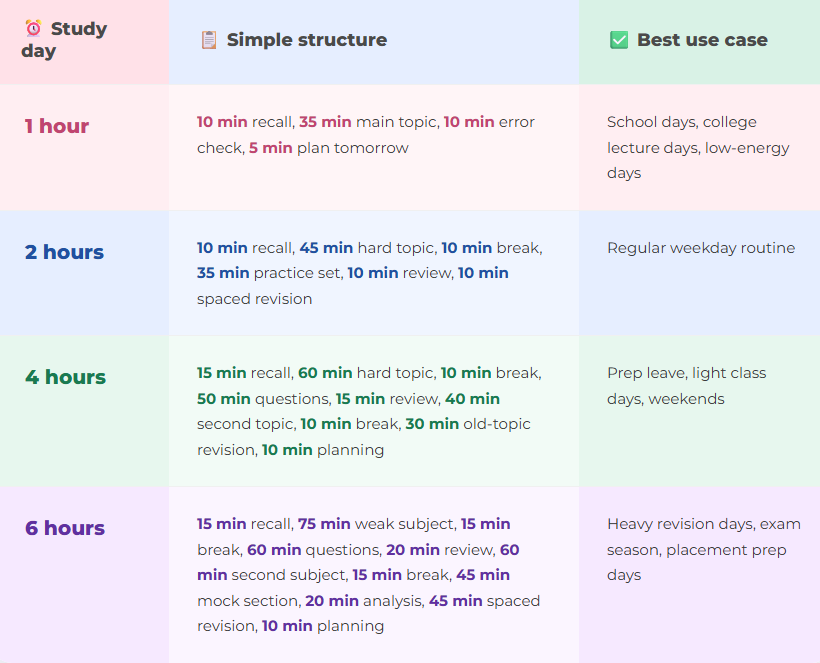
Sample daily schedules
Use these as starting points. The structure matters more than the exact minute, and the recall block can be blurting, flashcards, closed-book questions, or writing the formulas out from memory.
One session, worked end to end
A structure is easy to agree with and hard to act on, so here is a real hour on a real weak spot. The target is the kind of thing a useful problem statement looks like: not “I am weak at percentages” but “I lose marks when a question mixes markup with discount.”
Minutes 0 to 10, recall. Blank page, book shut. Write what you think you know. Most people manage “profit percent is on cost price” and then stall, which is the useful result: the stall is the session's real target.
Minutes 10 to 20, one worked example, slowly. A shopkeeper marks goods 40 percent above cost and then gives a 25 percent discount. What is the profit percent?
Let cost be 100, because percentages do not care about the actual amount. Marked price is 140. The discount comes off the marked price, not off cost, so the selling price is 75 percent of 140, which is 105. Profit is 5 on a cost of 100, so 5 percent.
Write the sentence that generated it underneath: markup is measured from cost, discount is measured from the marked price, profit is measured back against cost. Three different bases in one question, which is exactly why this type is where the marks go.
Minutes 20 to 40, three attempts with the page turned over. Same idea, arranged differently each time.
- Markup 40 percent, and the shop wants 12 percent profit. What discount can it give? Selling price must be 112, marked price is 140, so the discount is 28 out of 140, which is 20 percent.
- The shop must give a 20 percent discount and still make 12 percent. What markup does it need? Selling price 112 is 80 percent of the marked price, so the marked price is 140 — a 40 percent markup.
- Say out loud which quantity each percentage was taken on, for all three. If you cannot, the concept has not landed yet however many answers came out right.
Minutes 40 to 50, error review. One line per mistake, naming the cause rather than the question: took the discount off cost, or compared profit against selling price. A list of wrong question numbers tells you nothing next week.
Minutes 50 to 60, plan the return. Write tomorrow's first task and put this subtopic on the calendar for three days from now. Then stop, even if it was going well — stopping while it is going well is what makes tomorrow easy to start.
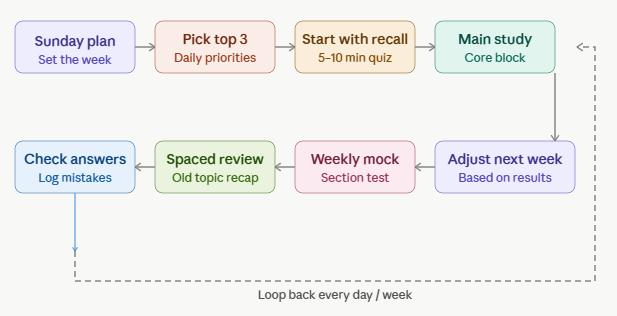
That is the whole shape, and it transfers to any topic: recall, one slow example, three closed-book attempts, error review by cause, schedule the return.
How to make the habit stick without burning out
The common mistake is building a routine you can only follow on a good day. Build one that survives an ordinary day instead.
Link study to a cue. Same desk, same time after class, same cup of tea. Given how long automaticity takes, the consistent context is doing more work than motivation is.
Keep a minimum version that is almost embarrassingly small. If your full routine is two hours, the rescue version is twenty minutes: five recall, ten on one weak area, five planning tomorrow. A routine with a low-friction fallback restarts after a bad week; one without a fallback ends there.
Protect sleep like part of the syllabus. Late-night cramming borrows from the memory and attention you are trying to build, which is the practical reason spaced practice beats a heroic last night.
And do not make every day a war. Heavier days for practice and mocks, lighter days for review. Burnout usually starts when nothing ever feels finished.
How to handle weak subjects and mock tests
Weak subjects improve fastest when you stop treating them as one large problem.
“I am bad at maths” cannot be acted on. “I lose marks in percentages when the question mixes markup and discount” can, and it is what the worked hour above was built around. Narrow the statement until a single session can address it, and the chunking keeps the load inside what working memory can hold. Narrowing is most of the work, and there is more on doing it systematically in turning a weak subject into a strong topic.
Mock tests belong inside your routine, not outside it. One mock without a review is mostly ego management. A practical review sheet has three columns and no more:
- Concept error — I did not know or understand the method.
- Careless error — I knew it, but read badly, copied badly, or rushed.
- Timing error — I spent too long, chose badly, or panicked.
The classification is what changes your next session. Concept errors need re-teaching, careless errors need slower reading and a checking habit, and timing errors need a better order of attempt rather than more theory.
Templates you can copy
Daily checklist
- Pick today's top three tasks before you begin.
- Start with five to ten minutes of closed-book recall.
- Put the weakest topic in your highest-energy slot.
- Do one practice set without looking at notes.
- Write one line on why each mistake happened.
- Revisit one older topic on the spaced schedule.
- End by setting tomorrow's first task.
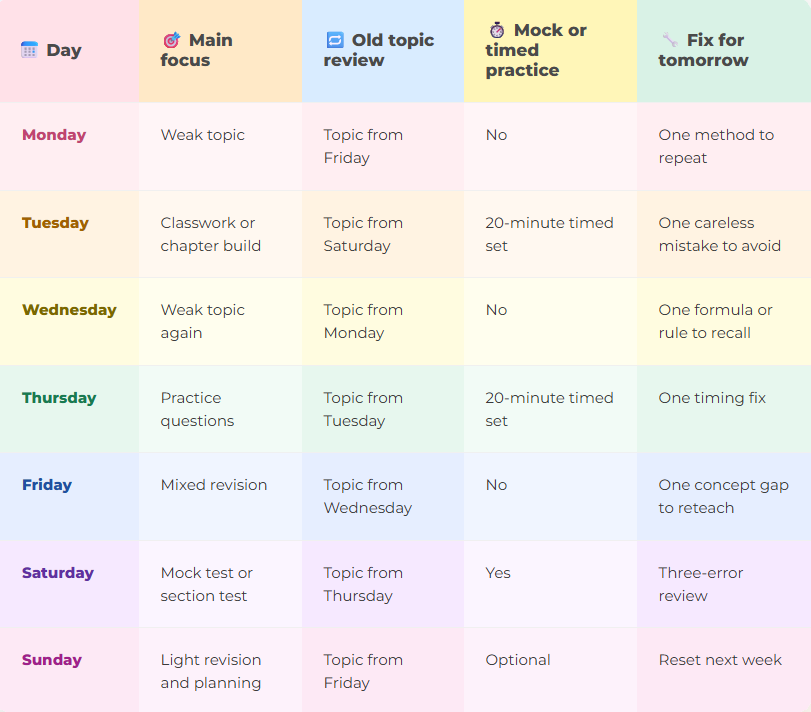
Weekly plan template
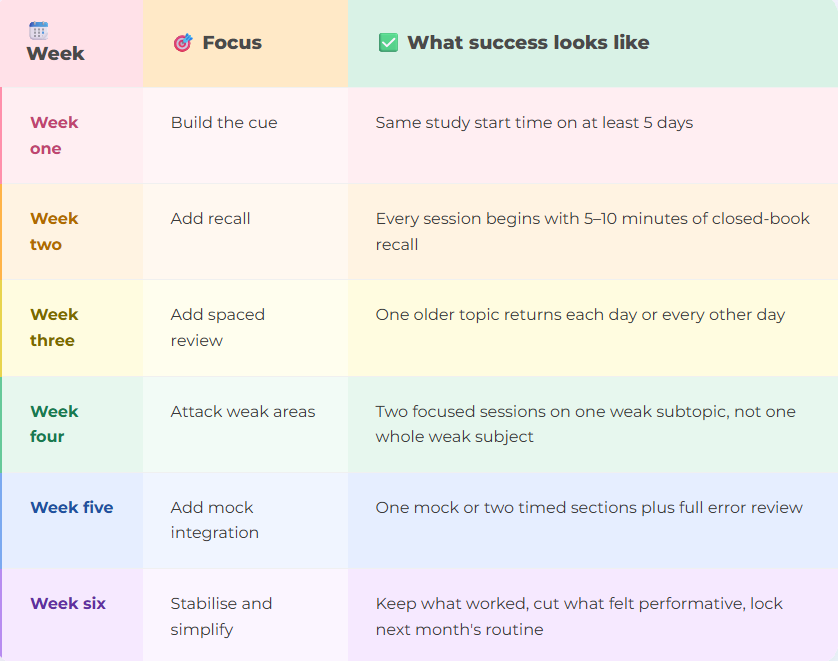
Six-week reset plan
Six weeks is long enough to build a rhythm and short enough to feel real. It also matches what the habit research suggests: repetition over time rather than one intense week.
Final thoughts
A study routine that works is not impressive from the outside. It does not need twelve colours, an all-nighter, or a timetable that looks like a military operation. It needs to be repeatable.
A fixed cue, short focused blocks, recall before re-reading, revision that comes back later, error review that tells you what to do next, and enough sleep to keep up. If you want one line to carry:
Start small, recall often, review later, and stop before your brain turns to soup.
Tags: daily-study-routine, smart-study-tips, effective-study-habits, exam-preparation-tips, career-growth-skills, effective-study-techniques, how-to-study-better, career-readiness