Logical Reasoning Preparation Guide for Campus Placements
By FreePare Team · Thu Jun 18 2026 · 27 min read

Logical reasoning is one of the most scoring sections in campus placement exams. It does not require advanced formulas or long theory. It mainly tests how clearly you can think, identify patterns, and solve problems under time pressure.
For freshers, reasoning can feel tricky in the beginning because every question looks different. But after regular practice, you start recognizing common patterns.
Whether you are preparing for service-based companies, product-based companies, or general campus recruitment exams, logical reasoning should be part of your daily study plan.
This guide will help you understand important reasoning topics, preparation strategy, puzzle-solving tips, daily routine, and common mistakes to avoid. Every topic below carries the method and at least one fully worked question, so you can learn the technique here and then practise the same question types on FREEPARE.
What is Logical Reasoning?
Logical reasoning tests your ability to understand information and reach the correct answer using logic.
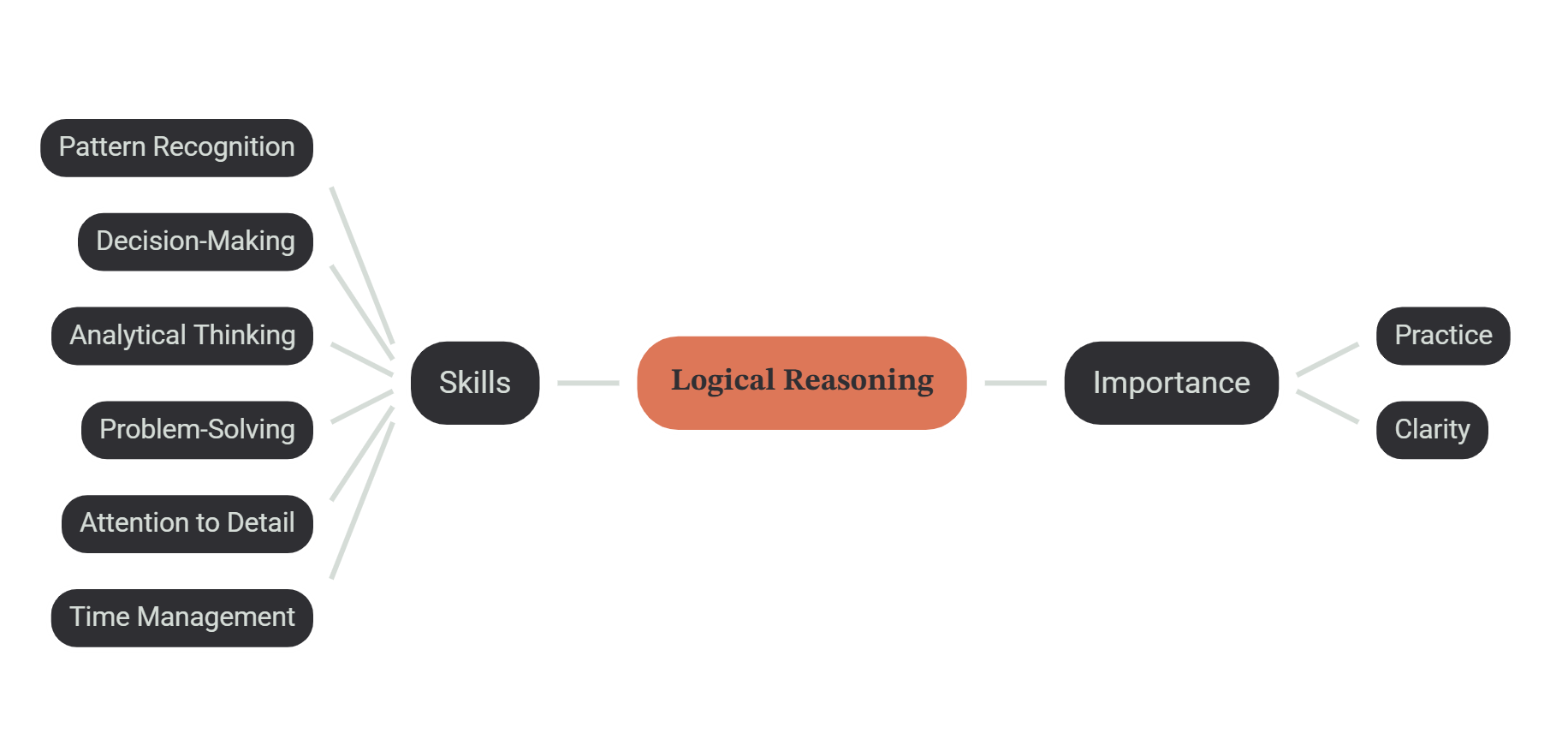
It checks:
- Pattern recognition
- Decision-making
- Analytical thinking
- Problem-solving
- Attention to detail
- Time management
Unlike quantitative aptitude, reasoning does not always depend on formulas. It depends more on practice and clarity.
Why Reasoning is Important for Placements
Logical reasoning is included in most campus placement exams because companies want candidates who can think clearly.
A good reasoning score can help you:
- Clear the first round
- Improve total test score
- Balance weaker aptitude performance
- Handle puzzles better
- Build exam confidence
For many students, reasoning becomes a scoring section because question types are pattern-based.
Important Reasoning Topics
Here are the most important logical reasoning topics freshers should prepare.
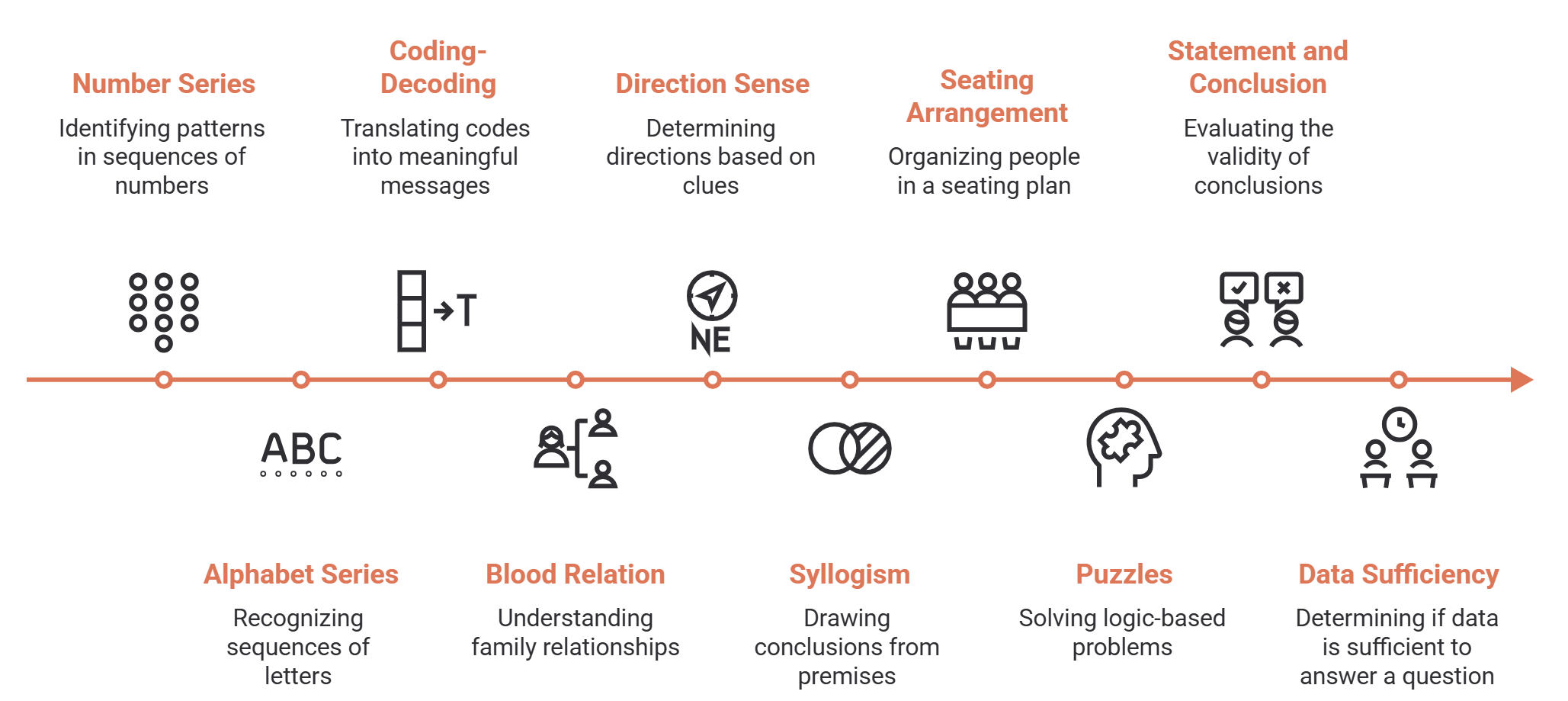
1. Number Series
In number series questions, you identify the pattern between numbers.
Common patterns include:
- Addition
- Subtraction
- Multiplication
- Division
- Square
- Cubes
- Prime numbers
- Alternate patterns
Start by checking the difference between numbers.
A fixed four-step method
- Write the differences between consecutive terms. If they are constant, the rule is "add a fixed number".
- If the differences are not constant, write the differences of those differences. A constant second difference usually means a square-based pattern.
- If the differences grow fast, check the ratio instead. A near-constant ratio means multiplication.
- If neither works, split the series into alternate terms and treat it as two interleaved series.
Example 1: 4, 9, 19, 39, 79, ?
- Differences: 5, 10, 20, 40. They are doubling, so this is multiplicative.
- Test "×2 then +1": 4 × 2 + 1 = 9 ✓, 9 × 2 + 1 = 19 ✓, 19 × 2 + 1 = 39 ✓, 39 × 2 + 1 = 79 ✓.
- Next term = 79 × 2 + 1 = 159
Example 2: 3, 7, 16, 35, 74, ?
- Differences are 4, 9, 19, 39, which are not obvious, so try a mixed rule.
- 3 × 2 + 1 = 7, then 7 × 2 + 2 = 16, then 16 × 2 + 3 = 35, then 35 × 2 + 4 = 74. The multiplier is fixed and the number added increases by 1 each time.
- Next term = 74 × 2 + 5 = 148 + 5 = 153
Example 3: 5, 6, 9, 14, 21, ?
- Differences: 1, 3, 5, 7. These are consecutive odd numbers.
- The next difference is 9.
- Next term = 21 + 9 = 30
Example 4 (square-based): 2, 5, 10, 17, 26, ?
- Compare with squares: 1 + 1 = 2, 4 + 1 = 5, 9 + 1 = 10, 16 + 1 = 17, 25 + 1 = 26. The rule is "square of the position, plus 1".
- Sixth term = 6 × 6 + 1 = 37
Example 5 (two interleaved series): 4, 7, 8, 14, 12, 21, ?
- Take the 1st, 3rd and 5th terms: 4, 8, 12. They increase by 4.
- Take the 2nd, 4th and 6th terms: 7, 14, 21. They increase by 7.
- The missing term is the 7th, which belongs to the first group.
- Next term = 12 + 4 = 16
2. Alphabet Series
Alphabet series questions are based on letter positions.
Important areas:
- Forward order
- Reverse order
- Skipped letters
- Letter gap patterns
- Mixed alphabet-number series
Remember A = 1, B = 2, C = 3, and so on. Two things make this topic fast. First, the memory hook EJOTY: E = 5, J = 10, O = 15, T = 20, Y = 25. From any of those five anchors you can count to any letter in two or three steps. Second, the opposite-letter rule: the letter opposite to a letter at position p sits at position 27 − p. So the opposite of H (8) is position 27 − 8 = 19, which is S.
Example 1: B, D, G, K, P, ?
- Convert to numbers: 2, 4, 7, 11, 16.
- Gaps: +2, +3, +4, +5. The gap grows by 1 each time, so the next gap is +6.
- 16 + 6 = 22, and the 22nd letter is V.
Example 2: C, F, I, L, ?
- Positions: 3, 6, 9, 12, each +3.
- 12 + 3 = 15, which is O.
Example 3 (reverse direction): Z, W, T, Q, ?
- Positions: 26, 23, 20, 17, each −3.
- 17 − 3 = 14, which is N.
3. Coding-Decoding
Coding-decoding questions test your ability to identify hidden patterns.
Common types:
- Letter shifting
- Number coding
- Symbol coding
- Word coding
- Substitution coding
Check whether letters move forward, backward, or follow position-based logic. In an exam, write the letters of the given word in one line and the letters of the code directly under them. The pattern becomes visible in seconds, and this alignment step is what separates a 30-second answer from a two-minute guess.
Example 1 (constant forward shift): If FROG is coded as GSPH, how is BIRD coded?
- Align them: F→G, R→S, O→P, G→H. Every letter has moved one place forward.
- Apply the same shift to BIRD: B→C, I→J, R→S, D→E.
- Answer = CJSE
Example 2 (larger shift): Code MOTHER with a shift of +3.
- M is 13, so 13 + 3 = 16 = P
- O is 15, so 15 + 3 = 18 = R
- T is 20, so 20 + 3 = 23 = W
- H is 8, so 8 + 3 = 11 = K
- E is 5, so 5 + 3 = 8 = H
- R is 18, so 18 + 3 = 21 = U
- Answer = PRWKHU
Example 3 (reverse alphabet): Each letter is replaced by its opposite, using 27 − p. Code CAT.
- C is 3, so 27 − 3 = 24 = X
- A is 1, so 27 − 1 = 26 = Z
- T is 20, so 27 − 20 = 7 = G
- Answer = XZG
Example 4 (number coding): If TEACH is coded as 37, how is CHAIR coded?
- Check the sum of letter positions for TEACH: T20 + E5 + A1 + C3 + H8 = 37. The rule is "add the positions".
- Apply it to CHAIR: C3 + H8 + A1 + I9 + R18
- 3 + 8 = 11; 11 + 1 = 12; 12 + 9 = 21; 21 + 18 = 39
- Answer = 39
Example 5 (substitution coding): In a code language, "sim la po" means "he is honest" and "la ki ta" means "honest and brave". What is the code for "honest"?
- Compare the two English phrases. The only word common to both is "honest".
- Compare the two coded phrases. The only code word common to both is "la".
- Since one word is shared and one code is shared, they must match.
- Answer = la. This intersection method is the whole technique for substitution coding: line up two statements, find the single shared word, and pair it with the single shared code.
4. Blood Relation
Blood relation questions test family relationship understanding.
Important relations:
- Father
- Mother
- Brother
- Sister
- Son
- Daughter
- Uncle
- Aunt
- Cousin
- Grandfather
- Grandmother
Use a family tree instead of solving everything mentally. Use a consistent notation every time: write + after a male, − after a female, place each generation on its own line with the oldest at the top, and draw a straight line between a married couple. Then read the answer off the drawing instead of holding five relationships in your head.
Example 1 (photograph type): Pointing to a photograph, a man says, "She is the daughter of the only son of my grandfather." How is the girl related to him?
- Start at the innermost phrase: "my grandfather".
- "The only son of my grandfather" — the man’s grandfather has exactly one son, and that son must be the man’s own father.
- So the phrase reduces to "she is the daughter of my father".
- The daughter of the man’s father is his sister.
- Always unwrap these sentences from the inside out. Solving them left to right is where people go wrong.
Example 2 (chain type): A is B’s brother. C is A’s mother. D is C’s father. E is D’s mother. How is A related to D?
- A and B are siblings, and A is male.
- C is the mother of A, so C is one generation above A.
- D is C’s father, so D is one generation above C, which makes D two generations above A.
- D is therefore A’s maternal grandfather.
- Read it in the direction the question asks: A is D’s grandson. E is not needed at all, which is deliberate — these questions often include one clue you never use.
Example 3 (coded relations): If "A + B" means A is the father of B, "A − B" means A is the wife of B, and "A × B" means A is the brother of B, then what does "P − Q × R" mean?
- Break it into pieces: P − Q, then Q × R.
- P − Q means P is the wife of Q, so P is female and Q is male.
- Q × R means Q is the brother of R.
- So P is married to R’s brother, which makes P the sister-in-law of R.
5. Direction Sense
Direction questions test movement and position.
Important areas:
- Left and right turns
- Distance covered
- Final direction
- Shortest distance
- Opposite directions
Draw arrows while solving. Two rules make every question mechanical.
| Currently facing | After a right turn | After a left turn |
|---|---|---|
| North | East | West |
| East | South | North |
| South | West | East |
| West | North | South |
The second rule is for shortest distance. Add up the north–south moves into one number and the east–west moves into another, then use the right-angle rule: shortest distance = square root of (north-south net squared + east-west net squared).
Example 1: A man walks 10 m north, turns right and walks 6 m, then turns right again and walks 4 m. How far is he from the start, and in which direction?
- He starts facing north and walks 10 m north.
- Facing north, a right turn makes him face east, so he walks 6 m east.
- Facing east, a right turn makes him face south, so he walks 4 m south.
- Net vertical movement = 10 north − 4 south = 6 m north. Net horizontal movement = 6 m east.
- Shortest distance = square root of (6 × 6 + 6 × 6) = square root of 72, which is about 8.49 m.
- Since he is both north and east of the start by the same amount, the direction is north-east.
Example 2 (movements that cancel): A girl walks 15 m south, turns left and walks 8 m, then turns left again and walks 15 m. Where is she now?
- 15 m south.
- Facing south, a left turn makes her face east, so she walks 8 m east.
- Facing east, a left turn makes her face north, so she walks 15 m north.
- The 15 m south and 15 m north cancel completely.
- She is 8 m east of her starting point.
Example 3 (clean right-angle numbers): A man walks 9 m east, turns right and walks 12 m. How far is he from the start?
- Facing east, a right turn makes him face south, so the 12 m is southward.
- Shortest distance = square root of (9 × 9 + 12 × 12) = square root of (81 + 144) = square root of 225 = 15 m, in the south-east direction.
- Placement papers reuse the 3-4-5 triangle and its multiples (6-8-10, 9-12-15) constantly. Recognising them saves the square root entirely.
6. Syllogism
Syllogism questions are based on statements and conclusions.
Common statement types:
- All A are B
- Some A are B
- No A is B
- Some A are not B
Use Venn diagrams for better clarity. Since you draw these on rough paper rather than see them printed, here is exactly what each statement looks like as a drawing:
- All A are B — a small circle A drawn completely inside a larger circle B.
- No A is B — two circles drawn side by side, not touching anywhere.
- Some A are B — two circles that overlap in the middle, with part of each circle left outside the overlap.
- Some A are not B — two overlapping circles where you specifically mark the part of A that lies outside B.
Then apply the conversion rules, which decide most questions on their own:
| Given statement | What definitely also follows |
|---|---|
| All A are B | Some B are A |
| No A is B | No B is A, and also Some A are not B |
| Some A are B | Some B are A |
| Some A are not B | Nothing reliable converts |
Example 1: Statements — All pens are books. All books are papers. Conclusions — I. All pens are papers. II. Some papers are pens.
- Draw the pens circle inside the books circle, and the books circle inside the papers circle. Three nested circles.
- Every pen sits inside books, and every book sits inside papers, so every pen sits inside papers. Conclusion I follows.
- Conclusion II is the valid conversion of "All pens are papers": if the pens circle is inside papers, then at least part of papers is pens. Conclusion II follows.
- Answer: both conclusions follow.
Example 2: Statements — Some dogs are cats. All cats are animals. Conclusions — I. Some dogs are animals. II. All dogs are animals.
- Draw dogs and cats as two overlapping circles. Draw the whole cats circle inside a larger animals circle.
- The overlap region belongs to both dogs and cats. Since all of cats lies inside animals, that overlap lies inside animals too. So at least some dogs are animals. Conclusion I follows.
- The part of the dogs circle that lies outside cats may be drawn entirely outside the animals circle without breaking either statement. So conclusion II is possible but not certain. Conclusion II does not follow.
- Answer: only conclusion I follows. "Possible" is never the same as "follows".
Example 3 (with a negative statement): Statements — No A is B. Some B are C. Conclusion — Some C are not A.
- Draw A and B as two separate, non-touching circles. Draw C overlapping B.
- The overlap of B and C contains at least one item, and it lies inside B.
- Nothing inside B can be A, because no A is B.
- So that item is a C which is not an A. The conclusion follows.
The "either or" case
Sometimes neither conclusion follows on its own, yet together they cover every possibility. That pair is called complementary, and the answer is "either I or II follows". Two pairs are complementary: All A are B with Some A are not B, and Some A are B with No A is B.
Example: Statement — Some pens are red. Conclusions — I. All pens are red. II. Some pens are not red.
- I alone is not certain: the statement allows some pens to be non-red.
- II alone is not certain either: the statement allows every pen to be red.
- But one of the two must be true, because either all pens are red or at least one is not.
- Answer: either I or II follows.
7. Seating Arrangement
Seating arrangement is common in placement reasoning tests.
Types include:
- Linear arrangement
- Circular arrangement
- Facing north
- Facing south
- Parallel rows
- Mixed direction
Start with fixed information first. Before placing anyone, fix the direction convention, because half of all wrong answers in this topic come from confusing left with right:
- Row facing north: draw the row left to right on your page. Each person’s left is your left and their right is your right.
- Row facing south: everything reverses. A person’s left is your right.
- Circle facing the centre: a person’s left is the clockwise direction and their right is anticlockwise.
- Circle facing outward: reversed again.
Worked example. P, Q, R, S and T sit in a row of five seats, all facing north. Seats are numbered 1 to 5 from the left.
- Clue 1: R sits third from the left.
- Clue 2: Q sits at one of the ends.
- Clue 3: There are exactly two people between Q and S.
- Clue 4: T sits immediately to the right of R.
- Start with the most fixed clue. Clue 1 puts R in seat 3.
- Clue 4 is the next most fixed. Facing north, "right" means the higher-numbered side, so T is in seat 4.
- Clue 2 leaves Q in seat 1 or seat 5.
- Test Q in seat 1. Clue 3 needs exactly two people between Q and S, so S would be in seat 4. But seat 4 is T, so this case fails.
- Therefore Q is in seat 5, and two people between means S is in seat 2, with seats 3 and 4 lying between them.
- The only person and seat left: P is in seat 1.
- Final arrangement, left to right: P, S, R, T, Q.
- Now answer questions off the finished line. Who sits second to the right of S? S is in seat 2, so first to the right is seat 3 (R) and second to the right is seat 4, which is T. Who is at the extreme left? P.
Notice the shape of the method: place the certain clues, then test the small number of remaining options and reject the ones that break a clue. You are never guessing, only eliminating.
8. Puzzles
Puzzles are time-consuming but important.
Common types:
- Floor puzzles
- Box puzzles
- Day-based puzzles
- Month-based puzzles
- Comparison puzzles
- Scheduling puzzles
Break long puzzles into small clues. For a floor puzzle, always draw the building with the top floor at the top of your page and number upward from 1 at the bottom, so that "above" on paper means "above" in the question.
Worked example. Five people — P, Q, R, S and T — live on five different floors of a building numbered 1 (lowest) to 5 (highest).
- Clue 1: T lives on an odd-numbered floor.
- Clue 2: There are exactly two floors between R and S.
- Clue 3: P lives immediately below Q.
- Clue 4: R lives on the topmost floor.
- Clue 4 is absolute: R is on floor 5.
- Clue 2 now has only one option. Two floors between 5 and S means floors 4 and 3 lie between, so S is on floor 2.
- Floors 1, 3 and 4 remain for P, Q and T. Clue 3 needs a consecutive pair with P below Q, and the only consecutive pair left is 3 and 4. So P is on floor 3 and Q is on floor 4.
- That leaves T on floor 1, and clue 1 is satisfied because 1 is odd.
- Final: floor 5 R, floor 4 Q, floor 3 P, floor 2 S, floor 1 T.
- Sample questions: who lives on floor 3? P. How many floors are there between T and Q? T is on 1 and Q is on 4, so floors 2 and 3 lie between, which is two floors.
Clue 1 did not place anybody. It only confirmed the answer at the end. Weak-looking clues are usually verification clues, so do not spend time on them first.
9. Statement and Conclusion
These questions test logical judgment.
You need to decide which conclusion follows from the given statement.
Do not use outside knowledge. Answer only based on the information given. The working test is simple: a conclusion follows only if it must be true whenever the statement is true. If you can imagine even one situation where the statement holds but the conclusion fails, it does not follow.
Example: Statement — "The college has decided to make 75% attendance compulsory for appearing in the semester examination." Conclusions — I. Students who attend fewer classes may be barred from the examination. II. All students will now attend every class.
- Conclusion I only restates the direct consequence of the rule. If attendance below 75% is not allowed to sit the exam, then students with fewer classes may indeed be barred. It follows.
- Conclusion II predicts human behaviour, which the statement says nothing about. The rule can exist while some students still stay away, and it asks for 75%, not 100%. It does not follow.
- Answer: only conclusion I follows. Anything about what people will feel, decide or do next is an assumption, not a conclusion.
10. Data Sufficiency
Data sufficiency questions check whether the given information is enough to answer a question.
Do not solve completely unless required. Check whether the data is sufficient. The answer options are almost always these five:
- Statement I alone is sufficient, but II alone is not.
- Statement II alone is sufficient, but I alone is not.
- Both statements together are sufficient, but neither alone is.
- Either statement alone is sufficient.
- Even both together are not sufficient.
Judge statement I on its own first, deliberately forgetting statement II, then judge II on its own. Only if both fail should you combine them. "Sufficient" means the data pins down exactly one answer — narrowing it to two possibilities is still insufficient.
Example 1: What is the two-digit number? I. The sum of its digits is 9. II. The difference between its digits is 3.
- Statement I alone: possible numbers are 18, 27, 36, 45, 54, 63, 72, 81 and 90. Many answers, so not sufficient.
- Statement II alone: 14, 25, 41, 63, 96 and many others qualify. Not sufficient.
- Both together: the digits must add to 9 and differ by 3, which gives the digit pair 6 and 3. But the number could still be 63 or 36.
- Two possible answers means the data still does not pin down one number.
- Answer: even both statements together are not sufficient. This is exactly the trap the topic is built around — combining the statements feels like progress, so people stop checking one step too early.
Example 2: Who is the tallest among P, Q and R? I. P is taller than Q. II. R is shorter than Q.
- Statement I alone gives P > Q but says nothing about R, so R could be the tallest. Not sufficient.
- Statement II alone gives Q > R but says nothing about P. Not sufficient.
- Both together give P > Q > R, so P is the tallest. One definite answer.
- Answer: both statements together are sufficient, but neither alone is.
Best Order to Prepare Reasoning
Follow this order:
- Number series
- Alphabet series
- Coding-decoding
- Blood relation
- Direction sense
- Syllogism
- Analogy
- Classification
- Seating arrangement
- Puzzles
- Statement and conclusion
- Data sufficiency
This order starts with easier pattern-based topics and slowly moves toward complex reasoning.
Two of these are quick enough to learn in a single sitting. Analogy asks you to name the relationship in the first pair and apply it to the second: in "Doctor : Hospital :: Teacher : ?", the relationship is "works in", so the answer is School. Say the relationship out loud in a short sentence before looking at the options, or the options will pull you toward a word that is merely related. Classification, or odd-one-out, works the other way: find the property shared by all but one. In 9, 16, 25, 30, 49, every number except 30 is a perfect square, so 30 is the odd one. If two candidates look odd, you have found the wrong shared property and should look for another.
How to Prepare Logical Reasoning
Step 1: Learn Question Types
Reasoning topics have repeated patterns.
For example, coding-decoding may involve letter shifting, reverse alphabet, number position, or symbol substitution.
Once you understand the type, solving becomes easier. Keep a single page per topic listing the types you have met and the first move for each one — "reverse alphabet, so use 27 minus the position", "substitution, so intersect the two sentences". Recognising the type is most of the work; the arithmetic afterwards is trivial.
Step 2: Practice Daily
Reasoning improves with regular practice.
Try solving:
- 10 series questions
- 5 coding-decoding questions
- 5 blood relation or direction questions
- 1 puzzle or seating arrangement set
Daily practice is better than solving many questions only once a week.
Step 3: Use Diagrams
Do not solve everything in your head.
Use diagrams for:
- Blood relation
- Direction sense
- Seating arrangement
- Puzzles
- Syllogism
Visual solving reduces mistakes. Each topic has one correct drawing: a generation tree for blood relations, a compass sketch with arrows for direction sense, a numbered line or circle for seating, a grid with one row per person for puzzles, and overlapping circles for syllogism. Practise drawing them until it is automatic, because in a timed test you will not want to decide what to draw.
Step 4: Track Time
Reasoning questions can consume too much time.
Suggested time limits:
- Series question: 30 to 45 seconds
- Coding-decoding: 1 minute
- Blood relation: 1 to 2 minutes
- Direction sense: 1 to 2 minutes
- Puzzle: 5 to 8 minutes
In the actual exam, do not get stuck on one puzzle. A useful rule: if a puzzle has not produced a single confirmed placement in the first two minutes, leave it, finish the rest of the section, and return only if time remains. One puzzle set is usually worth four or five marks, and so are five series questions that take one minute in total.
Step 5: Analyze Wrong Answers
After every reasoning test, check why the answer was wrong.
Common reasons:
- Missed a clue
- Read direction incorrectly
- Made wrong family relation
- Assumed extra information
- Spent too much time
- Misread conclusion
This analysis helps you avoid repeated mistakes. Write the cause next to each wrong answer, not just the correct option. Six questions lost to "assumed extra information" is a single habit to fix, and fixing it is far faster than solving another hundred questions.
Puzzle-Solving Strategy
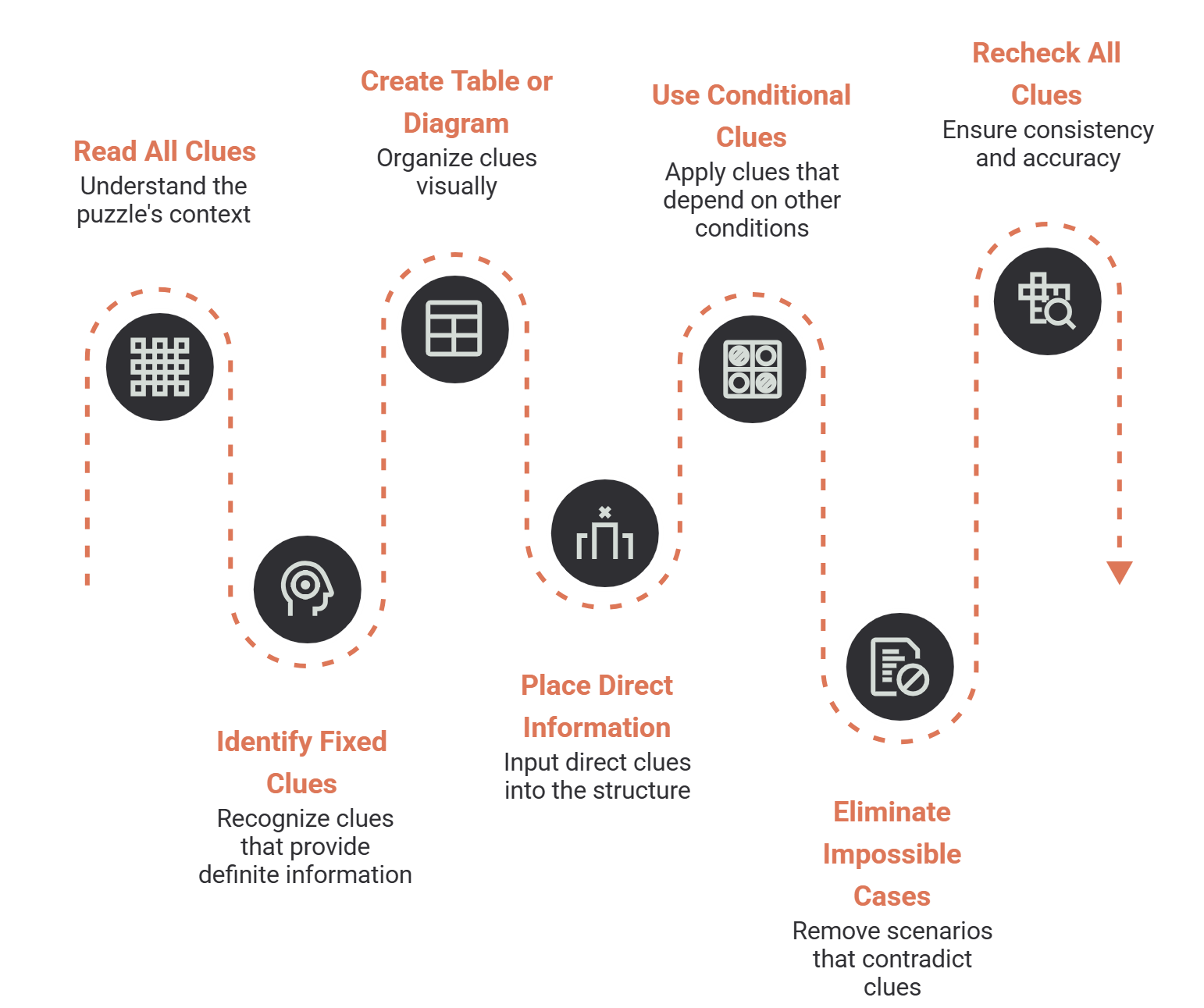
Puzzles can look difficult, but they become easier with a method.
Follow this process:
- Read all clues once
- Identify fixed clues
- Create a table or diagram
- Place direct information first
- Use conditional clues later
- Eliminate impossible cases
- Recheck all clues before final answer
Worked example. Four friends — J, K, L and M — have interviews on Monday, Tuesday, Wednesday and Thursday, one person per day.
- Clue 1: L’s interview is neither on Monday nor on Thursday.
- Clue 2: J’s interview is on the day immediately before K’s.
- Clue 3: M’s interview is on Thursday.
- Clue 3 is fixed and direct, so place it first: M on Thursday.
- Clue 1 is a restriction, not a placement. It narrows L to Tuesday or Wednesday.
- Clue 2 needs two consecutive free days with J first. Thursday is taken, so the only candidate pairs are Monday–Tuesday and Tuesday–Wednesday.
- Test Monday–Tuesday: J on Monday, K on Tuesday, which leaves Wednesday for L. Clue 1 allows Wednesday, so this works.
- Test Tuesday–Wednesday: J on Tuesday, K on Wednesday, which leaves Monday for L. Clue 1 forbids Monday, so this case is rejected.
- Final: J on Monday, K on Tuesday, L on Wednesday, M on Thursday.
Do not try to solve puzzles only mentally.
Written structure is important. Notice again that the direct clue came first, the restriction clue came last, and the answer emerged from rejecting one of only two cases.
Daily Reasoning Practice Plan
If you have 30 minutes:
- 10 minutes series and coding-decoding
- 10 minutes blood relation or direction
- 10 minutes syllogism or puzzle
If you have 45 minutes:
- 10 minutes series
- 10 minutes coding-decoding
- 10 minutes blood relation or direction
- 15 minutes seating arrangement or puzzle
If you have 60 minutes:
- 15 minutes easy reasoning
- 15 minutes medium questions
- 20 minutes puzzles
- 10 minutes error analysis
Whichever slot you can hold, keep the topic mix rather than spending a whole week on one topic. You can choose a subject and topic on FREEPARE and run a short timed set daily, and fit it beside the aptitude block described in the 30-day campus placement preparation roadmap.
Mock Test Strategy for Reasoning
Reasoning mock tests help you understand:
- Which topics are strong
- Which puzzle types are difficult
- Which questions take more time
- How accurate you are
- When to skip a question
After every mock test, divide mistakes into:
- Concept mistake
- Reading mistake
- Time mistake
- Assumption mistake
Then revise accordingly. Each category has a different remedy: a concept mistake means re-reading the topic method, a reading mistake means slowing down on the clue list, a time mistake means changing your attempt order, and an assumption mistake means re-training yourself to answer only from the given information. The review routine in the guide on how to use mock tests for campus placement preparation applies directly here.
Common Mistakes to Avoid
Freshers should avoid these reasoning mistakes:
- Solving without diagrams
- Ignoring easy topics
- Spending too much time on puzzles
- Not practicing daily
- Using outside assumptions
- Skipping mistake analysis
- Reading clues too fast
- Not revising patterns
- Attempting difficult puzzles first
Three of these cause most of the lost marks:
- Treating "possible" as "follows". In syllogism and statement-conclusion questions, a conclusion counts only if it must be true in every arrangement allowed by the statements.
- Getting left and right backwards. Fix your direction convention before placing a single person in a seating question, especially in south-facing rows and outward-facing circles.
- Stopping a data sufficiency question too early. Two remaining possibilities is still insufficient, and the exam sets traps precisely at that point.
Reasoning is about accuracy. Fast but careless solving can reduce your score.
Conclusion
Logical reasoning is a skill that improves with practice.
You do not need to memorize long formulas. You need to solve different question types, recognize patterns, and avoid careless mistakes.
Start with easy topics like series, coding-decoding, blood relation, and direction sense. Then move to syllogism, seating arrangement, and puzzles.
With daily practice and proper mock test analysis, logical reasoning can become one of your highest-scoring placement sections. Pair it with the quantitative aptitude preparation guide, since most placement papers test the two sections back to back in the same round.
FAQs
1. Is logical reasoning important for campus placements?
Yes. Logical reasoning is included in most campus placement exams and helps companies test analytical thinking.
2. Which reasoning topics should freshers prepare first?
Start with number series, alphabet series, coding-decoding, blood relation, and direction sense.
3. How can I improve logical reasoning?
Practice daily, solve topic-wise questions, use diagrams, and analyze mistakes after every test.
4. Are puzzles important for placement exams?
Yes. Seating arrangement and puzzles are common in many placement reasoning tests.
5. How much time should I spend on reasoning daily?
Freshers should spend at least 30 to 45 minutes daily on reasoning practice.
Tags: campus-placement, freshers-placement-guide, logical-reasoning