The Smarter Learning Guide: How to Study, Remember, and Apply What You Learn
By FreePare Team · Thu Jun 25 2026 · 9 min read

You sat through the class on profit and loss. You followed every step. Nothing the teacher did was confusing. Three weeks later a mock test puts a profit-and-loss question in front of you and you produce nothing — not a wrong answer, nothing at all.
The usual explanation is that you forgot. A more useful one is that you were never asked to do the thing the exam asks for. Following a solution and producing a solution are separate skills, and almost all study time goes into the first.
This guide is one complete cycle for taking a chapter from first read to exam-ready, with a time budget for each pass. It runs on profit and loss because that chapter is short enough to show end to end, and the same four passes work on any topic you will be tested on.
The whole cycle takes about forty-five minutes
Four passes, done in one sitting or spread over an evening. The point of separating them is that each one asks something different of you, and the third is the one almost everybody skips.
Pass 1: read for the governing sentence (10 minutes)
Read the chapter once, at normal speed, with one job: find the sentence the whole chapter rests on. Not a formula — a sentence about the world. For profit and loss it is this:
Profit and loss percentages are taken on the cost price, unless the question says otherwise.
That is unglamorous and it is where most marks in the chapter are won and lost. Write it at the top of a fresh page. Everything else on the page has to be consistent with it.
You are allowed to understand things in this pass and not remember them. That is normal. Do not stop to memorise anything.
Pass 2: compress it to one page you could hand to somebody else (10 minutes)
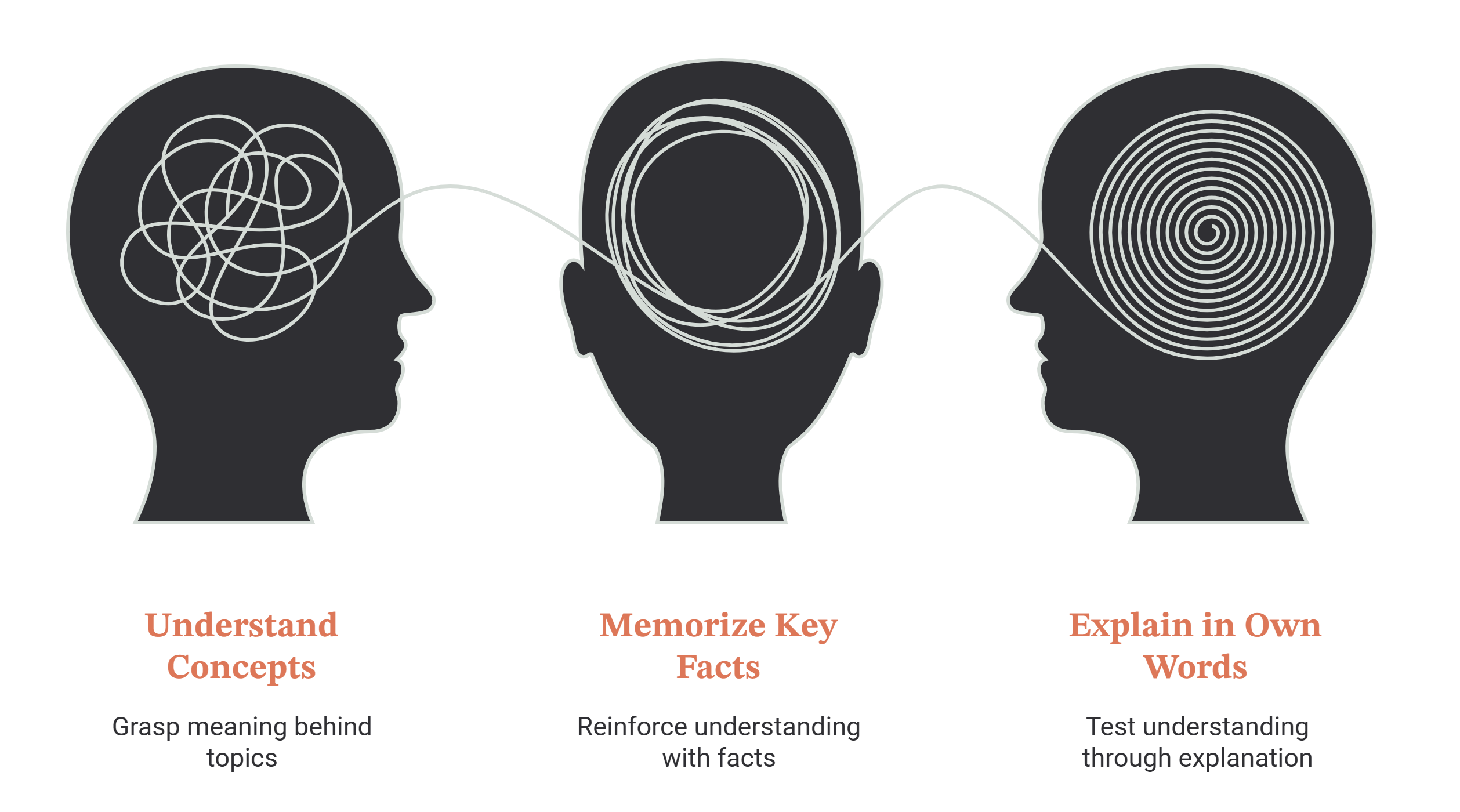
Close the book. On the page under your governing sentence, write the smallest set of notes another student could actually use. The test is the handing-over: if a line would not help somebody else solve a question, it is not a note, it is a reminder that the topic exists.
For profit and loss the page comes out roughly like this:
- Profit equals selling price minus cost price, and the percentage is that profit divided by the cost price. Bought at 800, sold at 920: profit 120, so 120 divided by 800 is 15 percent.
- Marked price is not selling price. A shop marks up from cost, then discounts from the mark. Cost 800 marked up 25 percent is 1,000; 10 percent off that is 900; the profit is 100 on 800, which is 12.5 percent, not 15.
- Two items sold at the same price, one at a gain and one at an equal loss, never break even. The cost prices differ, so the equal selling prices are different fractions of them.
- Where I lose marks: taking the percentage on the selling price, and applying a discount to the cost price instead of the marked price.
That last line is yours alone and belongs on every compressed page you make. Fill it from your own corrected answers, not from a general list.
Pass 3: produce it from a blank page (5 minutes)
This is the pass that turns following into producing, and it is the one that gets skipped because it is uncomfortable. Put the page away. On a clean sheet, write the governing sentence, then the notes, from memory.
Then compare, and grade each line into one of three states rather than judging the page as a whole:
- Came back correctly — leave it alone for a week.
- Came back slowly, or came back wrong — this is today's work, and it is the state that reading your notes again cannot detect, because a half-remembered line looks familiar on the page.
- Did not come back at all — return to the chapter itself, not to your notes. A summary cannot rebuild a concept that was never there.
Five minutes here tells you more about your preparation than an hour of re-reading, because it asks for the same operation the exam asks for.
Pass 4: solve against a clock (20 minutes)
Take ten questions from the chapter and give yourself twenty minutes, timed. Not to score yourself — to find out which failures are conceptual and which are mechanical, because they need opposite fixes.
Work a question the way the compressed page says to. Two items sold at 600 each, one at 20 percent profit and one at 20 percent loss: the first cost 600 divided by 1.2, which is 500, and the second cost 600 divided by 0.8, which is 750. Together 1,250 spent and 1,200 received, a loss of 50, which is 4 percent.
Then check it against something you already know, which is the habit worth building: 4 percent is 20 squared divided by 100, and that relationship holds for any equal-percentage pair. An answer that agrees with a second, independent route is an answer you can leave and move on from.
The same four passes on a chapter with no formulas
The cycle is not built for calculation chapters; it is built for anything you will be asked to produce. Take subject-verb agreement from the verbal paper.
The governing sentence from Pass 1 is: the verb agrees with the subject, and the subject is rarely the noun sitting closest to the verb. That single line is what most of the chapter's questions are testing.
The compressed page from Pass 2 has to pass the same handing-over test, so each line carries a case rather than a category:
- A phrase beginning with of is not the subject. In the list of items is on the desk, the subject is the list, so the verb is singular.
- Each, every and neither are singular however many nouns follow them. Each of the boys is present, not are.
- With either A or B, the verb agrees with whichever part is nearer to it, which is the one rule here that does look at proximity.
- Where I lose marks: choosing the verb by the last noun I read, on long sentences.
Pass 3 is unchanged — the governing sentence and the four lines, from a blank page. Pass 4 is ten sentences against a clock, and the classification afterwards is the same three buckets, with misread being by far the most common in verbal.
Nothing in the cycle changed. Only the chapter did. If you want the full topic order for that paper, the verbal ability guide has it.
What each pass looks like when it is working
Use this to tell a pass that did its job from one that only felt like it did.
| Pass | Working | Not working |
|---|---|---|
| Read | You can say what the chapter is fundamentally about in one sentence. | You can list what the chapter covers, but the sentence will not come. |
| Compress | Every line would help a classmate solve something. | Lines that name topics: "discounts", "successive percentages". |
| Produce | You know exactly which lines failed and why. | You skipped it because the notes were still fresh. |
| Solve | You can separate concept errors from arithmetic slips. | You marked a score and moved to the next chapter. |
The week after, in about twenty minutes total
One cycle does not finish a chapter; it makes the chapter cheap to return to. Return four times: tomorrow, three days later, a week later, three weeks later. Each return is Pass 3 alone — five minutes on a blank page, no re-reading.
A chapter that survives the three-week return can leave the rotation. That is the whole maintenance cost, and it is why the first forty-five minutes are worth doing properly: badly compressed notes make every return expensive. The reasoning behind spacing the returns out, and what to memorise deliberately rather than derive, is in why rote memorisation fails.
Reading a mock test as feedback, not as a score
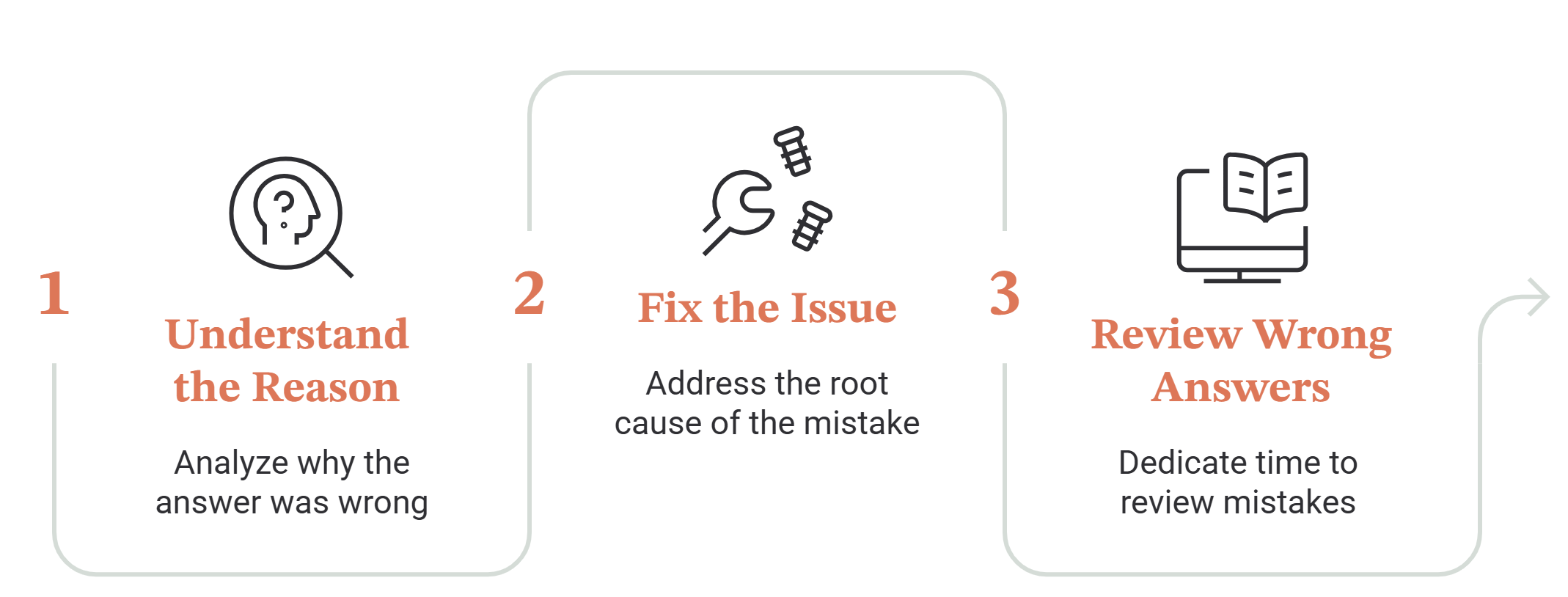
A mock score on its own tells you almost nothing you can act on. The same 60 percent can come from three different problems with three different fixes, and you can tell them apart from the paper.
Count your attempts and your correct answers separately. If you attempted many and got a low proportion right, the problem is concept or question selection — go back to Pass 1 on the weak chapters. If you attempted few but got nearly all of them right, the problem is speed, and the fix is Pass 4 with a tighter clock rather than more theory. If both are low in one topic and fine elsewhere, you have found a single chapter to repair rather than a subject to worry about.
Then classify every wrong answer into concept, misread, or arithmetic slip. Three misreads in one paper is a reading-speed problem and no amount of revision will touch it. Working through mock tests properly is mostly this classification, done every time rather than once.
The half that happens in the exam hall
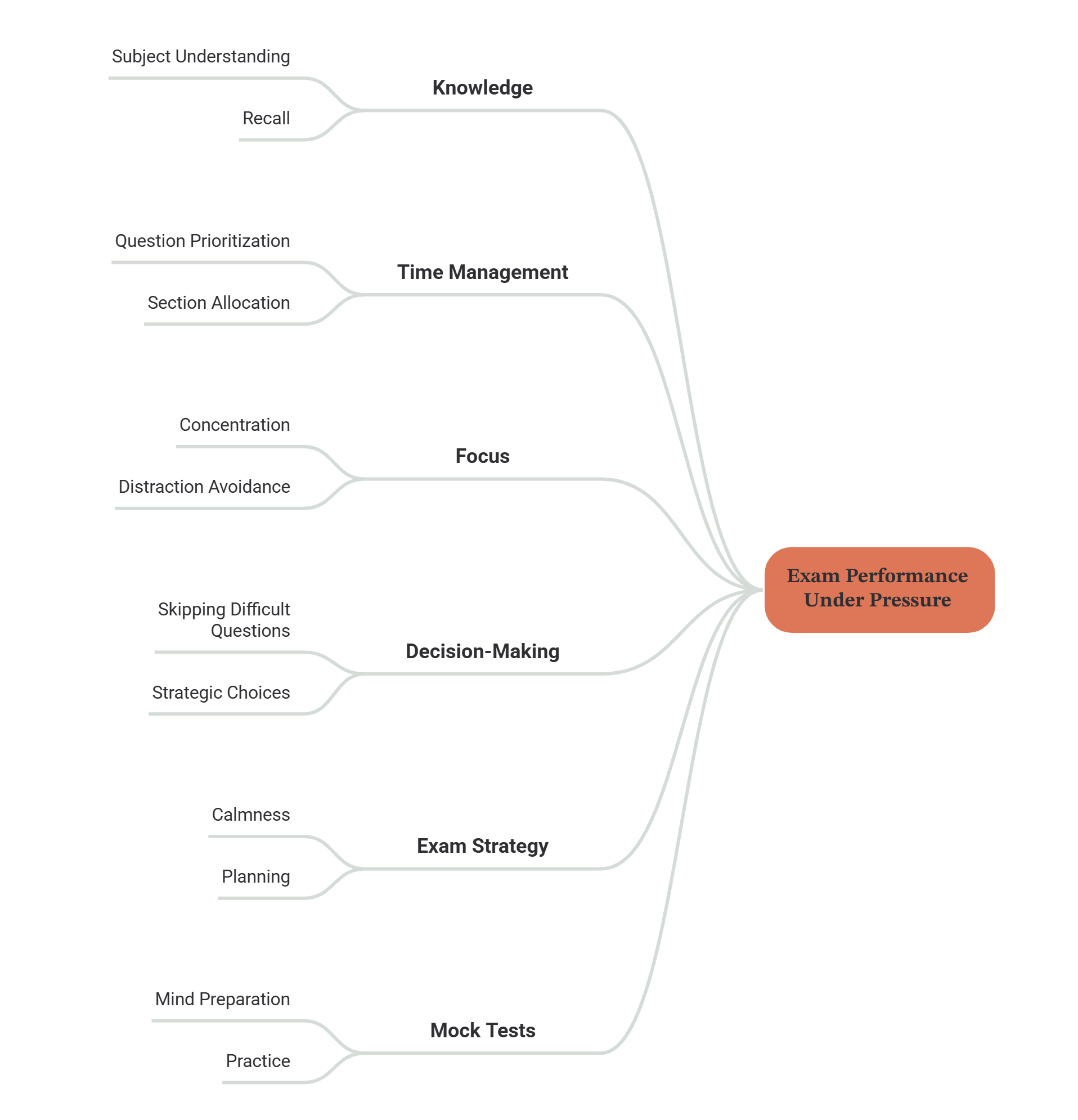
Everything above builds what you know. A paper also tests what you do with a clock running, and that is a separate thing to practise.
The single decision that moves scores most is when to leave a question. Give yourself a rule with a number in it, because in the hall you will not make a judgement call: read a question, and if you cannot see the first step within about thirty seconds, mark it and move on. You lose nothing by returning to it with ten minutes left; you lose a great deal by spending four minutes on it in the first pass and running out of time on questions you could have done.
Practise that rule in your timed sessions, not for the first time in the exam. Attempting a paper without panic goes through the rest of it — order, section time, and what to do when the first question is hard.
Start with one chapter, tonight
Pick a chapter you believe you already know. Run the four passes on it — ten minutes reading, ten compressing, five producing, twenty solving.
If Pass 3 comes out clean, you were right and it cost you forty-five minutes to confirm it. If it does not, you have found out at a desk instead of in a hall, and the compressed page you now have makes the repair take five minutes a week instead of an evening.
The method is worth applying to the aptitude chapters first, because they recur most reliably across companies; the quantitative aptitude guide lists them in a sensible order to work through.
Tags: smart-study-tips, study-tips-for-students, exam-preparation-tips, effective-study-techniques, how-to-study-better, student-learning-guide, career-growth-skills, freepare-blogs